Friday, May 30, 2014

RECIPES: Pollo Al Mattone (Chicken Under a Brick)

Early summer is a great time for grilling -- either outdoors, where it's not too sweltering, or indoors in a grill pan, when the night may be a little too crisp for lingering outside. Either way, a great dish perfected by the Italians and beloved by everyone who enjoys a delicious, flavorful, juicy chicken dish (and who in their right mind doesn't -- vegetarians excluded, of course...though you really must know you're missing out)? Pollo Al Mattone, or chicken cooked under a brick, in English.

Most likely Etruscan in origin (there are frescoes depicting the cooking of this dish in ancient Etruscan tombs), this dish in modern times is very Tuscan: simply prepared, using a few top-quality ingredients, with rosemary and lemon as prominent flavorings. Italians in central Italy have mastered the art of grilling, and this method is a wonderful way to create a crisp, flavorful, charred skin while keeping the meat juicy on the inside.Opening the chicken up by removing its backbone allows the chicken to lay flat on the grill or grill pan. The flattening of the chicken allows for even cooking. You can find terra cotta weighted covers for grill pans both in the U.S. and in Italy, but it's just as easy to use the weight of a cast iron pan, or an actual brick to weigh down the chicken. (If the brick is not used specifically for cooking, you can wrap the brick in foil beforehand). Even better is placing a brick on top of a cast iron skillet to really weigh things down. Just make sure to place the "bricks" on the chicken from the very beginning of its cooking time to flatten it -- this is essential for even cooking and crisping the skin properly.
And don't be shy on the seasonings. Lots of salt and pepper, particularly on the skin side, will offer great payback at the end of cooking. I love to add lots of dried peperoncino (chili pepper) flakes to make the chicken spicy, which then makes the chicken dish Pollo alla Diavolo al Mattone. Once you flip the chicken to cook the other side, adding some rosemary and lemon is always a good idea. Other tasty additions would include fresh thyme, a little chopped garlic, and even more peperoncino. Brushing with a good, peppery Tuscan olive oil helps to keep the chicken moist.

Enjoy the cooking process by sipping a chilled Vernaccia di San Gimignano, the Tuscan white of choice, or try an Orvieto Bianco from nearby Umbria. Since Tuscany's wine production is 80% red, however, you could also match the smoky fire and spice of the diavolo with a hearty red like a Brunello di Montalcino, a Sangiovese (the grape comprises the majority of Chianti Classico wine), or a Morellino di Scansano, a lesser-known wine from Maremma in Southern Tuscany. Nibble on some prosciutto and salame toscana, and maybe some piave vecchio cheese and wait for your chicken to cook. Serve with some wilted greens or a salad of arugula and tomato with great olive oil and balsamic vinegar, and you have a fantastic, casual meal. This is the bella vita...and the start of summer!
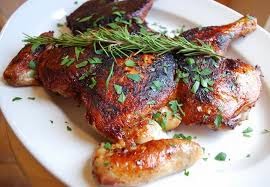


POLLO AL MATTONE (Chicken Under a Brick)

Serves 2-4


1 whole chicken, 3-4 lbs.

fresh herbs – thyme, rosemary, and/or sage

Extra-virgin olive oil

Salt & pepper to taste

Peperoncino (optional)

1 lemon, cut into quarters


-          Preheat oven to 450 degrees F.

-          Wash the chicken and dry thoroughly.

-          On a cutting board, with the chicken facing breast side up, cut along either side of the backbone to remove it and open the chicken up. (Alternatively, have your butcher do this for you, so you can lay the chicken flat).

-           Rub the entire chicken with olive oil, even under the skin of the breasts. Fit herbs into the cavity and under the skin if you like. Sprinkle generously with salt and pepper (and peperoncino, if desired).

-          Put a heavy skillet, large enough to fit the chicken when opened flat, onto a burner on high for 3-4 minutes. Add a glug of olive oil to the pan and allow to heat for another 30 seconds.If using a grill, heat on high so it's searingly hot when meat touches the grate.

-          Place the chicken, skin side down, into the skillet (or on the grill). Cover with another skillet, as heavy as you can find, and then place a brick or heavy stone or piece of marble or granite on top to weigh it down. The idea is to flatten out the chicken as much as possible while it cooks.

-          Cook for approximately 15 minutes like this (you can turn the heat down to med-high if your stove burns hot).

-          Remove skillet and weights from the stove, still in place, and put into the preheated 450 oven, or on the grill, for approximately 10 more minutes.

-          Remove skillet and weights from oven/grill, take off weight/brick and top pan, and very carefully turn the chicken over in the skillet or on the grill.

-          Return to oven without anything on top, simply in the skillet, and cook for another 15 minutes to let the skin side continue to crisp up.

-          Remove from oven and let rest for 5-10 minutes outside of the oven or grill before carving. Serve with lemon quarters if you like.

Sunday, May 11, 2014

HOLIDAYS: Mother's Day

Being a mother, as the saying goes, is the hardest job in the world. But my Mom has always done it with such aplomb and such devotion to her kids and her family that she made it look almost -- almost -- easy. Since I can remember, my Mom spent a large portion of her time shuttling my brothers and me from school to activity to sport, to rehearsals and games and lessons and competitions. As grown adults, she's been our counselor and reference and moral compass, our confidante and friend. And as the only other female in our family of 5, my mother and I have had a special bond between us, planning girls' afternoons shopping or lunching, or nights at the ballet with just the two of us. I started ballet lessons at the ripe old age of 3, in part because my mother had studied throughout her youth and she thought I might love it too. (I did, and continued studying and performing dance over the course of 25 years).
Dance turned out to be one of the longest-standing and greatest loves of my life. But not only. I share much more than genes with my mother: my tendencies come both from chromosomes and from shared experiences. The part of me that enjoys chemistry and math, that's inborn, and that's my Mom. My love of art and culture and travel comes from exposure to these interests, from my parents. A nurturing nature and fascination with flora and fauna...a positive outlook and aesthetic appreciation and a love of travel to foreign places...a cackle of a laugh, and a devotion to mint chocolate chip ice cream...they're all aspects of me that I can trace back to my mother.

Then, there's what my Mom taught me about cooking. Or rather, about feeding people. I loved cooking from a very young age -- mostly baking. Desserts. I am still a devout chocoholic, and I love making sweet treats for myself and for others. There's something so personal and heartfelt about a beautiful birthday cake, for example. My Mom and I used to bake together about once a week, either over the weekend or after school, making chocolate chip cookies and fudge and cupcakes.
Her mother also had a sweet tooth, and was an excellent baker as well, so we were our own great audience and tasters. We loved baking. I remember some great dinner parties we'd host at our family home in New Jersey, and my mother always did all of the cooking from scratch. I loved to help her with this elevated dinner party fare, or for a family summer BBQ, or for a Thanksgiving feast. I remember sprinkling a chocolate glaze over a deep chocolate-mint dessert bar of some kind, thinking how elegant it was. I think I was 9 years old at the time. And so I learned not only about cooking, but about the joy that cooking for others can bring to families and friends. I learned from a young age how eating together brings people together, and I loved being able to have that positive effect on people. I found it intoxicating enough that I would one day make it my profession.

From a very young age, my Mom helped me to cultivate an interest in cooking, in culture, in nature, and in the plants and creatures that end up as our food. And so I thank my beautiful, sweet, intelligent, and loving mother for all that she's done for me, for our family, and for the many people whose lives she's touched over the decades. I thank her for her dedication and for her love. I thank her for letting me be my own person, even when I've taken paths in life she might not have taken, or made decisions she might not have wanted me to make for myself. I thank her for her support in all of my endeavors, for putting up with me when I was problematic or resisted her advice, and for giving me a shoulder to cry on when I needed it. And as much as anything else, I thank her for being my strong female role model.

I love cooking for my Mom now -- a little positive payback for all the meals she made for me over the years, all of those delicious grilled cheese sandwiches for lunch, tasty dinner dishes, and decadent desserts. I recently made my first attempt at sauerbraten, one of her favorite all-time dishes. I am not terribly familiar with the dish, nor with German food in general (her favorite), but I pulled together what I thought would be the best ideas from many different recipes, and tried to combine them to make one great meal. I sauteed mushrooms with roasted potatoes, and I cooked red cabbage in apple cider vinegar, herbs, and spices. I'm not sure if I succeeded with this foray into classic German home cooking, but my Mom certainly gobbled up the food...for 3 nights in a row. I think it tasted better because she knew it was made with love. The perfect dessert afterwards? A cup of mint chocolate chip ice cream. With two spoons.


Thursday, May 8, 2014

SEASONAL INGREDIENT: Watercress

I'm not a big fan of bitter. Bitter food, bitter drinks, bitter people: not my thing. Except for greens. I adore bitter greens in their many forms: from arugula to puntarelle, chard to endive to radicchio, they make me happy. I think I developed a palate for bitter greens with all my time spent living in Italy. Their bracing flavor can stand up to a powerful dressing or sauce, including the many versions of a "Caesar" dressing that are so often paired with crisp, bitter greens. A slick of olive oil, the bite of garlic and pepper, the salty, umami zing of parmigiano cheese, cut through by the acid of citrus juice or vinegar...well, I'll stop here. Because I want to name-drop my favorite of all bitter greens: watercress. It's not so much straight-up bitter as it is peppery, spicy. Perhaps that's why I adore it. And its versatility.


Spring is the perfect season for watercress and its varietals (try upland cress, sold still attached to its roots, and just snip and sprinkle into salads or over grilled fish or meat). It's so much more than a simple accompaniment for the classic English tea sandwiches of "egg and cress": egg salad bound with mayonnaise and spread on white bread, topped with watercress, and cut into crustless triangles. Don't get me wrong, these sandwiches have their place, and I adore them as part of a classic English high tea, or as cocktail nibbles at spring soirees. But watercress in a salad breathes life into an overused mesclun mix. I love the bite and plump crispy leaves when tossed with fresh herbs in a salad. I particularly love the salad pictured here, which I make with roasted butternut squash cubes, goat cheese OR gorgonzola, pumpkin seeds, and pomegranate arils. I like to bring it together with a sweet-tart pomegranate vinaigrette.  
One of my favorite dishes of one of my very favorite cuisines -- Vietnamese -- is shaking beef, a wonderful combination of vinegar- and soy-marinated beef fillet cubes cooked with onions and served on crispy watercress, which absorbs the sauce but doesn't wilt much (another benefit of this wonderful green). And speaking of benefits, watercress is an incredibly healthy green among greens, as well as among other fruits and vegetables. It boasts more calcium than milk, more vitamin C than an orange and more absorbable iron than spinach. It's rich in vitamins C, B1, B6, K, E, Iron, Calcium, Magnesium, Manganese, and Zinc. And it contains more potassium than apples, broccoli, and tomatoes. Not bad for a spring salad green!


Wednesday, April 23, 2014

QUICK BITE: CHEF, the movie


I love being a part of the food world, and I've always been a big film fan as well. Today I found myself at the crossroads of food and film at a screening of the soon-to-be-released movie, "Chef," starring, written and directed by local boy Jon Favreau. The film was screened as part of the Tribeca Film Festival last night here in New York, so Mr. Favreau was on hand after the screening today for a discussion and Q&A with Peter Travers of Rolling Stone magazine. The movie itself is a fun, realistic story about a chef in L.A. who's in a creative rut. Although he wants to break this rut with interesting, inspiring dishes, he still has to answer to "the man" -- as in the restaurant owner, played by Dustin Hoffman. New to social media and egged on by his kitchen staffers and his 10 year-old son, the chef joins the Twitterverse, which eventually takes a somewhat tragic turn (technology in the hands of the uninitiated!) as his rant against a hateful food critic goes viral. He eventually quits his job and decides to start a food truck, therefore feeding his soul as a chef, as it were. It's not a complicated conceit, and despite some prominent cast members, it's got an indie feel, harking back to Favreau's fabulous "Swingers" from the '90s. It's pleasant, and lighthearted, and anyone who's ever worked the back of house will recognize a lot of familiar sights, sounds, and situations throughout the film. Casting note: the kid who plays the chef's son in the movie, Emjay Anthony, is adorable, with real acting chops.

A few fun facts from behind the scenes? Roy Choi, LA's food truck king (and who happens to share a similar backstory to that of the chef in the movie), was the "trainer" chef on this film, demostrating to Favreau how to make his chef character physically, actively convincing. He worked in conjunction with the food stylist to make sure both the chefs' screen time, and the food shots, were realistic and enticing. To Favreau's credit, these scenes are gorgeous and really shot well. As a professional, watching the process, I could taste every ingredient and every dish as it was created and plated: truly mouth-watering kitchen visuals. Another fun fact is that actor Oliver Platt played the petulant critic with the make-or-break restaurant blog, a role with which he's somewhat familiar: his brother Adam is the food critic for New York Magazine.

CHEF hits theaters May 9th.

Trailer:
http://variety.com/2014/tv/news/jon-favreaus-chef-serves-up-first-trailer-1201153686/

Saturday, April 19, 2014

ESCAPES: Charleston, South Carolina, Part 1

There's something about Charleston. It's a small, charming, typically Southern city on a Peninsula between two rivers that converge and feed into the Atlantic. Its pace is as languid and flowing as the locals' drawl. Even the way they pronounce their hometown echoes this: Chaaahhhlston, emphasis on the "ahhh." 

It's a town full of dichotomies: as charming and European as it is steadfastly American and conservative, firmly rooted in the past, but with a young population and a dynamic culture and arts scene that's moving the city swiftly into the future. It's full of classic Federalist architecture and churches aplenty, though its colorful "Charleston single" homes (one bedroom wide, long, with plenty of balcony and porch space to capitalize on any breeze) are built for the semitropical climate and rampant bourbon-soaked socializing of its residents. Its past is marred by its prominence in the propagation of the slave trade, though it's also historically known for its religious tolerance, particularly to minorities like Jews and Huguenots. It's where the Civil War began, quite literally, at Fort Sumter, though it's as peaceful and civilized a place now as you'll find in this part of the United States.

I love the south, I went to college in the south, and I know a lot of amazing people who hail from the south, including the state of South Carolina. Perhaps all of Charleston's dichotomies are what make this small southern belle of a city so interesting to me. Maybe that's why I've felt its pull for so many years. Nah...it's the food. The low country cuisine. Particularly the shrimp and grits. And the ham. Make that all pork products. And the fried chicken. And the fried anything. And the pickled, spicy, savory, sweet, delicious cooking of the Southern tradition. The whole country has been abuzz this past decade about the restaurant scene in Charleston. And I needed to get a taste for myself.

Where did I start? With Sean Brock, of course. One of the city's top toques and a staunch Southern foodways proponent, Brock owns both McCrady's, for many years an upscale staple in downtown Charleston, and Husk, a newer, dressed-down southern restaurant with fun, rustic charm and some seriously good food coming out of its kitchen. Brock believes in keeping things local, procuring from producers whom he knows and trusts, and looking to food history and products and dishes of a past era to inform his cooking. This is evident in the care he takes composing a dish, plating a dish, and in educating his serving staff as well so they can communicate this information to the diners. 
Our first night in Charleston we had a very enthusiastic and informed server (who was also a UVa. alumna with an English degree, much like yours truly!) at McCrady's, who walked us through her favorite dishes and ones about which we'd inquired, steering us towards a very delicious set of appetizers. We had the bay scallops over hominy, with butter peas and red mustard, and the sweetbreads with Appalachian red corn puree, green garlic and a lovage foam. Our fish courses were delicious and light, particularly the trout with brassicas (cruciferous veggies like broccoli and cabbage) and meyer lemon gel. The meat courses were a study in small portions of rich, densely flavorful cuts -- and not about making the protein the center of the dish, both literally and figuratively. Brock plates his food like no other chef I've encountered, often setting the proteins or the "main" of the dish off to the side, and letting what are often considered "sides" take center stage on the plate. 
The Wagyu beef coulotte with smoked potato puree and wild mushrooms was delicious, deeply tasty, and tender as could be. And the duo of Berkshire pork -- braised and seared belly, and tenderloin -- was marbled and crispy and tender in all the right places, with an interesting pumpkin brunoise (tiny dice) cooked various different ways and tossed together. The accompanying balsamic reduction and truffled honey sauces were the high and low notes of acidity and sweetness to both cut the richness and enhance the pork. Dessert was a local affair, too, with the better dessert a "frozen parfait of grits" -- that is, hominy ground so fine as to become a cornmeal powder, cooked like smooth creamy grits and then frozen like a semifreddo. This was served on a wild blueberry sauce and topped with a whisper-thin cornmeal biscuit, pressed into crispy perfection.

Husk is so immensely popular that the only meal for which I could nab a reservation was for lunch on Saturday. The line was out the door, regardless. It's a relatively casual spot, and a wonderful place to while away a few hours for brunch or lunch on a weekend, particularly if the weather is mild with a nice breeze. The outdoor balcony tables upstairs were made for that. But the inside dining rooms are warm and homey, too, a comfortable place to work your way through Brock's tasty menu. Drinks are given their own menu, so beyond the wine list, there are a few craft beers, as well as house-made cocktails featuring southern booze, like the "A Yard Too Far" with vanilla and ginger macerated bourbon, pecan orgeat, and pecan bitters: strong and smooth. Also of interest is the extensive cider menu, a reflection of a drink-making tradition that at one time outpaced beer production and consumption in the U.S. As for food, Husk will only work with ingredients that come from the South. Period. Of course, this leaves the kitchen with a lot to work with. The menu changes pretty much weekly, so you may or may not come across the same dishes we did, depending on the season and the creative whims of the kitchen. 

We started with some tasty smoked chicken wings with a honey mustard glaze, peanuts, and cilantro. Asian-Southern. That was accompanied by a "Southern Panzanella" -- a typically Tuscan bread and vegetable salad here using cornbread croutons and a roasted red pepper puree.We went with some fairly "traditional" dishes as mains, but they were prepared in quite non-traditional ways. 
Husk's version of shrimp and grits was a lot of smoke: there were the shrimp and Geechie Boy (local) grits, but also spring onions, sweet peas, homemade cotechino sausage, all brought together in a smoky tomato broth. Served in an earthenware pot, this was an earthy, soupy one-bowl meal that would work for breakfast, lunch, brunch, or dinner. I also had a perfectly-prepared cornmeal-crusted catfish fillet -- not something I'd usually select from a menu, mind you. But this was light, with a thin but crunchy crust encasing a firm, white flaky fish. This was nestled on a bed of sauteed cabbage, red beans, and a roasted Appalachian tomato sauce. It was so much more flavorful than I could ever make it sound, but just know that this is the essence of simple ingredients coming together and shining in a way that is much greater than the sum of their parts. A side of broccoli in a vadouvan curry sauce (a French-Indian hybrid) with shallots was just the shot of green we needed among the seafood and starch. 

Some suggestions for where to stay and what to see while in Charleston? I highly recommend the lovely Vendue Inn for a cozy, authentic, warm welcome and possibly the most comfortable king size bed I've ever slept in...and the fireplace, exposed brick walls, chandelier over the bed, and the wood beam ceilings didn't hurt. It's a gorgeous place to retire at the end of a long dinner and some post-prandial drinks, perhaps at the super-casual pub next door, The Griffon. Or try The Gin Joint, another small spot around the corner serving handmade Prohibition-style cocktails and "nibbly bits" to line the stomach. There are plenty of bars and local spots with live music, and East Bay Street south of the market is chock full of places to drink, eat, and listen. 

The Gibbes Museum of Art is a nice choice for art enthusiasts, with mostly American pieces, many relating to the South and its history. Try a carriage ride from any one of several companies offering them, many leaving from North Market Street. They'll give you an overview of the city and its layout so you can check out points of interest later, on foot. Speaking of on foot -- which is, by the way, the best way to see much of Charleston's downtown -- the Waterfront Park (Vendue Range at Concord Street) is a lovely stretch along the Cooper River where you can meander on a waterside path, look out over Charleston Harbor, visit the two famous fountains including the iconic pineapple fountain, and take a break in a shaded swing looking out to the water. Head to the southern tip of the peninsula and take a stroll along The Battery, where the gorgeous homes of Charleston's elite overlook the convergence of the Cooper and Ashley Rivers. It's a great place to jog or walk a dog, or just soak in some southern spring sunshine. 

More delicious dishing on Charleston to come...

Mc Crady's
2 Unity Alley
(843) 577-0025
www.mccradysrestaurant.com
 
Husk
76 Queen Street
(843) 577-2500
www.huskrestaurant.com

Vendue Inn
19 Vendue Range
(843) 577-7970
www.vendueinn.com

The Griffon
18 Vendue Range 
(843) 723-1700
www.griffoncharleston.com

The Gin Joint
182 East Bay Street
(843) 577-6111
www.theginjoint.com

Gibbes Museum of Art
135 Meeting Street
(843) 722-2706
www.gibbesmuseum.org


Wednesday, March 26, 2014

QUICK BITE: Salmon with Mustard Cream Sauce


It's been a long winter. Yes, the understatement of the year. I'm writing now in New York City, where it's a cool 33 degrees and almost April. This makes everyone in the city a little stir-crazy, itching for the thaw of spring weather and fresh green anything. Personally, I've had it with "restorative" soups and stews, braised meats and root vegetables galore -- much as I love these items in the thick of winter's cold. So, what to make when the mercury says it's still winter but our hearts, minds, and palates are aching for spring? Salmon with mustard cream sauce is the perfect "bridge" dish between the seasons. 

We all know by now that salmon boasts lots of Omega-3 fatty acids and that it's one of the most healthful varieties of fish to consume. A tangy mustard-cream sauce is a classic accompaniment that really brightens the fish and cuts its strong flavor and richness with zing. Adding a bit of freshly chopped dill to the sauce is a classic herbal touch, though not necessary. Pairing the fish with some winter veggies -- we do have to clear out our fridges of beloved winter greens somehow, don't we? -- grounds the meal in the now while we look towards the coming spring with open arms (and full bellies!). Roasted beets, sauteed brocoletti (with plenty of garlic and chili pepper), and a long grain and wild rice combo are the perfect sides to make this a well-rounded dinner. A mix of color is the easiest way for you to create a balanced meal without much effort.
 
How to make the sauce? Simple. You can use the same pan you use to cook the salmon. First, heat some olive oil in a saute' pan (nonstick is best). Sprinkle the salmon fillet with plenty of salt, and place in the pan. Note: if you have the skin on the fillet, you can place it skin side down in the pan first, to crisp it up. Otherwise, put the top side down. Second, sear for 3-4 minutes on the first side so it releases from the pan easily. Flip, and cook on the other side for another 4 minutes or so. Salmon is best served medium-rare to medium (if you like it cooked through, you can place in a 350-degree oven to finish). Third, remove salmon fillet from pan, and pour about 1/2 cup heavy cream into the pan. Add 1-2 tablespoons of grainy dijon mustard, and gently whisk to mix completely. Cook for 2-3 minutes until the sauce thickens a bit. Add salt to taste, and if you're adding chopped dill (chives or parsley work well, too), do that at the very end. Mix, taste for seasoning, and then  pour the sauce around the salmon fillet and any sides you like. Come spring, this salmon-and-sauce works extremely well with simple seared asparagus, as in the photo above. 

Enjoy, and here's to a tasty, soon-to-arrive SPRING!

Friday, March 14, 2014

ESCAPES: Chile's Central Coast: Valparaiso and Viña del Mar


At this point in the winter season, when we've all had our fill of snow and frigid temperatures, our sights turn to warmer climates and waterside escapes. One appealing antidote? Chile. And specifically, Chile's Central Coast featuring the towns of Valparaiso and Viña del Mar.

After a long holiday season filled with seemingly endless work hours for both myself and my friend Jessica (a dear friend of mine from my time in Rome who returned to her childhood hometown of Providence, Rhode Island when she left Italy), we were looking for an escape. She's a jewelry designer in constant search of quirky keepsakes from her travels, which she then "translates" into original pieces of wearable art. I'm a chef in constant search of new flavors and cultures from which to draw inspiration in the kitchen. We travel well together. And we decided Chile would be the perfect spot: it offered warm weather in December and January (southern hemisphere summer), good food (ceviche!), good wine (more on that in another post), and interesting and eclectic culture and history (always a good thing for market trips, sightseeing, and interesting travel). An added bonus for me? The beach! With the help of suggestions from a dear high school friend who'd moved to Chile a few years ago, we were able to cobble together a nice 10 day vacation with work benefits built in. We began and ended our journey in the Chilean capital of Santiago (look for my Santiago dining post to come soon), but spent New Year's Eve, and several relaxing days afterwards, kicking off the new year in sunny, 85 degree weather on the Pacific. And though these two sister towns are right next to each other, they offer visitors a yin and yang of Chile's central coast.

Valparaiso
Valparaiso ("Paradise Valley") is historically a port town -- until the Panama Canal opened, it was South America's busiest -- a working class city-on-a-hill. Actually, it's built on more than 45 hills, or cerros, which are covered with colorfully-painted houses, often constructed out of the corrugated metal torn from shipping containers, that look like candy confections tossed on undulating hills tumbling towards an azure sea. "Valpo" as it's called, is Chile's second-largest metropolitan area, and though it's on the sea, it's not a beach town. It's a somewhat chaotic jumble of South American culture and topography, Caribbean color, Germanic and Slavic immigrant influences in architecture and food, and a summertime climate that mirrors L.A. in the daytime and San Francisco at night. Confusing, yes. Eclectic, of course. And it's a lovely place to pass a few languid days recovering from New Year's Eve.

First off, I must mention Valpo's impressive fireworks display. Until the last couple of years (when a certain Middle Eastern city decided theirs needed to be the biggest and brightest on the planet), Valpo's fireworks show was the most expansive and explosive in the world. After having seen it, frankly I'm not sure I'd want one larger or longer. At just under a half an hour, and done over the C-shaped bay that runs along the Pacific coast to several towns north, the fireworks display was synchronized so you could see the grand fireworks right in front of you as well as those in the distance, all themed the same with the same colors displaying at the same time: really something to behold. We celebrated at a restaurant/bar/music hall called La Piedra Feliz, right on the water in the Errázuriz neighborhood. 
It was probably the busiest area in the city that night, and knowing public transportation was sketchy for the holiday, forewarned was forearmed: we walked from our lovely apartment across town to the restaurant, and were able to see most of the waterfront area of Valpo in the process. Once we (finally!) arrived, we enjoyed a prix fixe dinner with plenty of champagne and pisco sours. We watched the fireworks out of the window of the restaurant on the second floor, and many locals were gathered on the street below us. Once we toasted to 2014, we wandered around the place -- live music and dancing were everywhere, but of course as a chef, I found my way to hanging out at the bar with the staff: our waiter and the Uruguayan chef, and some locals who were friendly and fun...and made sure we never saw the bottoms of our glasses of delicious Chilean red wine.

We were excited to eat the fresh seafood for which Chile is justly famous, so our dinner hours were spent seeking out great fish spots -- and of course for me, this trip was the "Cevichepalooza" I'd been craving, so I had it at every meal I could manage! At Oda Pacifico, we had the place practically to ourselves, and enjoyed the view out over the hills down to the water (it got windy and chilly the night we went, though it would normally be lovely to sit at a table outside on the back patio). Service here, as in most places we went, was slow but extremely warm, and our waiter advised us on what was fresh that evening. We started with a massive portion of mixed seafood ceviche with passion fruit -- two of my favorite things in the world, together in a big bowl! It was delicious, and perfect with our crisp Chilean sauvignon blanc.
Main courses couldn't live up to the ceviche, but I enjoyed a local specialty: conger eel, here grilled and served over a stew of tomatoes, corn, and peas, topped with peppery watercress. Jess had tilapia cooked in a banana leaf, with a coconut-laced sauce. Again, the portions were huge and we couldn't come close to finishing them, but we did manage to wash it all down with more vino blanco. We were on vacation, after all.

Valpo has countless great vistas from which to view the port and the water below, but one destination on a hill, and viewpoint not to be missed, is poet Pablo Neruda's local home, La Sebastiana. The cozy multi-level house resembles part of a ship and fits in perfectly among the pastel houses surrounding it. The decor is often nautically themed, and is quirky and built to entertain, much like the man himself. It's filled with glasses and plates and artwork and bric-a-brac from Neruda's world travels, and like all of his homes, there is a dedicated bar area where he would mix libations for his guests after a day of writing. The view from his home is undoubtedly inspiring.

Viña del Mar
Just next door is Valparaiso's louder, more social sibling, Viña del Mar. It is the Miami Beach of Chile, to put it in U.S. terms, and it's bustling and full of life while Valpo is relaxed and laid back. The shoreline is both rocky and sandy at turns, and the lawns and flower beds are as manicured as the high-rise hotels and condos lining the beach. There is a downtown as well, and boulevards lined with shops and malls and churches and outdoor arcades. This is no sleepy beach town, and it's been the place where locals and the wealthy and famous from Santiago come to play, where they have second homes. It lacks the character and vistas that Valparaiso has, but it makes up for that with the beauty of the coast and the lively, infectious atmosphere in its streets.

As for the food scene in
Viña? Again, seafood is king here, but the variety of dining options is greater. Chile has great primary ingredients, great wine, great pisco. But as for a native cuisine, its neighbor Peru is better known. Case in point? All the ceviches. Seviche, as it's usually written here, comes in so many varieties that it makes sense to go for a sampling of types. At Sazon Peruana, we indulged in the trio at left, which included an octopus seviche with aji amarillo, the spicy Peruvian yellow pepper, as the base. We had local white fish with sweet potato and choclo, the ubiquitous oversized corn kernels. And we had salmon and shrimp with leche de tigre (the citrus juice and spice base of most seviches) with red pepper. I could have bathed in the stuff. We enjoyed mixed grilled seafood atop a salad.
Jess had the seafood soup, a slightly spicy stew of local treats from the Pacific made more substantial with yellow potatoes. And I pushed the boat out, as it were, with a light-as-air fried seafood platter (shrimp, squid, Chilean sea bass) with yucca, tartar sauce, and salsa criolla -- a topping of thinly sliced red onion, cilantro, and fresh chile pepper. The meal at the Peruvian restaurant turned out to be one of the best meals of my trip to Chile!
In Valpo, we lived like locals, renting an apartment in a residential area with a gorgeous view of the entire city from our balcony. In Viña del Mar, we went touristy -- but sometimes, you need to splurge. 
The Sheraton Miramar is perched on a rocky curve of the coast, on the way into town, and it jettisons out into the bright blue-green Pacific. All glass-and-steel, with soaring ceilings, this location was clearly built to allow guests the greatest appreciation of the sea. The shot above was taken from our balcony: the seats to the left are outdoor restaurant tables, as scenic for a seaside lunch as they are in the evening for dinner and drinks, to view the sparkling lights of the bay surrounding you. The pool overlooking the sea is a dramatic spot for sunbathing, by water both salty and fresh. Attached, there is a wonderful spa and gym where you can work up a sweat and then relax with a massage or facial. Not a bad way to pass an afternoon in January!

All in, we had a wonderful time on Chile's central coast -- not enough time, in fact. There were so many small beach towns lining the coasts both north and south of the Valpo area and we weren't staying long enough to explore them. Places like nearby Reñaca, surfer's paradise Concón, former whaling town Quintay, and the beautiful and aristocratic town of Zapallar: each offer a different taste of this stretch of the Chilean coast. We did make it to Quintero for an afternoon of lazing on the beach and eating empanadas, though it took a mini-hike to discover some less-trodden beach paths. Most of the beaches are rocky, and it's hard to get out of sight of the huge tankers that seem to be permanently parked in this part of the Pacific. But the water is beautiful and the trees and topography are stunning. Another positive? We were the only gringas in sight, always a good sign.

La Piedra Feliz
Avenida Err 1054
Valparaiso
+56 (32) 225.6788
www.lapiedrafeliz.cl

Oda Pacifico
Condor 35
Valparaiso
+56 (32) 223.8836
www.odapacifico.cl

La Sebastiana
Ferrari 692
Valparaiso
www.neruda.cl
+56 (32) 225.6606

SHERATON MIRAMAR
Avenida Marina 15
Viña del Mar
+56 (32) 238.8600
www.sheraton.cl

Sazon Peruana
3 Norte 370 Esquina 3 1/2 Poniente
Viña del Mar
+56 (32) 319.1160
www.sazonperuana.cl