Friday, July 27, 2012

RESTAURANT REVIEW: Miami's OLA

There weren't many chefs starting back in the '90s whose career trajectories I followed. But Douglas Rodriguez was always one of a handful of creative culinary figures of interest to me, in large part because of the exciting cuisine he pioneered along with his south Florida-based colleague, Norman Van Aiken: Nuevo Latino

Though he started in south Florida, his ground-breaking PATRIA in New York City was what brought his food to national attention. I loved that place: raucous and fun, yet sophisticated, like a great party. And the food was always not only delicious, but truly beautiful on the plate: plantain arcs bisecting ruby chunks of tuna speckled with electric green cilantro and creamy white coconut milk. Plus, my friend who's been a vegetarian since the age of 9 claimed it as one of her favorite places to eat in the city, because when you asked for a "vegetarian option" you left it up to the creativity of the kitchen, which always presented a gorgeous combination of vegetable and starch that was clearly no afterthought. 

Eventually Patria closed after a long run, and Rodriguez opened both Chicama and Pipa, one block apart, still in the Flatiron area. And Chicama became one of my favorite spots: great drinks, and an amazing assortment of ceviches that were out-of-this-world. Now, I could eat ceviche all day long and never tire of it. I hope to tour Peru and the rest of Latin America on a "ceviche grand tour 2013." To say that I still have dreams about his spicy, tart, and sweet ceviche with tuna, octopus and tamarind (note: if anyone can get their hands on this recipe for me, I'd be forever indebted!) -- reflects that it was truly one of the best things I ever consumed.

So when, after closing his New York outposts, I read that Rodriguez had opened in Miami, I knew I had to make the pilgrimage to worship at the altar of my favorite ceviche master. Though I have faith that all of his restaurants have been and will be excellent, his De Rodriguez Cuban place holds less interest for me than his ceviche-centric cocina, OLA, opened in late 2010. It was voted as "The Best Ceviche" by The Miami New Times's Best of Miami list. So to OLA I went.

The space is intimate, sultry, with Latin music humming in the background (this was lively, but certainly lacked the din and energy of the old Patria). We settled in for a very comfortable dining experience. The enthusiastic wait staff brought us some deliciously strong cocktails, including a cooling watermelon mojito that hit the spot on a steamy summer evening. The perfect accompaniment? Ceviche, of course: but how to choose?! I went for the mixto ceviche, with octopus, cobia, and shrimp in lime and orange juices with limo pepper, cilantro and kalamata olives. Delicious. 
But other amazing and diverse ceviches include the wahoo (love this fish!) with watermelon jalapeno juice, basil, diced cantaloupe, red onions and cucumber sorbet. Also interesting and rich is the tuna and foie gras, with kumquat-yuzu sauce, lemon oil, black pepper, serrano chiles and baby arugula. And for ceviche with an Asian twist, the himachi nikkei is mixed with yuzu, thai basil, togarashi peppers, cilantro, sweet soy glaze, and crushed seaweed and sesame seeds. And these are a separate menu from the starters, which are a series of mostly empanadas (try the short rib, lobster, or foie gras versions) and salads.

I must include some gorgeous photos of Chef Rodriguez's ceviche creations: truly edible art...


Back to OLA. Main courses tend to be generous portions of well-prepared proteins -- again, it's difficult to select from among all of the enticing options. I chose the sugar cane tuna, several pieces of adobo-rubbed and seared bright pink loin skewered on sugar cane and served over malanga goat cheese fondue, spinach, and shrimp escabeche. It's a playful preparation and offers a nice interplay of flavors and textures. Another signature dish is the mahi mahi crusted with green plantain, served over a braised oxtail stew with tomato escabeche
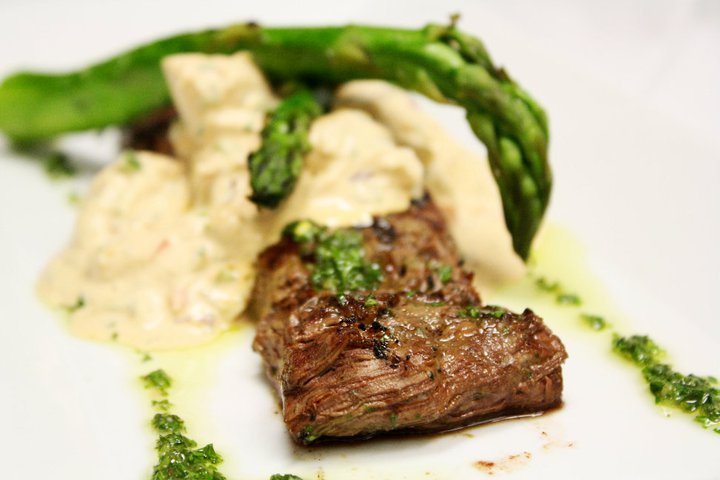
Another friend got the pescado a lo macho (macho fish?), which was the day's catch seared and served over sauteed baby spinach, grilled red onions with aji amarillo sauce, and clams, calamari, shrimp, and black mussels for a sort of deconstructed Latin seafood stew. And for meat lovers, there's the filet mignon churrasco, the signature carne, with grilled asparagus, chipotle crabmeat dressing and chimichurri. Of course, after all of this great food we were stuffed, but the desserts at Rodriguez's restaurants are always a treat as well, and worth saving a little room for.

Perhaps Chef Rodriguez's most iconic dessert, the "chocolate cigar," is an almond chocolate cake enrobed in semisweet chocolate mousse made to look exactly like a cuban cigar, and is served in an ashtray dish with coffee ice cream and a candy matchbox. Clever, adorable, and exquisite. It was my friend Mauro's birthday when we went, so when he excused himself to head to the men's room after the main course, we ordered a birthday dessert for him. Once he returned to the table, out came a beautiful plate on which was written "Happy Birthday Mauro" in chocolate sauce, with a flan de queso ice cream, pistachio cake, mixed berry salad, guava foam, and balsamic vinegar reduction: delicioso! 

Kudos to chef de cuisine Horacio Rivadero and Rodriguez's entire crew at OLA. I wish you all continued success, and hey Chef: come back to New York soon, we miss you!

OLA Miami at The Sanctuary
1745 James Street (between 17th and 18th Sts.)
Miami Beach, FL  33139
Phone: (305) 695-9125
www.olamiami.com

Tuesday, July 10, 2012

ESCAPES: Isola di Ponza, Italy -- Part 2, Eating on the Island


It's that time of year again, the early months of summer, when I would head down to Ponza for my annual trip to the magical hidden gem of an island off the coast south of Rome. This year marks the first in a long time that I won't make it there, and that I won't even be in Italy during June and July. Which, of course, makes me long all the more for the blindingly sunny days and bracing swims in turquoise waters, as well as aperitivi in the main piazza with locals and visiting Romans and Neapolitans. And it really makes me miss the wonderful dining one does while on Ponza. Whether in one of the local restaurants, or cooking in one's apartment (the way to go on the island, where hotel rooms are limited and overpriced -- and which of course allows you access to your own cucina), the fresh local seafood is the focus of the food on Ponza.

To really get a feel how you'll be eating on an "Avventura Ponzese" (Ponza adventure), we should start with the pizzeria in the port of departure, in Anzio, the beachside resort town 35 miles south of Rome, birthplace of both Nero and Cicero, as well as famed site of the World War II Battle at Anzio. But for our purposes, it's where the hydrofoil departs from, and where a dockside pizzeria serves a damned good seafood calzone, rich with an herb-laden tomato sauce and stuffed with octopus, calamari, and shelled clams and mussels. Perfect for filling your belly up before the hour-long journey to the island of Ponza.

Once you arrive in the port, you can see all of the fishing boats coming in with their daily catch. Some of the white foam crates filled with maritime goodies go directly to the back door of the island's best restaurant kitchens, and some items are for sale in the island's fish markets located among the winding rings above the harbor that are the tiny piazze and vicoli of Ponza town. Among the catch are always various sizes of shrimp (gamberi) and squid (calamari), octopus (polipi) and anchovies (alici or acciughe), as well as various types of local white-fleshed fish in the bream family, prized among them the sarago, fragolino (for its rosy hue), and pezzogna (recognizable by its oversized eyes). 


A great place to try the local catch, with a view of the port from on high, is at Ristorante EEA. It's fun to treat some of these restaurants a bit like tapas bars: ordering various antipasti,when they're this fresh, can be a great way to try various preparations of the local catch. Marinated anchovies are a fairly common preparation of the fresh fish in southern Italy: they have a lemony-vinegar kick and are refreshing in hot weather. Served here with panzanella, a cold summer salad made from old bread and ripe tomatoes, is a brilliant way of kicking the old standard up a notch. We also tried the octopus salad, and a tasty tempura-fried merluzzo (fresh codfish) with a sea urchin mayonnaise: fabulous.

One of my favorite types of crustacean in the world is the gambero rosso, or red shrimp. It's in fact bright red before and after it's cooked, and the flavor is phenomenal. At EEA they're done in a parmigiano crust, which worked, and highlighted the pairing of shrimp and aged cheese as one of the only examples in Italian cuisine in which cheese and seafood are matched. We continued to eat our way through pasta courses (spaghetti with pressed fish roe, called bottarga) as well as the classic southern Italian pasta pairing of swordfish and eggplant. Secondi included a delicate branzino (sea bream) with a pistachio crust. Add plenty of white wine and a gorgeous view and you have the perfect meal.


One of my favorite places to eat on any Italian island in the Mediterranean is perched above the other side of the port, at Orestorante. Chef Oreste (hence the pun) Romagnolo is a lively presence, riffing on Italian seafood classics and tweaking Italian cucina novella with local adaptations. My chef ex and I discovered this place many years ago, and I've been returning ever since with various friends in tow. Everyone is wowed by the vista, the light breeze up high, the tranquil candlelit setting, and the always-gorgeous and tanned crowd the place pulls in. The food is pricey, but it's also really delicious. 
 
The plates that arrive from the kitchen are presented beautifully -- like the crudo di pesce, basically a mixed fish tartare, served with a citrus sauce called "acqua di Ponza" for its electric-hued aquamarine color. Another memorable and very locally-themed starter is the fish on "hot rocks." Skewered pieces of Mediterranean ricciola are sent out on a plate with a blisteringly hot sea rock, on which you sear the pieces of fish, and then you dip them into a lemon-olive oil emulsion.
It's what a gourmet Robinson Crusoe might conjure up if he'd been lucky enough to be stranded on the Pontine islands.  And it's interactive. And zen! And then, to remind us we're still in Italy, the pastas are plentiful and most include some kind of shellfish or crustacean, like the rigatoni with mussels, gorgonzola, and tomatoes. A great choice is the playful primo piatto called Calamari due volte ("squid times two"): the chef uses fresh local rings of calamari and the pasta shaped like these rings, and tosses them with fresh tomatoes, capers, and wild fennel.
Paired with a crisp white with mineral and fruit nuance, like a local Fiano di Avellino or Falanghina, these seafood dishes soar. If you want a main course, there are items like the swordfish cutlet, simply seasoned, breaded and fried like a veal scaloppine might be served in northern Italy. I'd recommend, rather, that you leave room for a light dessert -- get the "chocolate salame" if it's on the menu -- and of course, the best digestivo one could have in these parts: ice  cold limoncello. 
Cin cin!
 
Ristorante EEA
Via Umberto I
04027  PONZA
+39 0771 80100 // +39 338 445.6849 (cell)
www.mondoeea.it

Orestorante
Via Dietro La Chiesta 3
04027  PONZA
+39 0771 80338 // +39 338 813.5730 (cell)
www.orestorante.it

To be continued...


Tuesday, June 26, 2012

SEASONAL FOODS: Fragoline di Bosco


It's strawberry season in full force right now, both in the United States and Italy. And in Rome, the bulk of the fragole you find in the green markets come from the nearby towns of Nemi (in the hills) and Terracina (by the sea).

An Italian chef ex-boyfriend once said to me "of all the fruits out there, the strawberry is the one that's changed the most drastically over the years." And on this one point, I agree with him (don't get me started on everything over which we disagree!) When I first lived in Rome, even before I attended culinary school, I noticed how different the smaller, flavor-packed local berries tasted compared to the gargantuan California monstrosities one finds year-round in the States. The berries in Rome aren't grown to impress the eye, but rather to excite the palate. And so...let's just say I ate my fair share of strawberries in Rome.


And then I discovered fragoline di bosco. And I was ruined for other berries forever. Now, I've always been a berry fan. I remember all the family vacations to Maine in my youth, tasting the sweet wild blueberries used in everything from ice cream to breakfast everything (once you have wild blueberry syrup on your pancakes, you'll be saying "maple wha-who?"). Ditto cranberries on Cape Cod: cranberry juice was always the only juice I drank, starting from about age 5, and cranberry fudge? A must, people, a must. And sure, I've always been a fan of raspberries and blackberries as well, so picking wild gelsi (a southern Italian large, plump blackberry) on the Italian islands from Ponza to Panarea -- and enjoying them in sorbet form, post-swim, made me giddy. Even more recent forays into esoteric, more exotic berries -- gooseberries, various currants, acai, and kiwi berries -- yes, all good. And all good for you. But fragoline di bosco still top my list.


The people of Nemi are as crazy about their local harvest as I am, and feature strawberries in just about every form you can imagine at their annual sagra di fragole, or strawberry festival. The town is perched above beautiful lago di Nemi, a picturesque volcanic lake that makes this hillside town a fabulous day trip destination from Rome. Throughout the town, vendors sell strawberries of various sizes, including the fragoline di bosco (literally "tiny strawberries from the forest").


In the center of town, not only are the crimson berries tossed into one huge glass bowl for the crowd to enjoy, they're made into delicious comestibles. From savory salads with arugula, parmigiano, and aged balsamic vinaigrette...to being tucked into tiramisu' and tiny fruit tarts topped with the baby berries...from icy-cool sorbetti to sweet-tart liqueurs featuring the fabulous fruit -- if you can imagine it, you can probably find it in Nemi.

But the way I really fell in love with fragoline di bosco? Well, plain and simple, purchased as is from the market. I would taste them at Claudio's stand at the mercato Campo de' Fiori in Rome, rinsing them off under the stream of water flowing from a nearby fountain, and popping them into my mouth to make sure they were in fact at their peak of flavor. And besides eating them out of hand, the best way to enjoy these little gems -- or any great Italian strawberries, really, is of course the local way: tossed in a mixture of aged balsamico di Modena (good quality aged balsamic vinegar) mixed with a little sugar, to form a syrup. Just mix that in a bowl to dissolve the sugar, toss the strawberries in, and gently...gently toss to coat. It sounds strange to the uninitiated. It has confused many a diner, and plenty of my clients as well. But trust me: it is a marriage made in heaven.


Wednesday, June 6, 2012

RECIPE: Pasta con Salmone, Cavolo Verde, e Pomodori Secchi


As a chef, delicious food is my top priority, and I believe the simplest route to eating well is using great quality ingredients. Even better is making delicious dishes that incorporate healthy, vitamin- and nutrient-rich foods. As a general rule, the more colorful the plate is, the richer the variety of vitamins and minerals. I think I've struck that balance of delicious, nutritious, and beautiful with a spring pasta dish combining 'super food' ingredients.

Salmon is rich in omega-3 healthy fat, and now is the peak season for wild salmon varieties. Kale is one of the most healthful things you can consume: it's packed with fiber and vitamins A, C, and K, and boasts a bevy of antioxidants and anti-inflammatory agents which make this cruciferous veggie a great tool in lowering cholesterol, linked both to heart disease and risk of cancer. Sundried tomatoes are full of vitamins A and C, and lycopene, a phytochemical that has been shown to lower the risk of certain cancers and heart disease as well. Lycopene is fat-soluble, so its potency is increased when paired with the olive oil in this recipe, for example, and processing increases its availability, so a cooked tomato has more bioavailable lycopene than a raw tomato. The garlic is great for fighting off carcinogens as well. And if you want to up the healthy quotient even more, use whole wheat or quinoa pasta for extra fiber and protein. 

Beyond all of these healthful benefits, this pasta dish is absolutely delicious -- enough to make any Italian proud! So dig in, and feel good about it. Oh, and serve with a glass of wine, particularly red wine which contains heart-healthy resveratrol. Now you can toast as the Italians do, and really mean it: Alla Salute! (To good health!)

PASTA CON SALMONE, CAVOLO VERDE, E POMODORI SECCHI
(Serves 2-4)


5-6 TBS. extra-virgin olive oil
8 oz fillet of fresh, wild salmon
1-2 cloves of garlic, peeled and roughly chopped
1 shallot, minced
1 bunch kale -- regular or lacinato variety, cleaned and sliced into a chiffonade
1/4 cup white wine
1/2 cup sundried tomatoes, chopped
Pinch of red pepper flakes (optional)
Salt & pepper to taste
1/2 lb. whole wheat or quinoa spaghetti or fresh tagliatelle (or pasta of choice, usually long pasta)

-Bring a large pot of water to a boil. Once boiling, salt the water generously.

-Heat a large skillet over medium-high heat, add 1-2 TBSP. olive oil, and heat until shimmering. 

 - Sprinkle the dry salmon fillet with salt and pepper and place in pan, skin side up. Cook for about 3 minutes until the fillet is browned and shakes free from the surface of the pan. Flip, and cook for another 3-4 minutes over medium heat. Remove from pan.
- Add the garlic and shallot and cook for about 1 minute. Add the kale, and stir to start cooking the greens down. Add the white wine and cook to evaporate the alcohol for about 3 minutes. 

- Remove the salmon fillet from its skin, and roughly chop/flake. Add to the pan along with the sundried tomatoes. Add the chili flakes and salt and pepper to taste.


- Cook the pasta until tender but firm, al dente. Remove pasta from the water with tongs, or drain in a colander and add it to the pan.

- Turn pasta to coat, adding olive oil and/or salt & pepper to taste, and a little bit of the salted pasta water if needed for consistency, and turn to mix thoroughly. Serve at once.

BUON APPETITO!


Tuesday, May 29, 2012

RESTAURANT REVIEW: Colonie -- Brooklyn Heights, NY

It took me way too long to finally get to Colonie. For one, I know one of the owners, Elise, whom I met through a mutual friend from my Rome days, Matt. Elise was the wine director at Public, which happens to be one of my favorite spots in the city since it opened almost a decade ago, so I had a hunch the new place was going to be good. Second, Colonie is right down the street from my Brooklyn Heights-dwelling friends, who frequent the spot and have been telling me I have to get my culo over to their neck of the woods. For dinner.And so finally, and recently, I made it there. 

Colonie opened in February 2011 and was the first restaurant project in New York City to be helped along by donations collected through kickstarter.com -- an innovative fundraising vehicle, and an even more clever marketing tool for these first-time restaurateurs. The locale uses the Dutch spelling of colony, and even Brooklyn ('Bruijkleen'), and is a celebration of New York: the menu is a collection of American dishes with a wink to NYC's history as New Amsterdam. As with most any restaurant that opens in New York City, the owners went through their trials and tribulations, but Elise, Emelie, and Tamer (they all met working together on the management team at Public) have managed to pull off a cozy restaurant and bar that's new for the neighborhood, where there was a dearth of great dining spots. But it also feels like it belongs, like it's been there for years. 

So, let's get to the food, the creations of chef Brad McDonald.
The menu focuses on locally-grown produce and proteins where it can. It's seasonal, in step with local culinary trends. And it's certainly casual, what with an open kitchen that offers bar stool seating where you can converse with the line cook plating your dish, and get recommendations on the chef's favorites, on specials of the day, whatever. It's laid back and interactive and low-key. Of course, there's also more traditional table seating in the dining room, chunky natural wood tables and benches that encourages casual interaction among diners. The food that arrives in front of you, however, is accomplished -- and delicious.

Yes, waiting time here can be an issue. But the time passes quickly when you're sipping refreshing cocktails and a delicious, springy fried baby artichoke appetizer with an herb-laden aioli for dipping. A cheese plate also helped to curb our appetites (and create a food base for our second cocktails...). Once seated at the rear bar, overlooking the operations of the kitchen, we started with the rabbit and foie gras terrine with a port reduction, which felt both suited to the rustic-farmhouse/industrial-chic dining room, and just right with a bit of nip still in the air.
I also couldn't resist ordering the beet salad. Does every American and French restaurant in the five boroughs of New York City feature some form of beet appetizer or salad? Indeed. And while this beet salad -- here served with horseradish syrup, violet mustard, and sorrel -- was not the most memorable I've had, it was tasty and tangy and earthy, and certainly looked beautiful on the plate, painterly strokes of gorgeous magenta covering the bottom of the bowl.
I also indulged in a delicious bowl of salsify soup, here given the Middle Eastern treatment with a 'shmear' of tahini, crispy fried eggplant balls, and the added zip of meyer lemon. It was truly lick-your-bowl-clean scrumptious. We then moved on to a couple of main courses.


This included a new arrival. The latest fish dish was a sea bass, I believe, the night we were there, which has since been replaced by tilefish. The preparation remains the same, however, as it is on the current menu: the fillet is seared and served over roasted potatoes and dressed with an herb-walnut pesto. This was flavorful and light, beautifully executed fish cooking at work. 
The pork chop was a heavier undertaking, with caramelized onions and turnips still representing the comfort food of an admittedly mild winter. The sauce was sweet and savory with a touch of mustard and wine -- perfect for sopping up with a bit of bread.

To close out the meal, my friends decided on the doughnuts with a salty caramel custard. I, however, took a slightly more savory route, and went for a final cheese course, a nicely veined blue cheese with fig marmalade and sliced green apple, accompanied by a glass of ruby port. How very European of me, no? And not a bad way to end a thoroughly enjoyable meal. We stepped out into the night and breathed in the air of this once-Dutch colony by the water. I peered inside and viewed the patrons still tippling at the bar. This, I thought, this is what it means to be a neighborhood spot. I'll be back again, with the hopes of colonizing a bar stool, for many languorous hours.
 
COLONIE
127 Atlantic Avenue (Bklyn Heights)
Brooklyn, NY  11201 
(718) 855.7500
www.colonienyc.com