Tuesday, January 17, 2012

LOCAL INGREDIENT: Puntarelle

In many ways, it's the essence of Italian Food: it's seasonal, it's hyper-local, and it's a great use of a vegetable that may otherwise go unused, uneaten, and unappreciated. Puntarelle.

Its season begins as the cold weather descends upon the center of the Italian peninsula, and puntarelle usually don't last much beyond the winter months. Puntarelle means "little tips" in Italian -- these are the tender bottom ends of a specific variety of cicoria, or chicory. Cicoria is a bitter leafy green usually par-boiled and either served cold with lemon or sauteed in olive oil with garlic and chile pepper. It's ubiquitous in Rome, much like sauteed spinach is in Florence. But in the winter months, roughly November to March, Romans focus on the puntarelle, the stems of the chicory plant which are cleaned of any leaves, sliced lengthwise in thin strips, and soaked in cold water until they curl up. 

You'll see older Roman women and men in the markets of Rome working with great dexterity over a bucket of water, peeling and slicing the puntarelle so that customers can buy them already cleaned and ready to use. Much like the beloved Roman artichokes, puntarelle are a labor-intensive labor of love. 

When making puntarelle, one begins with the dressing: an unctuous vinaigrette flavored with ground anchovies, fresh garlic, lemon, and wine vinegar, with a healthy glug-glug of top quality extra-virgin olive oil and salt and pepper to taste. Then you mix this in with the cleaned puntarelle, and let it sit for 30 minutes or so. And then? Magic. The greens stay crispy, yet they absorb the flavor of the dressing, which you'll want to sop up with bread after you clean your dish of the greens.

It's a very old Roman recipe -- to my mind, probably assimilated into the Roman culinary canon from the city's Jewish community, because of its telltale use of anchovies (Jewish Romans often used {kosher} anchovies where Roman Catholics would use  guanciale, or cured pork cheek, as a salty flavor base in a recipe). The cool thing about puntarelle? It's a super-extra-totally Roman vegetable, so even people in nearby areas like Abruzzo, Tuscany, and Le Marche don't get to enjoy the bitter-savory winter contorno. 

It's really the original Caesar salad, in a way -- and actually from the land of the Caesars.

When in Rome? Head to the Campo de' Fiori market where you can purchase the greens and all the ingredients to make the salad at home. Then head to the famous Forno at the top of the piazza for some warm pizza bianca fresh out of the oven, to accompany the dish. 
If you're lucky, the Forno's sandwich shop, right across the tiny vicolo from the bakery, will be serving Pizza con le Puntarelle: a fabulous sandwich of the pizza bianca stuffed with puntarelle salad. Crunchy, chewy, warm, cool, salty, bitter, with the astringent zip of lemon and garlic...it's a heavenly Roman winter sandwich sure to make anyone a very happy campo-er.

When Rome is not your home? Puntarelle are, as noted, extremely local, though I have been lucky enough to stumble upon a special of puntarelle salad one cold winter night in New York, at the authentic and always-excellent Bar Pitti. When I asked the waiter in Italian where he'd managed to find puntarelle, he responded very simply, "eh, signora: dall'Italia. Ovviamente." From Italy. Obviously.


Puntarelle alla Romana
If you're not one of the lucky few who can get his or her hands on the real deal, you can approximate the texture and bitterness of the puntarelle by thinly slicing a mixture of celery and belgian endive lengthwise, then putting those slices in ice water so they curl a bit. Then mix with the dressing as you would the puntarelle. As with Caesar salad fans, you have those who like it heavy on the anchovies, and those who prefer a less fishy flavor. I think there should be a nice balance of flavor -- using the anchovy liberally, but mashed well, will give the dressing its best consistency.

8 oz. washed & dried puntarelle (sliced chicory stems curled in cold water)

1 clove garlic

1 lemon, for juicing

6 TBS. extra-virgin olive oil

1 TBS. red wine vinegar

1-2 anchovy fillets

salt & pepper to taste


- In a salad bowl, rub the garlic clove over the surface of the bowl and then with the tines of a fork, crush it a bit.


- Add the anchovy fillets and crush them with the fork as well.


- Squeeze the lemon juice over the garlic and anchovies, add the vinegar, and muddle the ingredients so they form a paste.


- Using the fork – or even better, a small whisk – add the olive oil in a thin stream until a vinaigrette forms. 


- Add salt and pepper to taste, or more oil if necessary. Toss puntarelle in vinaigrette and serve.

Tuesday, November 29, 2011

HOLIDAYS: The First Thanksgiving...in Rome

For the length of my adult life, Thanksgiving has been my favorite holiday. Not burdened with religious associations or the need for gift-giving (and spending), this is a holiday about food, loved ones, and celebrating American tradition.

In college, it meant coming home to see family and friends, and there were always tons of social happenings and great food to enjoy. Post-college, living in New York City, it was more of the same -- sometimes fewer friends coming back to our hometown, but lots of family, food and so many of those closest to me. Then I moved to Rome. Suddenly, I was living in a country where the fourth Thursday in November was not a holiday. Where even my English-speaking friends weren't all American. Where I had to take the day off to celebrate. 

So that first year living in Rome, in 2000, take the day off I did! I was working in a restaurant called Le Bain (French-sounding name, but Italian food....with sushi. Italians trying to be progressive. A story for another place and time). I'd had the idea to host, along with my American roommate Leah, the first official Roman Thanksgiving among our group of friends -- expats, many of them. We didn't invite Italian friends. We invited some Brits and a Canadian for good measure, however (and to show them -- show off, really -- what an American feast looked like). And so we got to planning what was a wonderful joint effort and coming-together of American ingenuity in a land where finding Thanksgiving essentials we usually took for granted (cranberries, pecans, sweet potatoes...and even, well, whole turkeys!) were difficult to come by. What a project. And what a blast!

And so there were trips to the various markets around the city, Campo de' Fiori being the most central and one of the largest (and most expensive!). The stall that would become my second home in the market, Da Claudio, would order "strange foreign ingredients" for me upon request in subsequent years -- I like to think the reason Rome now has access to fresh cranberries, American sweet potatoes, and butternut squash is thanks to my long discussions and litigation with the guys about availability and seasonality and what we need for our American feasts. But this year, this first year, I didn't know enough to order these things in advance, and I wasn't yet established as a chef in the city. So, Castroni was our fallback for a lot of things. This mythical international food store has so much great product, and you pay through the nose for it. But it's worth it. A good meal always is. And no one understands that line of thinking better than the Italians.

I remember the morning of Thanksgiving: it was pretty chilly that year, especially since in subsequent years in Rome, I remember wearing a t-shirt to run last-minute errands. The only way to procure a whole turkey in Rome is to order one well in advance, and I'd ordered one from a trusted butcher shop in Trastevere, who delivered as well. They knocked on my door early in the morning with a 6 kilo bird (15 pounds, which I worried wouldn't be big enough. How quickly I learned that in Rome, the turkey is only the meal's centerpiece in name!). And it still had some feathers intact for me to pluck off, oh joy! 

Once that turkey was safely in my fridge, I called my friend Patrick back to tell him I was ready to be picked up. He'd called me extremely early that morning -- he always had to get up early to open his laundromat -- and when I'd answered my cell groggily (I worked until after midnight at the restaurant the night before), he sang in my ear: "goooooood....mornin', good MOR-nin'!", the song from Singin' in the Rain, which of course also includes a "buon giorno!" This became our go-to song to sing into each other's ears, either over the phone or in-person, when we wanted to annoy each other in a very goofy way. So, Patrick swung by on his scooter and we were off on a run for plates, cups, and flatware, etc. He knew of a place in Monteverde that had some such colorful items, and we laughed and sang "Good Mornin'" the whole ride to the store and back. 
Our friend Elizabeth, whose sister is a florist in Chicago (and who knows a thing or two about flower arranging herself) helped with the table setting too. And finally, around 7 or so, everyone started showing up. Remember, this is not a holiday in Rome and some guests were coming straight from the office.

We had some American friends visiting among our group, including my older brother. We decided the best way to cobble together a feast would be to dole out food responsibilities to every guest, initiating what would become our tradition: everyone brings a dish (or is assigned one), a bottle of wine, and a small monetary contribution to defray the costs of table settings and flowers and the like. This worked out incredibly well, as everyone participated.
Me proudly holding my first Roman tacchino, 2000

I took care of the turkey, mashed potatoes, gravy, cranberry sauce, and 2 kinds of stuffing, along with several desserts: Leah and I each took a stuffing and if I remember correctly, she made a brown sugar cake while I made a chocolate swirl cheesecake and either an apple pie or a chocolate pecan pie. Maybe all 3. Friends brought salad, vegetable sides like carrots and sweet potatoes and broccoli and zucchine and of course Martin's favorite, creamed corn (he's from Iowa). 

November and December in Italy means novello, the young red wine that's meant to be consumed un-aged (many people know the French version, beaujolais nouveaux), which happens to go well with turkey and all the trimmings. We seemed to have endless bottles of it, certainly more than one per person. And I believe we consumed all of it! 


It was quite the festive evening: relaxing and warm and delicious, and all the more rewarding for the fact that we were able to pull together and recreate our personal versions of Thanksgiving together, as old and new friends gathered around a table in our adopted home, The Eternal City.
I hope everyone had a buon giorno di ringraziamento...Happy Thanksgiving!

Monday, October 31, 2011

Cheese from the Goat Farm & "Toscumbrian" Feasts

It took her a while to discover it, but since she has, my friend Laurie has been a regular at Val di Mezzo, the goat farm in Anghiari, Tuscany owned by a Michigan native named Brent. It's close to the Umbrian border and its small town of Lippiano, where Laurie has a country house. This is a gorgeous and less-discovered area of 2 famous neighboring Italian regions. And though Chianti in Tuscany, and Orvieto and Perugia in Umbria, are amazing places...well, there's something really nice about being somewhere that feels distinctly more local. 

I hadn't been to Laurie's in several years, as we seemed to have just missed each other in Italy the past few seasons. Late September and early October this year, however, we finally got our timing right. I headed up to what I call "Toscumbria" (the Tuscany/Umbria border area where one fades into the other almost seamlessly, then back again), with some friends from Rome. It was still very much late summer in central Italy, with warm sunny days and nights that were just cool enough to warrant a sweater or jacket. Laurie's fig tree on the sloping hill alongside her house was still heavy with ripe fruit, and the wild lavender alongside it still perfumed the air. She'd wanted me to visit Brent's goat farm and I really wanted to see what this American was stirring up in the Italian countryside. So we went.
As it turned out, Brent had just departed for the U.S. for a few weeks, but his helpful dairy farm hand led us around and gave us a tour of the place. Most of the goats are female, of course, and many had given birth in the spring. Others were pregnant (a handful of studly male goats were loudly 'bahhh'-ing in a nearby pen). All were happy to see us and really took to Laurie's visit inside their pen just before feeding time.


We met a nice family that runs a farm west of Charlottesville, Virginia (town of my alma mater, UVa. -- the husband was actually a graduate of their masters program in poetry. Small world!). They were there learning the ropes: Italian cheesemaking combined with innovative American touches, to produce some traditional local cheeses as well as some interesting twists of Brent's own invention.
A tasting allowed us to try different versions and ages of goat milk cheeses. They were all delicious, and we bought lots of it: the Italian caciotta, a feta-like caprino (goat cheese) best for grating, a goat cheese aged in ashes made of local herbs like rosemary and lavender, and one wrapped in chestnut leaves.

When we got back to Laurie's house, We picked a handful of fresh figs from her tree, their insides a deep, brilliant crimson, and I made a fig-peperoncino jam to accompany the caciotta. It was a delicious end to a "Tuscumbrian" meal that we made in her kitchen: a meal for which we spent the day gathering local ingredients. 
Dinner -- particularly that local caciotta and homemade fig-peperoncino jam -- truly tasted like Umbria, like Tuscany, like our home away from home.


Friday, October 14, 2011

RECIPE: Pollo alla Romana...and Giallorosso

Alla Romana means 'Roman style', and there are plenty of food preparations, from pastas to tripe, that are Roman style. It means something different in each iteration, though the most alla Romana of any dish out there, to my mind, is Pollo alla Romana. Why? Because it's giallorosso, of course! This refers to the colors of the dish, yellow (giallo) and red (rosso) -- but it's also a reference to La Roma, or AS Roma, the Eternal City's beloved soccer team.

Fans of AS Roma are called Romanisti, or giallorossi, after the team's official colors. Technically, there is another team for Rome and the whole region in which Rome is located: Lazio. But to most locals who live in the city, to suggest that they are Laziale is to call them traitors, even fascists. The commonly-held view is that AS Roma is Roman to its core, founded in the popular neighborhood of Testaccio in 1927, and followed by the locals with an amazing dedication and ferocity, despite the fact that they've only won the scudetto (the Italian soccer championship) 3 times in the team's history. I was lucky enough to be privy to one of those wins, June 17th, 2001. 
Hometown hero and world-class player Francesco Totti helped lead his beloved team to victory, and I can honestly say I've never seen quite a celebration of a sports victory in any city, ever. (Yes, I've seen the Yankees win the World Series in New York, the Giants win the Superbowl. I was even in Rome when Italy won the World Cup in 2006 -- the only time I saw a celebration comparable to Roma winning the '01 scudetto).
The fact that one of my all-time favorite players, Argentina's Batistuta (mmm...Bat-i-stu-ta), led ROMA to victory alongside Totti, made it that much sweeter! Red and yellow flags and confetti were everywhere, car horns honked nonstop, literally for days on end. The bars stayed open into the wee hours that night. The following week, Rome hosted a huge concert at the Circo Massimo in honor of their home team's glorious win, where an estimated one million fans came to celebrate the victorious team. People were hanging from the ruins of the Palatine Hill to get a view! I remember it like it was yesterday: Antonello Venditti sang what's considered the soccer team's anthem, "Grazie Roma" with Italian beauty Sabrina Ferilli parading on stage (she'd promised to strut naked in Circo Massimo if Roma won -- which didn't happen, though she is wearing next to nothing!). http://www.youtube.com/watch?v=mXVFbVtkopg
 ...It was the kind of celebration, grande festa, that happens once in a lifetime. Forza giallorossi!... https://www.youtube.com/watch?v=IidgnZ3lR2c 

I've always say that Italians are fiercely loyal to three things: town, team, and table (in no particular order). With AS Roma, town and team go hand-in-hand. Pollo alla Romana, a gorgeous stew of chicken with red and yellow peppers, tomatoes, onions, and a bit of peperoncino and vinegar for kick, is the perfect representation of table, of i romani sul piatto (Romans on a plate): colorful, bold, a bit spicy, a bit acido. Not timid. But also comforting. And with late summer lingering, the peppers in this dish are still very much at their peak. Try to find a free-range chicken raised without antibiotics, to approximate what the best Roman home cooks would use (possibly even from their own land outside the Roman city walls).
Enjoy, and forza Roma!

Pollo alla Romana
-->
Serves 2-4
1 whole chicken, cut into pieces
4 peppers, red and yellow, sliced into 2-inch-long, ½-inch-wide slices
2 small onions, sliced thinly into half-moons
4 fresh plum tomatoes, or a small can of whole peeled San Marzanos, chopped
1 clove garlic
¾ cup white wine
½ cup chicken broth (optional)
¼ cup red wine vinegar
Extra-virgin olive oil
Salt + pepper to taste
Sprig of rosemary (optional)
Peperoncino (flakes are fine), a healthy pinch

- Wash the chicken and dry thoroughly, leaving it out to reach room temp (this allows it to crisp better).
- In a heavy-bottomed sauté pan or skillet, heat enough olive oil to cover the bottom of the pan. After 30 seconds, add the garlic clove and cook until fragrant and starting to brown.
- Sprinkle the chicken pieces with salt & pepper just before they go into the pan. Brown them on both sides, and remove from pan when browned. Work in batches if you need to so as not to crowd the pan.
- Add a bit more olive oil to the pan and sauté the onion and the peppers until they begin to soften, about 5 minutes.
- Add the white wine and vinegar to “deglaze” the pan, scraping up all the browned bits from the chicken that were stuck to the bottom. Cook another 2-3 minutes.
- Add the tomatoes, breaking them up, stirring. Add a sprinkle of salt and cook for another 5-7minutes.
- Add the chicken to the pan, plus rosemary and/or peperoncino if desired, and cover and cook for 10 minutes.
- Lift the cover and stir the chicken in with the peppers and onions so it’s no longer sitting on top of them. Cook another 30 minutes, checking occasionally, and adding some chicken broth or water if it gets too dry. Salt to taste. When done cooking, remove cover and serve immediately…although this dish is great heated up the next day after the flavors have had 24 hours to “meld” together.
* In Photo: Pollo alla Romana served with oven-roasted fingerling potatoes and grilled asparagus. Buona Cena!

Thursday, September 29, 2011

ESCAPES: Isola di Ponza, Italy -- Part I

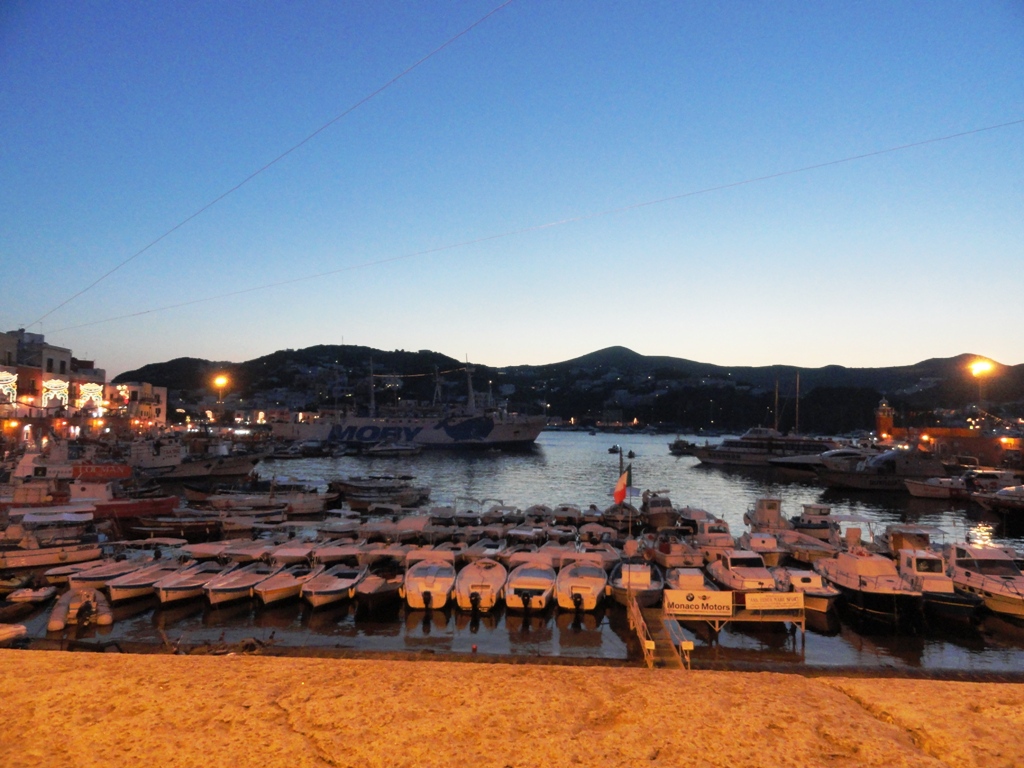
Shhhhh. Don't let the word get out. Ponza, an island escape off the Mediterranean coast between Rome and Naples is a hidden gem -- at least as far as foreign tourists go. And we who've enjoyed the island for years for its unique natural beauty, its bountiful fresh seafood and local vegetables, its impossibly clean aqua waters, its open-air bars and restaurants with jawdropping views, its cute shops open until late...well, we'd like to keep it somewhat hidden. Here, wandering the steep and winding streets, one hears almost exclusively Italian, with its various dialects, Neapolitan and Roman being the most pronounced. And this is refreshing in Italy, a country with so many gorgeous and enchanting spots that seem to have been discovered and sometimes overtaken by foreign tourists.

And what an enchanting and gorgeous spot it is. Ponza is one of the group of isole pontine, and along with its nearby sister island, Palmarola, offers some of the most beautiful landscape off the coast of the Italian peninsula.
Palmarola isn't really an inhabited island, but you can take giri (tours) around the island by day, stopping for swims along the way. There are plenty of places to drop your anchor, countless gorgeous coves and charming spots to share with other visitors, or in which to find oneself alone, in pace. Those arriving in sailboats can even stay the night in one of these beautiful coves, and wake up in the morning to an invigorating swim in crystalline waters teeming with tiny fish. On Palmarola, there are also a couple of lunch spots that serve up the fresh catch of the day, and do excellent pastas and specialty items. We indulged in a local zucchine in scapece (sauteed and cured in vinegar, garlic, and a bit of peperoncino), and an insalata di polpo, fresh-caught octopus salad, a classic antipasto from Italy's central coast on down to Sicily.

The Chiaia di Luna beach is a stunning stop-off, with various grottoes and a vista from the water where you can take in the vertiginous limestone cliffs that drop down into the sandy beach below. The sapphire water that meets the white cliffs offers a truly stunning juxtaposition of color and light.

When returning from an island boat trip, the thing to do is to share aperitivi with friends in the main piazza overlooking Ponza's harbor. Italian pre-dinner drinks, like the classic spritz, or any variation on alcohol or soda with a bitter like Campari or Aperol, are a must. The scene at our favorite, Bar Tripoli, is always lively -- and you're sure to make new friends with vacationing neighbors, sailors, and various ponzese (Ponza locals) as colorful as their island houses. Plus, the view at dusk is hard to beat.


Tuesday, September 6, 2011

RECIPE: Sano e Semplice, Fish Fillet

So many people I speak with -- clients, students, friends -- tell me they're afraid of cooking fish. Everyone seems to think that because a fillet of white fish is relatively delicate, it's a complicated task to prepare. Not so. A white, flaky fish fillet (and not canned tuna!) is, to my mind, the chicken of the sea: everybody likes it, and you can almost always find some variety of white fish where you purchase fresh seafood, filleted and ready to be cooked and eaten. The local catch varies from place to place, of course, and in many cultures, fish is usually sold whole. This is not to save the fishmonger the work of filleting the fish, but more for the discerning customer who wants to judge the freshness of the fish by checking to see that its eyes are clear, and that the fish's gills are a rosy red. But in the U.S., whole fish can be hard to come by. Seafood shops resemble sushi counters, with a variety of already-filleted specimens arranged on ice for the customer to select. Here, since you can't look the fish in the eyes, it becomes important that you trust that your fishmonger is getting in a constant supply of fresh fish.

But regardless of where you are on the globe, how you buy your fish, or what your local catch may be, you can always whip up a healthy, fresh fish meal in about 30 minutes. Recently, I found a gorgeous fillet of locally-caught wild blackfish. I wanted a light, healthy meal for a warm September evening. I often plan my plates using color as a guide -- a surefire way to pair foods containing a variety of vitamins and minerals -- so here I accompanied the fish fillet with diced oven roasted sweet potato and fresh snap peas. The result is a dinner plate filled with a riot of eye-catching color, and great flavor. Since it's easy to prepare a pan sauce after cooking the fillet, I decided to make use of a fresh lime and some sauvignon blanc I had on hand.

This recipe is for one; it can easily be multiplied for any number of guests you may have.

You'll need:
*Fillet of white flaky fish: any fresh catch will do, from sea bass to snapper to flounder and anything in between. 6-8 ounces per serving.
*Sweet potato or yam
*Handful of snap peas
*1 lime or lemon
*1/4 cup crisp white wine
*dash of white balsamic or rice wine vinegar
*good quality olive oil
*pat of butter
*salt and pepper
*Sriracha sauce (if you like a bit of a kick)

- Preheat an oven to 350 degrees farenheit/175 celsius. Scrub a sweet potato or yam clean under running water. I left the skin on. You can peel it if you like. Cut the potato into 1/2 inch dice, sprinke with salt and pepper, and toss with a dash of good quality olive oil. Arrange on a baking sheet and bake, tossing occasionally, for about 30 minutes, until the pieces are cooked through and lightly browned.

- In the meantime, bring a small pot of water to boil. Clean the snap peas (a handful per person) by pulling off the stringy membrane on the flat side of the pod. When the water is boiling, add a healthy pinch of salt. Toss the snap peas into the water and cook for 2-3 minutes. Drain the snap peas and dump them immediately into ice water to stop the cooking. Once completely cooled, drain.

- Heat a nonstick saute pan over medium-high heat. Drizzle a glug of good quality olive oil in the pan. Heat until it shimmers a bit and tilt the pan so the whole surface is covered in the oil. Sprinkle the dry surface of the fish fillet with salt and pepper, and place skin side up in the pan. Do not touch the fillet for at least 3 minutes. This is important: when cooking delicate white fish, patience is a virtue!
Sprinkle the skin side with salt and pepper, and shake the pan a bit -- when the first side is done cooking, the fillet should shake free from the surface of the pan. With a fish spatula, gently flip the fillet. Turn the heat down to medium. Continue cooking another 3 minutes until the fish is cooked through. Remove from pan and put on a plate.

- With the flame still on, cut a lime or lemon in half and squeeze the juice directly into the pan. Add 1/4 cup crisp white wine (per serving), and a dash of white balsamic vinegar. Turn the heat up to high and reduce the liquid by 2/3. When it's been reduced, turn the heat down to medium-low. add a pinch of salt and a tablespoon or two of butter, gently swirling the pan to melt but the butter, but don't allow the sauce to bubble.

- In the meantime, take the potatoes from the oven, and serve as is or toss with a squirt of Sriracha sauce (sweet potatoes are a great foil for a piquant sauce and can stand up to the heat). Plate the potatoes and place the fish fillet on top. 

- If the sauce is a little thick, add a touch of warm water to the pan and swirl to blend. Taste and adjust for salt. Drizzle the sauce over and around the fish fillet.

- Turn the heat up on the pan, toss the snap peas in, and warm through. This will also coat the peas with the remaining pan sauce. When they're warm, put the snap peas on the plate alongside the fish and potatoes.
- Serve immediately...and pour yourself a glass of that crisp white wine. Enjoy!