Thursday, August 9, 2018

DINNER PARTIES: Marble House Project Farm-to-Table Dinner

When I received the email telling me I'd been selected from among roughly 700 candidates to win a residency at the Marble House Project in Dorset, Vermont, I was a little incredulous. I'd applied on a bit of a whim, never expecting to be awarded the culinary residency, especially since so few of these residencies exist for those of us in the food world. I thought about applying as a writer (something I'd end up doing a lot of anyway during my chef residency, since I'm working on various culinary book projects) -- but since my primary career for the past 18+ years has been as a chef, and this opportunity was so rare, I went for it. Culinary residency it was.

Marble House Project hosts one of 3 culinary residency programs in the U.S., and the other two are really year-long paid chef positions cooking for the other artists in residence. This was different. At MHP I was considered to be an artist in my own right, and though we'd all rotate cooking dinner for our fellow residents Monday through Friday, I wasn't expected to do more than anyone else in the Marble House home kitchen. As the sole culinary resident in my session, I was given my very own work kitchen/cooking barn in which to experiment, test recipes, and just generally cook up a storm. When other artists retreated to their studios to create (film and photography, sculpture, music, dance, film, animation, and writing), so did I. Nobody had any imperatives to complete projects during the program. This was a safe haven in the verdant hills of Vermont where we could just create, and hopefully show our work to the public during "Art Seed" the final SAturday of our session. Except, well...I had the imperative of creating a farm-to-table dinner for 40 people, on the Friday night at the end of our three week residency. So, there was that.


But we chefs live to cook for others, to bring people pleasure, to feed bellies as well as souls. So I was enthusiastic about making this farm-to-table meal a happy task, and an excuse to get to know the area a bit, speaking with the local farmers and food purveyors. Since I was simultaneously working on Italian recipe testing, I decided to marry the Mediterranean flavors I dealt with on the daily, with the local culinary strong suits of Vermont. This meant putting the amazing dairy products of the Dorset area front and center. I made my own ricotta cheese with the high-quality milk from Larson's Dairy Farm in nearby Wells. (Bonus: the owners were an absolute pleasure to work with!). 

I sourced specialty items from the Dorset Farmers Market. I sourced local organic chicken from a nearby farm, and the only fish I used was river trout, a local substitute for sardines in a classic Venetian preparation. There were a surprising amount of "Italian connections" for lack of a better term, in the Dorset-Manchester area. Al Ducci's Italian market (featuring Bennington's Maple Brook Farms' homemade mozzarella and burrata) and Fortuna's sausage for some great homemade salumi were two mainstays. I worked with the Vermont Butcher Shop to source locally made guanciale (cured pork jowl) -- and though it was nothing like the original Roman version, it was its own version of the classic, and it gave my pasta all'Amatriciana a hyper-local touch. 


My husband collecting freshly laid eggs
Of course, we have our own Marble House hens for delicious, fresh eggs from happy chicks; these made for some delicious fresh egg pastas and helped to make one of the main dishes, shakshuka, a stand-out. And although the cooler spring weather had caused most of the Marble House garden to run close to a month behind season, I used what we had and what we could forage -- herbs, strawberries, asparagus, ramps, edible flowers -- to speak to the seasonality of the menu. And of course, I had to incorporate Vermont's finest local dark maple syrup into dishes wherever I could! This syrup came directly from a local neighbor's trees and it was delicious and flavorful. The entire meal was accompanied by Mediterranean wines picked (with the help of owner John) from the local natural food store, Nature's Market, in Manchester, where they know their wines!

The prep required a whirlwind four days of intensive shopping, sourcing, and prep. I had great help in the form of Marble House staff and volunteers from among my fellow residents, assisting me with everything from candying flowers to rolling out homemade gnocchi, from sautéeing and smoking to chopping, slicing, and dicing. It was a series of small miracles, but it came together on Friday, June 1st in what turned out to be a magical night at Marble House. Below, I share the menu and a collection of photos from the constantly-changing buffet. It was a culinary journey through the Mediterranean, from all over Italy, north to south, to Spain, Greece, Israel, Lebanon, Morocco, and beyond -- all filtered through the flavors and spirit of Vermont.

I explained to the crowd, seated in the big barn at two long, family-style tables decorated with MH flowers and greens, that this was a feast created with my fondest food memories in mind. It was both a nostalgia trip and something completely new for me, with the influence of the community of food producers I'd found in Vermont married with my love of Mediterranean meals, the tradition of which is to linger at the table for many hours. 
I explained the buffet would always be changing, morphing, and when some serving platters were emptied, often, that was it for the dish. This was a marathon and not a race. Those who stuck around for the dessert buffet would reap the rewards. And the diners were kind enough to come and tell me how much they enjoyed the marathon after it was over. I hope you enjoy getting a glimpse here!

*Please scroll down for gorgeous photos, many of which are thanks to fellow resident and photographer, Francisco Vazquez Murillo.


MARBLE HOUSE PROJECT
Mediterranean Meets Vermont

APERITIVO
Signature Spring Cocktail: Rhubarb-strawberry-basil spritz
Selection of local cheese, salumi, homemade black grape mostarda, honey, grissini
Crostini, Vermont mozzarella & burrata, homemade ricotta with herbs, heirloom tomatoes
Green gazpacho shots

DINNER
Salads and Antipasti
Israeli Salad
Orange & fennel salad with red onions + kalamata olives
Fregola sarda, sautéed vegetables, herbs, Vermont honey-saffron-lemon vinaigrette
Lebanese eggplant with pomegranate & tamarind, Vermont yogurt, pistachios, mint
Local Chioggia beets with Vermont goat cheese, lavender vinaigrette

Primi
Pasta all’Amatriciana with Vermont guanciale
Homemade gnocchi with heirloom cherry tomatoes, basil, Calabrian chile oil
Homemade fettucine with ramp-almond pesto
Timballo of anelletti in tomato sauce with eggplant and ricotta salata

Mains
Grilled chicken kebabs, beet hummus, sumac onions & warm pita
Koufounisi-style gigante bean stew
Wood fire-grilled shakshuka with Marble House eggs
Pork tonnato
Trout en saor with Vermont maple syrup agrodolce

Sides
Moroccan potato salad with harissa vinaigrette, green olives, preserved lemon, sumac, parsley
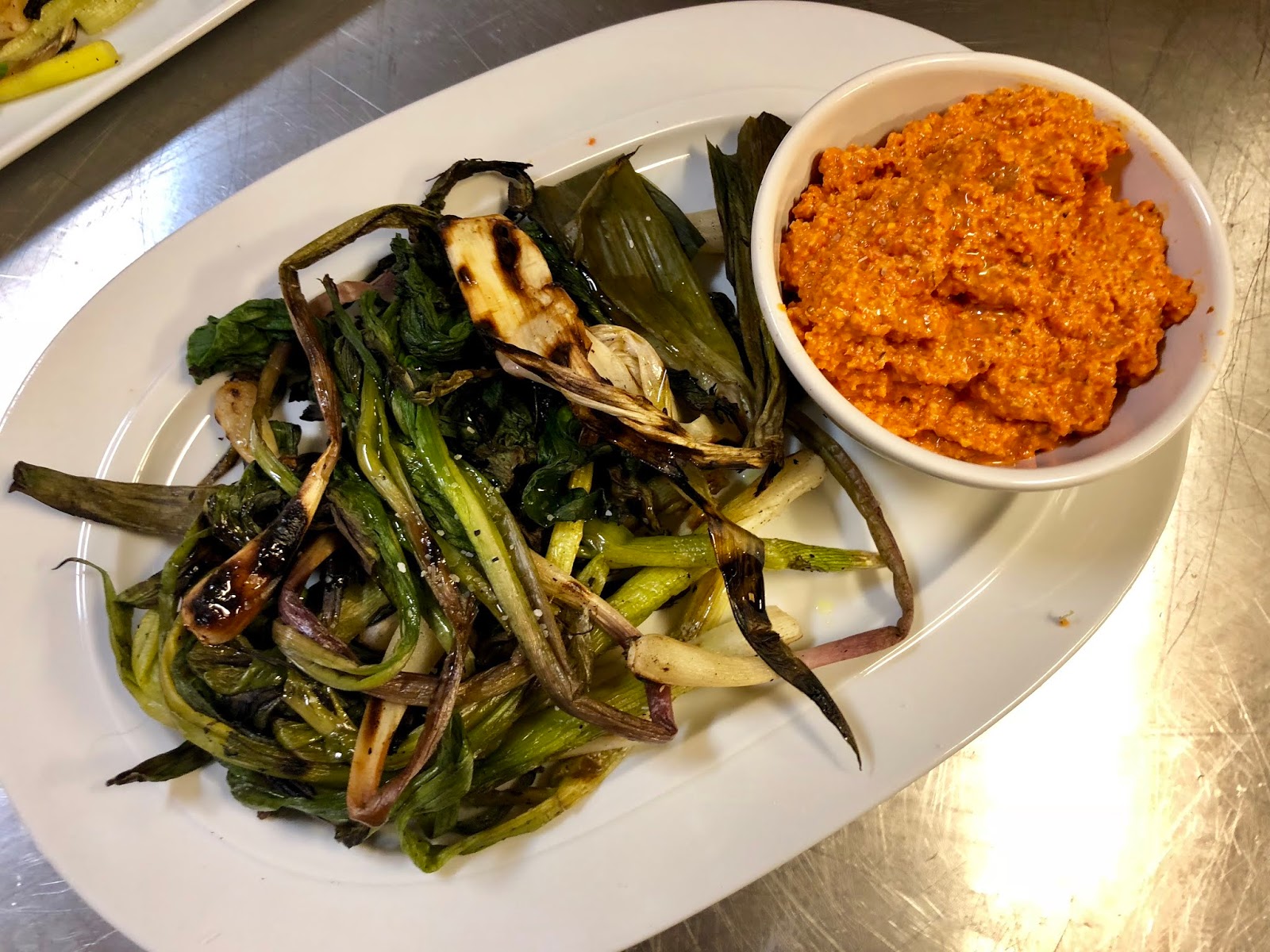
Grilled leeks, ramps, scallions with Romesco sauce
Grilled green and purple Marble House asparagus

Desserts
Homemade ricotta cheesecake, balsamic strawberries
Vermont maple cheesecake topped with blueberry-tarragon sauce
Torta sbrisolona
Torta caprese
Biscotti & meringue baci
Baklava with local Vermont honey
Chocolate salami

Orange, fennel, and black olive salad

Chioggia beet and goat cheese salad with lavender vinaigrette
Fregola sarda with vegetables, herbs, Vermont honey-lemon-saffron vinaigrette
Lebanese eggplant with pomegranate and tamarind, yogurt, and mint

Koufounisi style stewed gigante beans with tomato, Greek oregano, and warm spices

Homemade fettucine with homemade ramp-almond pesto

Pasta all'Amatriciana with Vermont guanciale

Homemade potato gnocchi with fresh heirloom cherry tomatoes, basil, and Calabrian chile oil


Green herb-marinated locally farmed chicken kebabs, sumac onions, beet hummus

Lightly smoked shakshuka with Marble House Project eggs and herbs

Pork tonnato
Grilled ramps, leeks, and scallions with Romesco sauce

Moroccan potato salad with harissa vinaigrette, green olives, chickpeas, preserved lemon, sumac, parsley

Chocolate chip cheesecake made from homemade ricotta, MH strawberries in balsamic

Homemade baklava with Vermont honey

Chocolate "salami" with pistachios and candied ginger

Torta Caprese (flourless chocolate cake with ground almonds)

Homemade almond and hazelnut biscotti


Marble House


Tuesday, July 17, 2018

QUICK BITE: Patatas Bravas


Spain has been at the culinary forefront of world cuisine for decades now. So, among all of the famous Spanish chefs, among the myriad destination restaurants topping the "World's Best" lists, and all of the avant garde theory behind elevated regional Spanish cuisine (not to mention the headline-yielding political divide between the various regions of this Iberian country of late), it seems strange that the closest thing to a national dish would be a plateful of fried potatoes. Yet, this popular (and populist) tapa, this essential Spanish bar food, is generally considered just that. Beloved by everyone from the poorest of university students to the most lauded chefs in the land, patatas bravas are the one dish everybody in Spain loves. Its simplicity of presentation belies both the complexity of flavor of the dish, and the thoughtful preparation required to achieve the perfect patatas (or papas) bravas. 


To begin, patatas bravas consist of three elements:
1. Fried potato
2. Spicy (red) sauce
3. Allioli

As for the first element, one can argue (and Spaniards do) about what variety of local potato they feel is best for this dish. There's even a potato museum in Madrid if you're looking for historical context and more background information than you'll ever need to happily consume a potato. But no matter, the generally-accepted process is to blanche (or par-boil) the potato first, then dry it and fry it. Some fry it twice, as is done with french fries. Some, like chef Marc Roca at his Barcelona eatery Blau BCN, don't fry the potatoes at all, and instead boil them but make the sauce the interesting textural counterpoint in the dish. It's not traditional bar food patatas bravas, but it is delicious, doused in a smoked paprika and tomato-based sauce and topped with tons of fresh allioli. Still, the frying of cubed, irregularly-cut potatoes is what makes these such a tapas bar staple. You can stick them with a fork or a toothpick and share a plate easily with your eating companions.

Patatas bravas sliced into discs, accompanying
another tapas staple: garlic shrimp
As for the sauces, here the regional variances come into play. Element #2 is the (usually) spicy, (usually) red sauce. Generally speaking, it's some combination of tomato sauce, vinegar, paprika, and a hot sauce like Tabasco, along with any random spices (black pepper, cumin, cayenne, etc.) the preparer likes to add to enhance the sauce's flavor (if at all). It is said that this piquant sauce has basque roots. We know one thing for sure: a true spicy sauce for patatas bravas cannot be ketchup. Period.

The allioli (ay-OH-lee), the Catalan word for a garlic mayonnaise, is the other key sauce. In Catalonia they often forego the egg in making this white sauce, though egg certainly acts as a binder and makes the allioli fluffier. These are some of the many modifications one might make in creating an allioli. There are certainly many variations on the aliioli itself: black garlic, smoked paprika allioli, lemon allioli, truffle allioli -- just a few of countless possibilities and among those I've tried on patatas bravas. Net-net? They're all good. It's garlic mayo, at the end of the day, so we're looking at a very high baseline deliciousness quotient!

The beauty is in the melding of all of the flavors, and these flavors are best absorbed by a hot potato. Think of the potato itself as a malleable base, a blank canvas on which you can pour other layers of delicious flavor. To me, a perfectly fried potato is a textural dream, already the holy food trinity of potato, fat, and salt. So adding spice and creaminess with the kick of garlic on top of it? Perfection, any way you look at it.


Thursday, June 21, 2018

RECIPES BY REQUEST: Straccetti con Rughetta


With the weather turning warmer, sometimes the thought of a big serving of protein as a main course -- a piece of chicken or a steak, for instance -- can sound heavy in this season, even if simply grilled. My go-to secondo on balmy Roman nights was always, and remains, one of the most beloved but least-discussed dishes in the Roman culinary canon: straccetti. These are torn, as the word means in English, thinly-sliced pieces of beef made to look like rags (straccci). But the slightly disparaging-sounding name belies the deliciousness of this dish. 

The shaved beef slices are quickly sautéed in a pan with some olive oil and a little garlic. They're done in batches, if you're making several servings for a group (as pictured above). When all of the beef pieces are cooked through, you turn up the flame and simply add your acid: here, I used both balsamic vinegar and red wine, but some just use white wine and a squeeze of lemon, others use only balsamic, and so on. Finish with some olive oil at the end (and shhhh...a bit of butter). Then, the straccetti get served on a bed of arugula, or rughetta, in Roman dialect. I like to add a few finishing flourishes, like cherry tomatoes and scaglie (shavings) of parmigiano cheese. In Jewish Roman cooking, artichokes are added to the mix, sometimes in place of the arugula, which is also a great combo. But however you prepare it, the liquid from cooking the beef always gets used as a kind of warm vinaigrette to dress the dish (once again, nothing gets wasted in Italian cooking), and voilá! You have a simple second course that's easy enough to make for one person on a work night, but is also great for groups -- a real crowd-pleaser. This is always paramount when you have a group of 12 hungry diners awaiting their meal...


STRACCETTI CON RUGHETTA, CILIEGINI, E SCAGLIE DI PARMIGIANO

Serves 4-6

2 pounds beef sliced extra-thin (ribeye or chuck work well) -- ask your butcher to slice on a meat slicer if possible, or slice thin, pound flat, and slice again into little torn "rags"

2 cloves of garlic, whole

Extra virgin olive oil

1/4 cup red wine

1/4 cup balsamic vinegar

2 TBS. cold butter

12 ounces baby arugula

1 pint cherry tomatoes, sliced in half

Handful of slices of shaved parmigiano cheese

Salt & pepper to taste

- In a large sauté pan, heat a few spoonfuls of olive oil over medium-high heat. Add a garlic clove and let it cook for 20-30 seconds.

- Add just enough of the the thinly-sliced beef to fit in the pan without being crowded, and cook, moving the beef around the pan so it doesn't stick, until the redness has turned to brown and the beef is cooked through. Season with salt and pepper, and transfer to a bowl. 

- Continue with the remaining beef in this way, until all of the beef has been cooked through and seasoned.

- Return the beef to the pan over medium-high heat, and when it starts sizzling, add the wine, cooking to evaporate the alcohol, for about a minute. Add the balsamic, and let that cook for about 3 minutes more. Taste and season appropriately. 

- Throw in the butter and allow it to melt into the sauce. Taste again and adjust the seasoning.

- On a plate or platter, arrange the baby arugula, then place the beef on top of the arugula, using tongs. Top with the tomatoes.

- Spoon the pan sauce over the dish, then top with the parmigiano shavings and a drizzle of olive oil.

BUON APPETITO! 

* Serve with bread to properly fare una scarpetta (mop the sauce with the bread) afterwards.

Tuesday, May 22, 2018

MARKETS: Santiago's Mercado Central


Chile's capital city is a bustling metropolis, a modern Southern hemisphere hub featuring the juxtaposition of an ancient, dramatic mountainscape alongside glass-and-steel skyscrapers. The modern and efficient city planning leaves room for lots of wonderful green space as well. This is fitting for the city that represents this South American nation on the Pacific coast -- one that boasts a bounty of agricultural wonders and an amazing assortment of seafood to fill a grand market space like the Mercado Central in Santiago. The market's neoclassical structure was inaugurated in 1872, and is today a protected Historical Monument of the city.


This vast covered market offers food sellers of all stripes, but is overwhelmingly known as the fish market for its exhaustive selection of Pacific "fruits of the sea". There are all kinds of fish in the categories of white flaky fish, there are darker-fleshed oily fish high in Omega 3s. And you can find every kind of shellfish and cephalopod imaginable in this market. Just be careful to keep an eye on where you're walking, as the market floor tends to get a bit hazardous from the constant hosing-down of the seafood stalls. (It would be no fun landing in a puddle of seafood-scented saline sludge!)


One item that I'd never seen in any market before, in all of my travels, was the Pacific giant squid. In the photo here, those crab claws are not baby-sized. They're normal-to-large as far as crab claws go (another local treat). Those rectangular-shaped pieces of what are calamari steaks are essentially sliced rings of the giant squid. They're enormous! The squid are monstrous in size and can grow to be as large as 45 feet long and weigh as much as 600 pounds! These squid sold here may not technically be THE giant squid, but they're really large and are at the very least related to them. And despite what you might think about these large creatures -- my initial thought was that they may be incredibly tough or rubbery when cooked -- they're actually delicious and tender.

No market would be complete without meat for the landlubbers among us. Chile is more of a seafood nation compared to its beef-consuming neighbor, Argentina. But there are still plenty of carnivorous Chileans keeping the meat markets frenetic and literally filled to the rim (of the refrigerator cases) with the king of meats in these parts: beef. The stalls I checked out had impressive displays of all types of bovine cuts, and they were all ruby-red and seemed to be as fresh as they were plentiful.

The Mercado Central of course has lots of fruit and vegetable vendors inside and outside of the market building. When I was there, stone fruits and tropical fruits alike were flooding the bins at the mercado. Gorgeous, brilliantly-colored cherries and tomatoes sat next to pineapples and mandarins. 
I was probably most impressed, however, by two items, not only because of their outrageously good flavor everywhere I ate them while dining out, but also because they were so inexpensive while being so flavorful: avocados (paltas in Chilean Spanish) and strawberries -- big, juicy, magenta strawberries called frutillas in Chilean Spanish. I consumed both in whatever form I could, wherever and whenever I could. 

Besides boasting all of the magnificent market stalls in the Mercado Central, the market is also home to 22 restaurants within the market space where shoppers can dine on -- what else? -- market-fresh foods ranging from snacks and fruity drinks to multi-course seafood and meat feasts. 
It was here that I finally got to indulge in the local dish that Pablo Neruda made famous: Caldillo de Congrio, or conger eel stew. He actually wrote a poem called Oda al Caldillo de Congrio! I must admit, it was tasty enough to make anyone wax poetic.
What else? well, the palmito salad was pretty much worth the price of admission as well. It's a common ingredient in these parts of South America, but in the U.S. it's rare to find a hearts of palm salad. 
Another treat for all the other seafood lovers out there: scallops pil-pil. These are succulent medium-sized scallops with the roe sacks still attached, sautéed in a generous amount of garlic-and herb-infused butter and olive oil. This, people, is why we prepare good seafood simply. Period.


So, when heading to Santiago's Mercado Central, you can shop for a little while, and then be sure to time it so you can check out the teeny but charming restaurants around the perimeter of the market building. Try to go for authentic, less touristy-looking places. You will be rewarded with delicious food, cooked to order, so you have a full belly to go along with your full shopping bags.

MERCADO CENTRAL San Pablo 967, Santiago
Sunday - Thursday 6 am - 5 pm
Friday 6 am - 8 pm
Saturday 6 am - 6 pm
https://www.mercadocentral.cl/

Friday, May 4, 2018

RECIPE: Olive Oil-Citrus Cake with Cream Cheese Icing and Fresh Citrus


It's only been about a week since we were wearing winter coats and wool sweaters in New York. Winter weather seemed interminable, and temperatures lingered in the forties throughout most of April (uggghhhh). An upside to this is that our citrus supply seems to be happily lingering as well. We still find oranges and clementines and tangerines, lots of various citrus fruits in the markets. 

And so, with this abundance, and with a sunny, springy outlook now that May is here, I created an Italian-inspired (specifically Sicilian-inspired) olive oil cake with plenty of citrus zest in the batter -- even a little juice -- and of course, top-quality Italian extra virgin olive oil. The frosting is my favorite kind, of course: cream cheese. The tangy zip of this topping holds its own against the acidic zing of the citrus cake itself, and pairs wonderfully with the fresh citrus fruit I arrange on top of the cake, both for fresh citrus flavor and for gorgeous added aesthetic appeal. There's even a touch of fresh rosemary in the batter, so I've garnished the top with some sprigs as well (rosemary pairs so well with citrus).

The additional good news for the gluten-averse? I made this cake with only a touch of AP flour, which is optional, because the bulk of the dry ingredients here is comprised of almond flour. This provides for a very tender crumb and super-moist cake with a golden, almost crunchy shell. It's a pretty fabulous recipe, if I do say so myself. My husband, the healthy trainer with a sweet tooth, loved it -- and finished this one off even more quickly than usual! 

I hope this  cake brings a little Sicilian sunshine into your kitchen -- and I'd love to hear about your modifications, if you make any, in the comments section. Enjoy!


OLIVE OIL CITRUS CAKE WITH CREAM CHEESE FROSTING AND FRESH CITRUS 
Serves 8

For the cake:
Butter for greasing the pan
3 oranges: blood, cara cara, etc.
about 1/2 cup Greek yogurt
3 large eggs
1 1/4 cups almond flour
1/2 cup AP flour
2 teaspoons baking powder
1/2 tsp. baking soda
1/2 tsp. salt
2/3 cup extra virgin olive oil (Sicilian is best here)
2 tsp minced fresh rosemary

For the icing:
2 8-oz. packages of Philadelpha cream cheese
2 cups (or to taste) confectioner's sugar

For the citrus topping:
Various supremes or rounds of fresh citrus, rosemary sprigs for garnish

- Preheat oven to 350 degrees, butter an 8- or 9-inch springform pan
- Grate zest of 2 oranges and mix into the sugar in a bowl, with your fingers to distribute evenly.
- Supreme 2 oranges: cut off the bottom and top and run a knife along the rounded shape of the fruit to remove the peel and pith (white part). Cut the orange segments from between the connective membrane and collect with juice in a bowl. Tear segments into bite-size pieces.
- Halve the 3rd orange and squeeze the juice into a measuring cup. Add the yogurt to reach 2/3 cup total. Pour this liquid mixture in the bowl with the sugar, and mix.
- Add the 3 eggs to the sugar-liquid.
- In a medium bowl, whisk together the flour, baking powder and soda, and salt. Whisk these dry ingredients into the bowl with the wet ingredients in 2 batches. Fold in orange segments and the diced rosemary.
- Whisk in the olive oil into the batter until it comes together and is mixed thoroughly.
- Pour batter into the pan and smooth the top. Bake for about 50 - 60 minutes, and test for doneness after 50. The top should be golden brown and almost crusty, and a toothpick inserted into the center should come out clean.
- Cool to room temperature. Move to a cake plate.
- To make the frosting, soften the cream cheese to room temperature. Beat with a hand mixer or a stand mixer until the cream cheese is light and airy. Add the confectioner's sugar, 1/2 cup at a time, until desired tangy-sweetness. You can add a touch of orange juice or zest for sweetness, if you like.
- Frost the cake and place the rounds of fresh citrus on top to decorate, along with fresh rosemary sprigs.

Buon appetito!

Friday, April 13, 2018

QUICK BITE: Churros con Chocolate


I've never been much of a breakfast person. This stems in part from my never having been a morning person. I don't drink coffee, much to the chagrin of most people I encounter. And as much as I love the lifestyle and eating habits on "The Continent", I believe a continental breakfast is best enjoyed once a week, tops. There is, however, one European morning culinary tradition I can get behind: churros con chocolate.


The churro is a fried baton or ring of deliciousness made from a kind of choux pastry (the dough used to make profiteroles or eclairs, for example). These treats originated on the Iberian peninsula, though their historical provenance is disputed. Some trace them to Spanish shepherds who may have been able to fry such a treat in pans over a fire while camping out in various countryside locations -- who supposedly named the treat after the shape of their sheep's horns. Others claim the Portuguese explorers brought an early version of the churro back from China, and modified their riff on the Ming Dynasty's youtiao to create their version. This would be further refined by the Spanish, who would extrude the pastry dough through a star-shaped die. (This shape, by the way, allows for maximum surface area, and therefore maximum crispness. Good move, Spain!)


Either way (or neither way!) the churro -- also called "calientes" or "calentitos de rueda" when fried in a continuous spiral wheel ("rueda") and cut into portions afterwards -- is a distinctly Iberian treat that has gained popularity in former Spanish and Portuguese colonies and Iberian-influenced regions the world over. Churrerías (or Xurrerias in Catalan) are both established brick-and-mortar cafes and dedicated shops, as well as carts in markets and at street festivals. You can always spot them by the line of hungry churros-eaters eagerly awaiting a freshly-fried batch. 

In Spain, you can certainly find filled churros as well as the "classic", usually filled with chocolate or nutella, or a vanilla pastry cream. I've had them in Barcelona, glazed in dark chocolate: nothing could be bad there. In Cuba, straight, filled churros are popular, stuffed with fruit like guava (sounds amaaaazing), or filled with the beloved dulce de leche in Brazil, Argentina, Bolivia, Chile, Peru, and Mexico. They're glazed with arequipe (another South American word for caramel) in Colombia and Venezuela. And in Uruguay, the churros are sometimes served as a savory snack, filled with melted cheese. 


While all of these versions sound delicious in their own ways, I would argue for the importance of the classic, as it were, served with a rich, thick hot chocolate. And so, we return to my original "exception breakfast" of the churros con chocolate. The churros, warm out of the fryer, are dusted with a cinnamon-sugar. They're usually handed over to you in a paper cone or bag. And they come with an embarrassingly indulgent cup of creamy, dense hot chocolate into which you should most definitely dip your churro. As often as possible, really. As you can see by the expression on my husband's face in the photo at right, dunking your churro in your chocolate can be a very serious matter, especially if you're trying to avoid dripping the hot chocolate down the front of your shirt. But that, too would be worth it for the amazing flavor...the crispy shell of the churro cracking and giving way to the warm, tender center...the subtle spice of the cinnamon and the granular crunch of the sugar...the bittersweet warm chocolate covering it all in a smooth pudding-like cream. It's addictive -- and certainly makes getting up in the morning feel well worth it!

Monday, March 26, 2018

SEASONAL INGREDIENT: Citrus


Normally, at this time of year, the citrus season is winding down. But with the numerous nor'easters to hit us in late March, a lot of the U.S. still looks like it's in the throes of winter. The especially awful flu season this year has run unabated, too, so our need for the Vitamin C that citrus provides is still as relevant now as it was in mid-January. Sigh.

Still, the days are thankfully longer now that we've sprung forward, and at least with April's approach, we can see a light at the end of the tunnel. But for now, the variety of citrus fruits available to us is a great bridge to get us from cold months and snowy storms over to budding life and milder weather. Citrus just tastes like the sun, doesn't it? And I've found that using it in unexpected ways, in both savory and sweet dishes, allows us to sprinkle a little sunshine throughout our meals, throughout our weeks.


We've long had winter access to Florida and California citrus (I'm partial to Florida, as I'm an east coast gal myself). My father occasionally sends me "care packages" of wooden crates filled with grapefruits and oranges, salve for my soul during my months of harsh hibernation in Manhattan. I eat these out of hand, or scoop out the sections of a grapefruit as a mid-morning snack. But I also use the grapefruit (ruby red, mmm) in my work, like in the homemade grapefruit-rosemary sorbet that I paired with the pine nut tart at left.
A close sibling of the grapefruit in use and flavor is the pomelo. It's more dry than the grapefruit, so the sections peel out with less mess. And the actual pieces of pulp are large and pull apart easily. Pomelo is used in a lot of southeast Asian cooking, often paired with savory and spicy dishes like the spicy grilled river prawns and pomelo salad I once ate poolside in Bangkok. Pomelos are also a part of the Vietnamese salad with shredded chicken and cabbage that I love so much -- it's often replaced by grapefruit here in the States, but the original uses pomelo. Other large citrus that we use mostly for their skin or rind or juice -- and really, above all, we often use their scent -- are the citron, bergamot, calamansi, ugly fruit, and the etrog. Since we're focusing on what we eat and drink from the citrus species, we'll skip the details on these guys. They do provide the flavor for some delicious drinks, liqueurs, and vinegars however. Another time, another post.


In Italy, I look forward to two types of citrus showing up in the markets. One is clementini, or clementines, which always signal to me the approach of the winter holidays. Christmas in Italy means that pretty much every household has a gorgeous painted ceramic bowl full of clementini on the kitchen or coffee table. The second type of citrus I pine for until winter is the Sicilian blood orange, known as arancia rossa in Italian. Their flesh ranges in color from fuchsia-tinged bright orange to deep, dark magenta. These sweet, barely-acidic babies become happily ubiquitous at the end of the calendar year and throughout winter. They're in salads -- particularly those of Sicilian origin, like the blood orange-fennel-olive salads I love at this time of year. They're in desserts. They go into spremute, or freshly-squeezed juices sold in bars and in markets all over Italy. They're also great paired with prosecco, for a gorgeously colored aperitivo cocktail that's better than any mimosa you've ever experienced. 

They're squeezed into vinaigrettes and made into sauces -- they happen to pair really well with steak fish to brighten a typical white wine sauce. They're an unexpected touch anywhere you'd normally use lemon or regular orange. They're delicious seared on the grill and paired with pork or duck. They're also great candied, dipped in chocolate. The possibilities are pretty endless, actually. And they're accessible now that they've become popular in the U.S.


And then we have the other categories of orange-skinned citrus. Mandarins and tangerines are often slightly sweeter versions of oranges, larger than clementines but just as delicious and versatile. They're great paired with pomegranate in a spremuta, and my vendors in Campo de' Fiori in Rome have been selling these alongside their market stall now for years. Of course, the smallest of all these orange cousins is the kumquat -- a slightly tricky fruit, but one that can actually be eaten whole, peel and all (these are thin-skinned little guys), and do really well sliced and cooked in a sugar syrup so they're softened, half way to marmalade. 
This kumquat syrup can be made into a compote with the addition of other fruits, it can be made into a chutney with spices and some savory elements, or used as a flavoring syrup with an herb or two to be used as the base for a cocktail or to be topped off with sparkling water. Kumquats also do well included in other dishes like the composed salad here, with shaved fennel, beets, wild asparagus, avocado, and sunflower seeds on a bed of Greek yogurt. Other varietals of orange-skinned citrus like the satsuma, the tangelo, and various cross-breeds have been flooding the citrus market in recent years. I try to sample these fruits when I see a variety I've not yet tasted, and I have to say I've liked just about everything I've tried.


When it comes to a delicious acidic kick in cooking, limes are probably my star ingredient. They bring ceviche to life, they cut the richness of grilled meats in Mexican tacos and fajitas, they are pivotal in Southeast Asian marinades and dips, and they're the perfect finishing agent for freshly cooked seafood and freshly grilled veggies like corn on the cob -- I love smothering corn in a miso-lime butter. Limes are a must on any cocktail bar (dark and stormy, anyone?). Lime is also a wonderful ingredient for desserts. 
A truly well-made slice of key lime pie is hard to beat. The key limes are deliciously tart and work well in tropical cuisine that matches the environment in which they're grown. Lime sorbetto is ultra-refreshing. And lime curd is delicious, and pairs well with berries, like in my raspberry-lime-ginger tart at right. We're now starting to see the availability of other varieties like finger limes in specialty markets these days. These are to regular limes what pomelos are to grapefruit, and are excellent when the pulp is used in savory preparations. Kaffir limes are amazing, particularly in southeast Asian cuisine, but they're relatively dry and so are best used for their aromatic zest and above all, for their gorgeous fresh leaves. Nothing, for me, compares to the flavor kaffir lime leaves impart to curries and stews and soups. And dried limes are a big part of the flavor profile in Persian cooking, a cuisine I love and am learning more about all the time.


And then, of course, we have the lemon. I could write an entire post alone on lemons -- and I will, at some point. Having honeymooned last year on the Amalfi Coast of Italy, we walked through a pergola of lemon trees just to get from our suite to breakfast each morning in Anacapri. My friends had luscious lemon trees in the back yard of their B+B in Puglia. Even my friends with more than a corner of terrace space in Rome have citrus trees. And I've used lemon leaves in my cooking as well - they're great for wrapping things in and grilling. The amazing Italian lemons themselves go into everything from a light salad dressing to sauces for seafood to desserts and cakes and gelato and sorbetto and mmmmm, granita. They are served alongside tea (tè al limone) as well as a bistecca alla fiorentina. But lemons from all over the world help to add flavor to marinades and ceviches and meringue pies and tarts and candies, and anything at all that needs a little brightening of flavor.


They are a part of the sgroppino, an after-dinner drink which I've already highlighted on this blog here: http://bluaubergine.blogspot.com/search?q=sgroppino -- but it's so delicious it's worth mentioning again. And the lemons of the Amalfi coast have long donated their rinds to the best cause of all: limoncello.  What lemons have added to our world of drinks alone makes them worthwhile! Limonana, the Israeli slushie drink of lemon and mint, is a refreshing glass of wonderfulness, improved upon by the addition of a little vodka. And the coccolimone drink and grattachecca sold on the streets of Rome in warm weather are a revelation.


With the creation of the meyer lemon, which is a cross between a lemon and an orange, we have a best-of-both-worlds situation which allows us an interesting, mellowed citrus flavor to utilize in both sweet and savory. Lemon bars are given a tweak, and meyer lemon curd adds interest to the coconut cake and chocolate tuile at left. They're great in sauces and to make an aioli ethereal. Grilled and squeezed on seafood, they lend amazing dimension. There's very little a regular lemon can do that a meyer lemon won't improve. Give them a try the next time you find them in the market. In fact, pick up as many citrus varieties as you can get your hands on, then store them in the fruit bin in your fridge, and go in search of recipes that utilize these wondrous, versatile fruits. They'll help you bring on the spring!


Haricots verts with almonds, beets, and orange supreme
Branzino topped with meyer lemon aioli, over roasted artichokes and sea beans
Moroccan honey-citrus cake, orangeflower citrus, roasted figs, sweetened yogurt
Lemon sole over beluga lentils and wilted chard, roasted citrus beurre blanc
Southeast Asian style soft-shelled crabs with citrus-cucumber nuac mam, citrus segments and butter lettuce
Rustic Italian flourless lemon-almond-poppyseed cake, four berry sauce, lemon sugar whipped cream