It
had been quite a few years since my last foray into Central Europe, and
though I'd previously hit many beautiful and interesting cities in this
part of the world -- Prague, Vienna, Berlin, Split -- I had yet to make it
to Budapest. So with a couple of my girl friends, we
planned a long weekend in the heart of the former Austro-Hungarian
Empire, replete with market visits and spa indulgences for which the
city is justly famous.
 It
was a monumental birthday for Elizabeth, and our friend
Jessica (with whom I've globe-trotted before) and I wanted to celebrate
somewhere new -- for all of us -- with her. We'd been aiming for Morocco, but came up
short and too last-minute in the planning process, so an easy jaunt to someplace nearer to our home bases (east coast U.S. and Rome) was the ticket. We came in the full-fledged spring
season. In Hungary, this meant both torrential downpour rain and
glorious sunny blue skies replete with fluffy cumulus clouds, creating a
cartoon-like backdrop of a sky for viewing castles and gothic architecture, bridges and spas. The city itself is divided by the Danube into Buda, the hilly landscape to the west, and Pest (pronounced "pesht"), the flat urban center of the city where most of the living and working is happening these days. And Budapest is very happening.
It
was a monumental birthday for Elizabeth, and our friend
Jessica (with whom I've globe-trotted before) and I wanted to celebrate
somewhere new -- for all of us -- with her. We'd been aiming for Morocco, but came up
short and too last-minute in the planning process, so an easy jaunt to someplace nearer to our home bases (east coast U.S. and Rome) was the ticket. We came in the full-fledged spring
season. In Hungary, this meant both torrential downpour rain and
glorious sunny blue skies replete with fluffy cumulus clouds, creating a
cartoon-like backdrop of a sky for viewing castles and gothic architecture, bridges and spas. The city itself is divided by the Danube into Buda, the hilly landscape to the west, and Pest (pronounced "pesht"), the flat urban center of the city where most of the living and working is happening these days. And Budapest is very happening. We stayed at the beautiful Corinthia Hotel Budapest, which is a gorgeous, grand building in the heart of Pest. Besides the standard city hotel rooms, the Corinthia also owns an adjacent building which is more of a condo complex, where mini apartments with a central courtyard are a charming alternative, offering the conveniences of a top-notch hotel with the comfort and space of an apartment rental. Ours had two bedrooms and two baths with a kitchen and living/dining room -- which turned out to be important when I came down with a nasty sinus infection. I was able to have my own space and not infect my girlfriends or keep them up at night (at least, not too badly) as I was sneezing and coughing all night long.
  In the main hotel, the lobby and restaurants encourage lingering, and the Royal Spa is a stunning Art Deco building, constructed in 1886, with a 15-meter pool under its stained glass roof as its centerpiece. Of course there are all of the usual spa treatments on offer (massage, facials, etc.), as well as free use of the pool and whirlpools of varying degrees of heat. On a cool rainy night, when we didn't feel like venturing out into the city streets, we took comfort in the spa bathing process, the ritual of cool to warm to hot and back again, the change in temperatures bringing a flush to our cheeks. We then scurried back to our spacious room in plush bath robes and slippers, and ordered a comforting room service dinner, and just relaxed. We had been out already, and we
had more nights to spent eating and drinking our way through Budapest.
That night, it was all about unwinding (and some serious catching up
with the girls).
In the main hotel, the lobby and restaurants encourage lingering, and the Royal Spa is a stunning Art Deco building, constructed in 1886, with a 15-meter pool under its stained glass roof as its centerpiece. Of course there are all of the usual spa treatments on offer (massage, facials, etc.), as well as free use of the pool and whirlpools of varying degrees of heat. On a cool rainy night, when we didn't feel like venturing out into the city streets, we took comfort in the spa bathing process, the ritual of cool to warm to hot and back again, the change in temperatures bringing a flush to our cheeks. We then scurried back to our spacious room in plush bath robes and slippers, and ordered a comforting room service dinner, and just relaxed. We had been out already, and we
had more nights to spent eating and drinking our way through Budapest.
That night, it was all about unwinding (and some serious catching up
with the girls). Budapest is a great city for wandering. It's got monuments and many points of interest, and Castle Hill in the Buda section, on high and overlooking the Danube, is one of its most visited sites. It's a good idea to do this part of the city on foot, so you can wander around at will, check out Buda Castle, the Fisherman's Bastion, and the beautiful Matthias Church. Gellért Hill is also on the Buda side, and overlooks the Danube with a precipitous drop downhill. Along this hill's fault line, many of the city's medicinal springs emerge, and supply Budapest's most famous, historic Gellért Spa and Rudas Baths. People from all over the world have been coming here to "take the waters" since the 13th century.
 Back in Pest, you can visit the city's Museum of Fine Arts, pictured here, to view one of the greatest collections of Old Masters paintings in Europe, or the Hungarian National Museum, featuring items of historical significance to Hungary...and even Beethoven's piano. It's also in Pest that you'll find the world's third-largest parliament building, its neo-Gothic architecture dominating the riverfront. You can happily meander along the cobblestone streets, window shopping (or actual shopping). There are any number of beautiful outdoor markets that seem to pop up around every other corner.
  Part of my friend Jessica's mission was to find unique items in these markets
to turn into or inspire jewelry, so she was up early and combing those
markets on the daily. I preferred a more laid back approach, but found
some interesting items, including an all-natural solid perfume which I carry in my purse with me always. I also came across something I'd never seen before: tool-shaped chocolates. I'm not sure why they exist, I just know now that they do exist. And, um, I guess I'll eat chocolate that looks like a wrench -- why not, right?
Part of my friend Jessica's mission was to find unique items in these markets
to turn into or inspire jewelry, so she was up early and combing those
markets on the daily. I preferred a more laid back approach, but found
some interesting items, including an all-natural solid perfume which I carry in my purse with me always. I also came across something I'd never seen before: tool-shaped chocolates. I'm not sure why they exist, I just know now that they do exist. And, um, I guess I'll eat chocolate that looks like a wrench -- why not, right? The Danube is wide and lovely, and a boat tour on the river will allow you to see many city landmarks from a different vantage point than on land. It's a great way to see Budapest's famous bridges up close (and underneath), too, like the Chain Bridge and the Elisabeth Bridge. Also worth seeking out are the Shoes on the Danube exhibit, a public art memorial commemorating the victims of the Holocaust. Sixty pairs of iron shoes form a row along the river bank, representing the Jews who were shot into the river during World War II.
 A stroll around the city center will take you to St. Stephen's Cathedral, a beautiful structure set on a grand square. Construction began on the church in 1851 and took 50 years, and it is Budapest's largest church.
  Nearby, and certainly within strolling distance, is a serene outdoor park with modern infinity pools and lots of outdoor benches and steps and cafe tables where you can sit and bask in the sun, if you're lucky enough to enjoy nice weather in Budapest.
  We were, and there were countless open-air food sellers who lined this promenade-park, from traditional stalls hawking sausage with peppers, duck with purple cabbage, and all kinds of Hungarian sweet treats...to indie-style producers of organic jellies and vinegars, dips and things on sticks -- a little bit of Brooklyn in Pest.
  A little further down the main boulevard from St. Stephen's and this open air mall, you wander into the Central Synagogue complex of Budapest, what is the largest Jewish synagogue in Europe, and among the largest in the world. The neo-Moorish Central Synagogue once served one of the most populous and dynamic Jewish populations of any city in the world.
  Inside, the soaring ceilings are hung with chandeliers that look like models of clusters of atoms, and a color theme of red and rich gold (both the yellow color and the gilded stuff) throughout. It's a very grand place, and you can imagine, while standing inside these walls, what it must have been like during shabbat services at the turn of the 20th Century.
 The synagogue also has a small museum in an upstairs annex, and features various pieces of artwork to commemorate the Holocaust. The most interesting of these is the "Tree of Life" in the yard behind the synagogue, designed by Imre Varga in 1991.
  The tree stands over the mass graves of Holocaust victims from '44-'45, and the metal "leaves" on this tree are carefully inscribed with some of the names of the hundreds of thousands of victims.
 The Dohány Street Synagogue (as it's also known) is the entree into the Jewish quarter of Budapest; like so many former Jewish ghettos of European cities, this nabe is now a trendy part of the city center boasting lots of bars and pastry shops, and restaurants both traditional and modern. In the "old school" category, you can get some great Ashkenazi/Eastern European Jewish food at Macesz Bistro. The usual suspects are there, including matzo ball soup, latkes, cholent (now that's old school!) and even hummus, as well as stick-to-your-ribs meat dishes, like leg of lamb on stewed chickpeas with paprika. They even feature light fish dishes (sea bass and the like), and to counter that, a very rich goose foie gras pate' with sun dried apricot. To satisfy a sweet tooth, you can stroll along in the Jewish quarter and stop in at any number of pastry shoppes for that central European tradition of an afternoon tea-and-cake break.
 But what was the food scene like, I wondered, in a Central European capital whose glory days seemed to be behind it? As it turns out, it's a mash-up: one part Eastern European/Soviet communist nostalgia kitsch, one part former empire cafe' society; on the one hand, euro-modern, on the other, old school European. What does this all mean? Well, it means visitors have their choice. They can indulge in the comforts of babushka-made, stick-to-your-ribs goulash, duck, cabbage, and dumplings (available in restaurants and as street food, too).
  They can enjoy cutting-edge cuisine served with professionalism and expediency (though alas, this may be harder to find here than in most European countries). They can enjoy coffee, tea, cakes, and savory bites in grand cafes with all of the old world glory of this category of establishment. And, most particular to this part of the world, visitors can partake in ruin pubs and other Soviet-era spots that have been given new life via nostalgia.
KOLOR, where we enjoyed a lovely lunch, was a funky restaurant-bistro hybrid that serves sandwiches and salads and classic dishes. Sadly, it's closed now, but the OG of ruin pubs, the first one to really open to success nearly 17 years ago, is Szimpla, now settled in the old Jewish quarter. They do the standard pub grub -- burgers, wings, salads -- plus classics like goulash. And the setting is unique. It's definitely a worthwhile venture to seek out a ruin pub at least once during a stay in Budapest, if for nothing else than the cultural relevance. The unique ambience is an added bonus.
Central
Market Hall (Feny Utca) is a 19th Century covered market in the tradition of grand
market halls of the past -- but it's a bustling scene nowadays as well.


As for fine dining, we had some really nice experiences in Budapest. KIOSK is a funky restaurant and bar housed in a warehouse-like setting on the banks of the Danube, hard by the Elisabeth Bridge -- which looks amazing at night when it's dramatically lit and requires that you crane your neck to see it in full, looming large overhead.


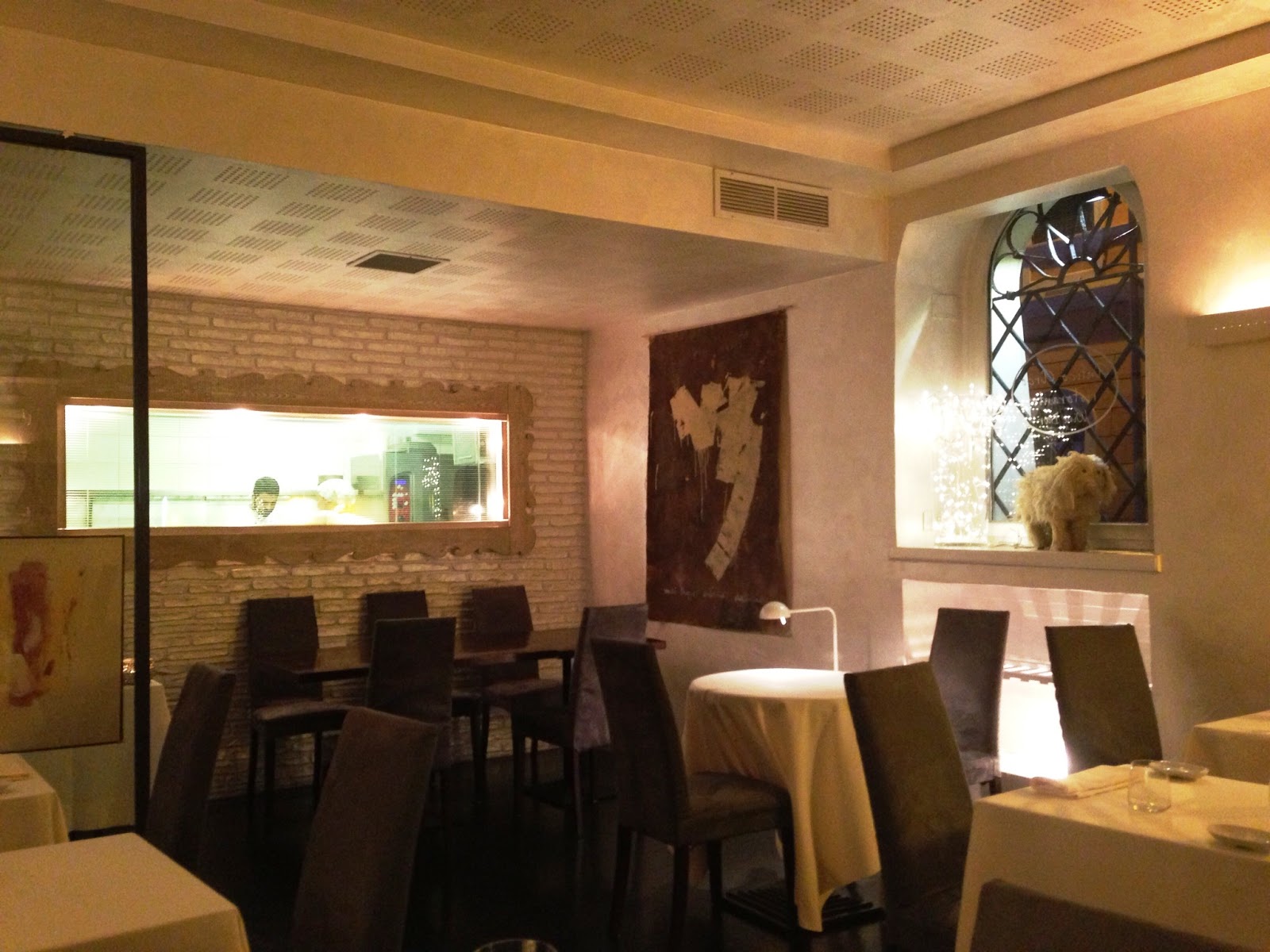
 Our "push the boat out" meal during our trip was at Aszú Étterem, an elegant space with arched ceilings and backlit glass walls with designs that look like amber and marble, plus detailed cut gilded wood dividers, and baroque-sputnik-style chandeliers. The design of the place, from the entrance to the bar to the bathrooms was just cool...as was the service, but in a very professional way. The wine list was amazing, offering wines exclusive to the restaurant itself. The somm recommended an interesting tokaj (their specialty, of course) for us to sample, and we were off! I began with a goose liver pate with grape jelly and must essence: simple and perfect. We also tried the beef tartare with black garlic, marinated onions, and fried crispy onions on top. Third on the starters was a wild mushroom veloute' with long-ripened cow's milk cheese, which was a big hit with my friend Jessica who can't get enough of pureed anything.
 For our main courses, we selected the catch of the day, which was seared snapper fillet with a fennel-broccoli cream with apple.
We also ordered a very tasty, modernist, and sophisticated version of chicken paprikash.


I do know that this was our final evening in the Hungarian city, and that we went out with a bang. It was a pleasure heading back to our lovely apartment at the Corinthia Hotel Budapest, to a good night's sleep and to the next leg of my trip, which was back to Rome. We'd finally made it to this lovely city on the Danube, and were able to experience a bit of what the old Austro-Hungarian empire must have been like...or at least, what it looked like. And we soaked in the culture and enjoyed some delicious central European fare all the while.
Corinthia Hotel Budapest
Erzsébet körút 43-49
Budapest H-1073
Tel: +36 1 479 4000Erzsébet körút 43-49
Budapest H-1073
www.corinthia.com/en/hotels/budapest
budapest@corinthia.com
Eastern European bistro in the Jewish quarter
26 DOB Street, 1072 Budapest
+36 1 787 6164
http://maceszbistro.hu
Kazinczy utca 7
Budapest 1075
+36 20 540 4891
http://szimpla.eu/
Ruin pub
KIOSK Budapest
1056 Budapest, Március 15. tér 4.
+36 70 311 19 69
+36 70 311 19 69
http://kiosk-budapest.com/
Aszú Étterem
1051 Budapest, Sas utca 4+36 1328.0360
+36 1328.0155
www.aszuetterem.hu
Feny Utca Market
Lövőház u. 12, 1024 Budapest
http://www.fenyutcaipiac.hu/
Open 6 am - 6 pm daily, closed Sunday
Lövőház u. 12, 1024 Budapest
http://www.fenyutcaipiac.hu/
Open 6 am - 6 pm daily, closed Sunday