Friday, September 19, 2014

SEASONAL INGREDIENTS: Basil... + Pesto alla Genovese

Quick, hurry! Before summer is officially over in a few (not-really-that-short) days! For anyone who has grown her own basil this summer, whether in the back yard or on a windowsill or -- if she's lucky enough -- in her own lush, expansive, dedicated herb garden: it's pesto time. Pesto, as a sauce, originates from the Italian verb pestare (to pound or crush), which gave rise to the word pestle, as in mortar-and-pestle -- the instruments originally used to make the sauce. In Italian cuisine, pesto refers to any sauce made with a mortar and pestle, and has myriad iterations. From the northwest coast of Liguria, and the city of Genova, where pesto alla Genovese originates, to the island of Sicily, where the local pesto is most often red (from tomatoes)...a pesto sauce can mean many things to many different people. Today we're focusing on the world's most famous pesto. Made with only a few top-quality ingredients, at their seasonal peak, pesto alla Genovese is the essence of Italian cooking in a simple condiment. 


The basil pesto made famous by the Genovese uses the local ingredient par excellence: basilico genovese, a DOP item (denominazione origine protetta -- meaning the origin and varietal of the basil is protected under Italian law. Meaning it's the good stuff, the real thing). This is crushed with garlic and European pine nuts, plus a little salt. This paste is made into a sauce with the addition of olive oil -- in Liguria, it's the golden, relatively mild and fruity variety made from local taggiasca olives. A grated cheese is added at the end, either parmigiano-reggiano or a pecorino or both. The cheese you use will determine how salty the end result is, so waiting to add most of the salt until the end is advised. In Genova, this sauce is most commonly served with a local pasta called trofie, a twisted short pasta, and often tossed with boiled potatoes and green beans as well. Of course, the traditional way of making it with a mortar and pestle is the best way to appreciate the process -- but it's the modern day food processor that allows you to make the sauce in a snap.


With the abundant crops of basil throughout the late summer, now is the time to turn the beautiful anise-scented leaves into a perfectly summery sauce that freezes well and lasts for a month or two even in the fridge, as long as it's covered with a layer of olive oil to seal it off from the air. Spread on late summer heirloom tomatoes, this pesto adds the perfect touch to a light September lunch. You can toss it with pasta, serve it with grilled meats, spread it on tomatoes or drizzle it on top and bake the tomatoes. You can use it alone or mix it with mayonnaise for a great sandwich spread or dip. And you can even stir it into vegetable soups as the French in Provence do with their soupe au pistou. Any way you use it, pesto alla Genovese is a great way to use your late summer basil, and to keep enjoying it for months after summer officially ends.

Arrivederci, estate! (Farewell, summer!)

PESTO ALLA GENOVESE 

(8+ servings)

8 cups basil leaves, washed and dried
2 cloves garlic, peeled
1 cup toasted pine nuts
Approximately 1 cup extra-virgin olive oil, very good quality (from Liguria if possible)
½ cup grated parmigiano or pecorino cheese, or a mix of both
salt to taste

- In a food processor or blender, turn the switch to on and drop in the garlic clove so it is finely minced.


- Turn off the blender and remove the top, and add about half of the basil leaves. Return top and blend, adding about half of the olive oil. Now add half of the pine nuts. Add salt to taste.


- Continue this process, balancing the flavors until you reach the proper flavor and consistency you’d like. It can be a bit more liquid rather than thick, because you’ll be adding the parmigiano cheese which will thicken it a bit.


- Remove from food processor/blender and pour into a bowl. Stir in the parmigiano cheese.


- When adding to cooked pasta, mix the pesto with some of the pasta’s cooking water to thin. Use also as a sandwich spread. Keeps in the refrigerator for weeks: cover the sauce with a film of olive oil to seal it from air (this way, it won’t turn black). Wrap/cover tightly.


Friday, August 29, 2014

MARKETS: Mercato di Pesce in Catania, Sicily

It's a wild and memorable stop on any giro in the historic center of Catania, Sicily's southeastern city-on-the-sea, in the shadow of Mount Etna: the Mercato di Pesce, or fish market. It encompasses more than just fish, but the daily catch from local waters is really the star of the show here in the mercato. And what a show it is, every day!

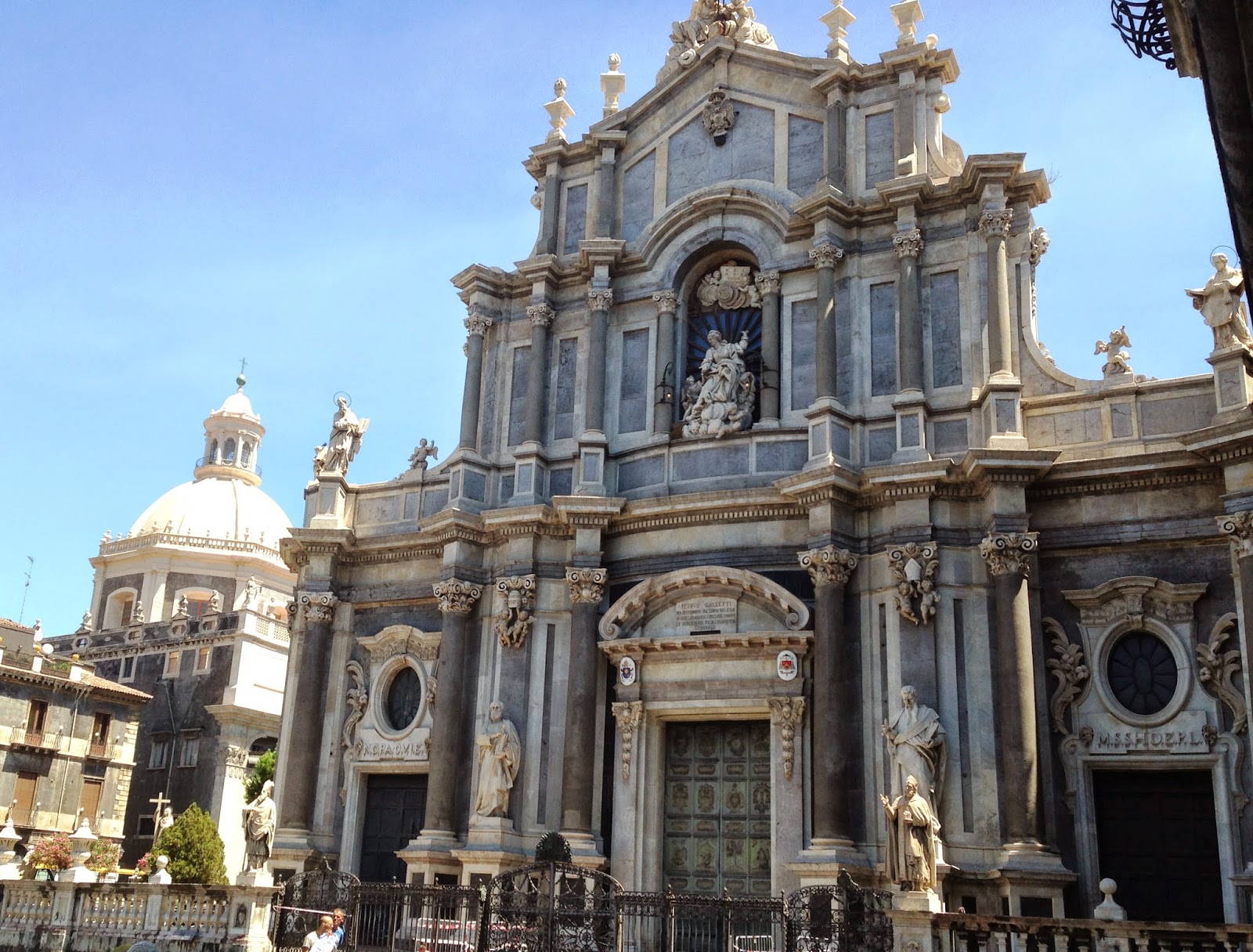
Catania is Sicily's second-largest city, with 300,000 residents in the city proper and 1 million people in the metro area. Much of the city's beautiful architecture, like that of the surrounding Val di Noto, is barocco (baroque) -- ornate and expressive with detailed facades and embedded sculpture. Like its surrounding towns in the Noto Valley, Catania was rebuilt after the great earthquake of 1693, and so these towns were redesigned in the popular style of the era, which happened to be Sicilian baroque, disseminated from its origins in Rome. The fish market's fortunate positioning places its entrance just off the Piazza del Duomo, with the gorgeous pale grey-blue facade of its baroque church. The market has been in its current location since the beginning of the 19th century, when the galleria for the market was dug from the site of the historic center's 16th century city walls. 


Once you enter the market, all the tranquility and beauty you just witnessed in the Duomo and the nearby fountain turn to chaos and shouting, hawking and salesmanship and showmanship. That Sicily was once the provenance of the Arab world, (and its proximity to North Africa) can be felt here, viscerally. The mercato di pesce is part Italian market, part souk. The fishmongers are yelling pleas of "buy my fish, it's the best!" and "There is no fish fresher than mine!" and some say simply "Signora, signora, what can I offer you? Best price just for you!" On the whole, these fishmongers are selling more or less identical products. As you wade through the fish stalls (and I do mean wade: wearing wellies is a better idea than wearing sandals or flip-flops), the prices are more or less on par, so the only thing separating these stalls is the quality of the merchandise...and the marketing skills of the sellers. In the photo here, you see some of the most typical seafood for sale: anchovies and sardines, and shrimp of all sizes, including the delicate and delicious gambero rosso, or red shrimp from the Gulf of Catania, best eaten raw. There are triglie and branzino and orata (various Mediterranean white-fleshed fish), and calamari and octopus.

There is famously fresh tuna in these waters, much of which comes from the west and north coasts of Sicily, between the island and Calabria on the peninsula -- most of which either gets cooked and canned sott'olio (in oil) for Sicily's famous high quality preserved tuna fish, or sold to Japan, where its vertiginous prices are paid by the Japanese sushi and sashimi purchasers. But you can find it here, its flesh a fresh semi-translucent ruby red. And you can find its white-fleshed steakfish friend, pesce spada, or swordfish, all over Sicily. It's particularly good here. I purchased some for our dinner later that night, to be composed of entirely market-bought items. I also bought some beautiful whole calamari.
I was ecstatic to find neonati, teeny-tiny "just born" whitings that, grouped together by the hundreds, would make the base for polpetti -- little fish "meatballs." Other interesting items in the fish market include bottarga (salt-cured tuna roe) and ricci di mare, sea urchin. Such items are typical in these parts of southern Italy, and we'd been gorging ourselves on pasta with sea urchin and pasta with bottarga since we arrived down south a week earlier. So I went for something a little different. With my fish gathered and a menu coming together in my head, I passed by a few stalls in the fruit and vegetable part of the market, and then we were off for a swim in the sea just down the street from our apartment. And then, and only then...to cook!

What did I make at the end of the day? My take on various Sicilian specialties and flavors, using locally purchased ingredients, of course. I made those polpetti with neonati, bread crumbs, egg, herbs, and spices, and deep fried them. I took the gorgeous swordfish from the fish market and sliced the steaks as thin as possible, then stuffed them with an eggplant caponata (sweet-and-sour ratatouille) I made from market vegetables, and rolled that into involtini. I made a sort of salsa verde (green sauce) with basil, mint, and parsley from the herb plants on our apartment's terrace, and spread that on top of the oven-cooked swordfish.
And I took the calamari, cleaned them, and chopped the tentacles up and tossed them with bread crumbs, parmigiano cheese, seasoning, and lemon zest, and stuffed the calamari with this mixture. I baked those in the oven as well, and in the meantime made a spicy sauce from the gorgeous local pachino cherry tomatoes and basil and garlic from the market. I served that with the calamari, on the side. It was a memorable meal that we accompanied with a chilled Sicilian white wine from grapes grown in Mt. Etna's volcanic soil, and finished off with some local fresh figs and wild fragoline, tiny strawberries. I found everything we used, except for the bread crumbs and the raisins and pine nuts, at the mercato di pesce and surrounding vegetable market. That's what I call a local meal.

Cin-cin to Sicilia and her gorgeous culinary gifts!

Footnote: If you're not lucky enough to be staying in an apartment with a kitchen, or aren't much of a home cook, there are some terrific, highly-recommended restaurants within a stone's throw (and sometimes inside) of the fish market. Three of these are:
- Ambasciata del Mare
- Osteria Antica Mare
- Trattoria La Paglia

Friday, August 22, 2014

RESTAURANT REVIEW: Red Bar Brasserie, Southampton, NY

Sometimes I review restaurants that have recently opened or that offer something new to the dining public. But just as often, I like to write about a restaurant simply because it gets it right, and often it has been getting it right for many years now. Red Bar Brasserie in Southampton is one of those places that falls into the latter category. There's nothing earth-shattering here, no molecular gastronomy or $100-a-pound lobster salad to set tongues a-wagging. Simply put, this is and continues to be a restaurant where I want to eat. Where pretty much everything on the menu appeals, and it's almost certainly well-executed. And it's been open for almost 18 years -- which, in the seasonal setting of The Hamptons, means it must be doing something right, both with summer tourists and with locals. That alone is a feat worth celebrating.

Restaurateurs Kirk Basnight and David Loewenberg have created a dining room that works equally well for a group of friends having a social evening or for a couple enjoying a romantic candelit dinner together (again, not an easy line to straddle). Chef Erik Nodeland has created a menu featuring local produce, seafood, and meat whenever possible -- and the East End provides an ample bounty for those chefs looking for delicious primary ingredients. His dishes pair French and Mediterranean technique with an American sensibility, and the results are generally excellent.
Appetizers to try (though they do change seasonally) include a fluke crudo with avocado, cucumber, citrus, and chiles, as well as a similar-but-spicier Hawaiian poke (pronounced POE-kay) with avocados, cashews, a spicy sesame vinaigrette and plantain chips. For those interested in rich meats, the braised pork belly with pickled rhubarb, baby arugula, and ricotta salata is a nice option. Or go for broke and indulge in the foie gras terrine with candied kumquats, pistachios, and crostini. The signature main is a truffled chicken breast with mushroom risotto and french beans, though I rarely order chicken in a restaurant (I reserve that for home cooking), so I'm more likely to go for the duroc pork chop or a savory steak, of which there are several to choose from on the brasserie menu.

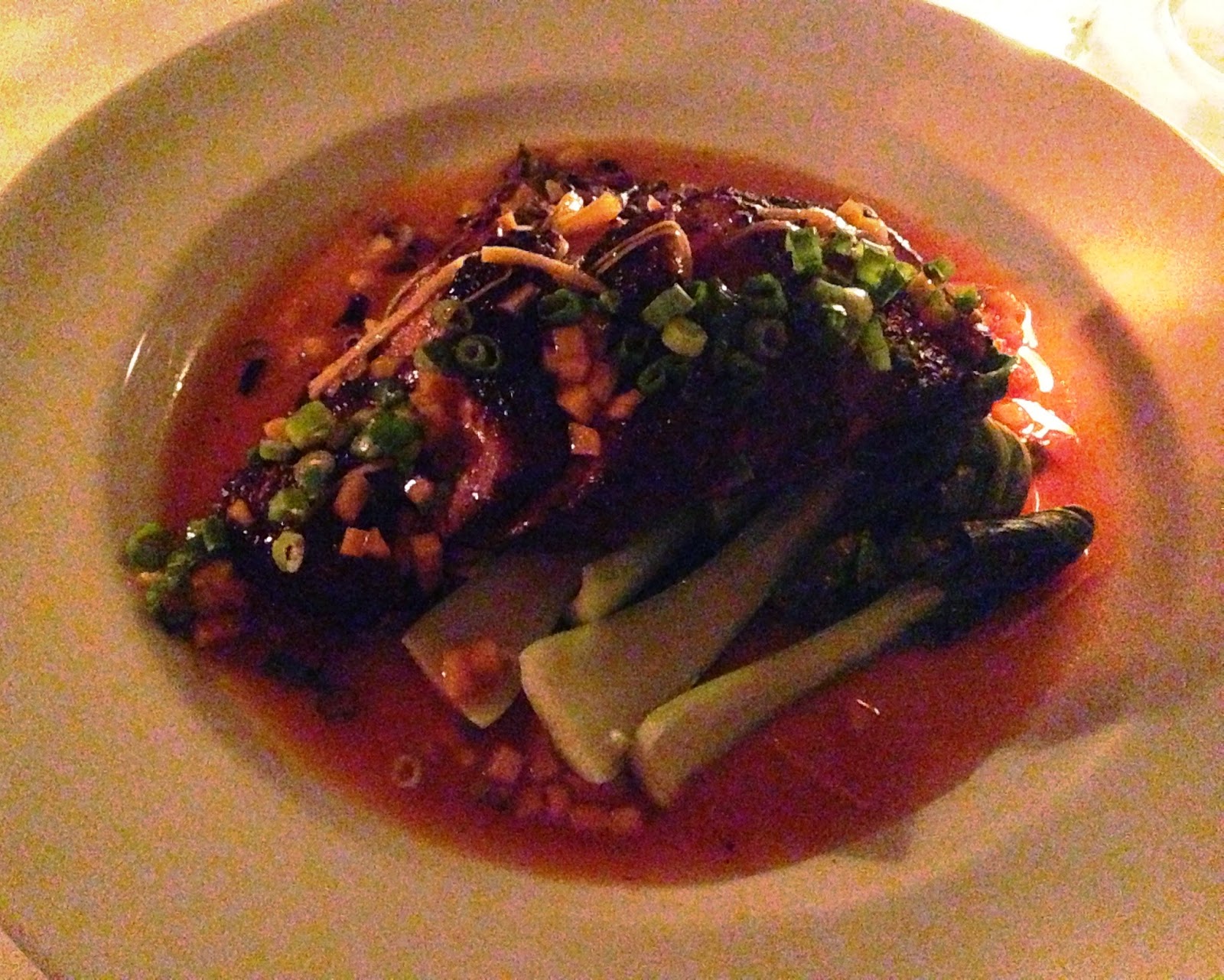
But since I'm out in eastern Long Island, I'm much more inclined to get a fish dish. Recent temptations include the miso-glazed local tilefish (I'm seeing a lot more tilefish on menus lately, and it's great eating) with spinach, leeks, shitake mushrooms and meyer lemon. Also of note is the striped bass (also local) with littleneck clams, chorizo, potatoes, tomatoes, fennel, and white wine. Of course, Long Island duck breast is always a good choice in these parts, and Red Bar always has it on the menu. Right now it's the seared breast with lentils du Puy, butternut squash, braised kale, and bing cherries. 
I liked the Asian-inflected version I had last year even better, with bok choy and a tamarind broth that made me want to lick the plate. As for desserts, interesting options are a fresh fig and frangipane tart with vanilla ice cream and raspberry sauce, or the toasted coconut and almond bread pudding with a mango-pineapple sauce. Or, you could go for the ever-so-retro Baked Alaska. There's something about the showmanship of that dessert that makes it a perfect restaurant dessert choice. It requires some great service in the dining room to pull it off properly, setting the whole orb alight with rum and fire. Red Bar Brasserie is more than capable of this, since their dining room service is generally welcoming and top-notch. This, along with interesting and well-executed dishes from the kitchen, makes Red Bar Brasserie what can now be considered a perennial Hamptons favorite, and one of my go-to spots "out east."


Red Bar Brasserie
210 Hampton Road
Southampton, NY  
(631) 283.0704
www.redbarbrasserie.com

Friday, August 15, 2014

RECIPE: Concia, a Roman Jewish tradition

Rome's Jewish ghetto, 2 pm. I'm starving and sweating in Rome's midday heat and humidity. I don't want pasta, or risotto, or even any secondo that is served warm. I want room temperature and cold dishes, and something refreshing and flavorful with an acid kick. I want concia (pronounced "CONE-cha"). 


What is this dish exactly? It's one of many examples of cooked vegetables marinated in an acid (in this case the vinegar) to preserve the vegetable. That it adds interesting depth of flavor may be just a happy coincidence: like many dishes of Jewish origin, this was cooked and then eaten a day or two later, on the sabbath, when observant Jews are not allowed to cook or do work of any kind. Concia, a dish specific to the Roman Jewish ghetto, may have originated in Rome. But it may have been brought there by Jews fleeing the Inquisition at the end of the 15th century in Spain. Many Spanish Jews fled to Italy, and brought with them an interesting array of foods previously unknown to Italian palates. That this dish so closely resembles the Neapolitan "scapece" may be another link among Jewish cooks: once Naples was conquered by the Spanish a decade or so after the Inquisition began, the Jews in Naples may have fled to Rome, where "scapece" became "concia." Indeed, "scapece" is incredibly similar in sound and spelling to the Spanish "escabeche," which is the identical culinary concept. 

But whether we have the Spanish or the Romans to thank for this dish, it's definitely got Jewish roots. And it's definitely delicious. Enjoy this cooling dish on a warm night throughout the summer months -- and pretend you're sitting on the sidewalk of a trattoria in Rome's beautiful Jewish ghetto...


CONCIA DI ZUCCHINE

Ingredients
*6 medium zucchine, about 2 pounds
*1/4 cup extra virgin olive oil
*6 medium cloves of garlic
*Half a bunch of mint, leaves pulled from the stems, and torn or sliced into a chiffonade {alternatives include flat leaf parsley and/or basil}
*2 teaspoons kosher salt
*Freshly ground black pepper to taste
*1/4 cup red wine or balsamic vinegar
*{freshly grilled bread, optional}


Directions

- Trim the zucchini at both ends and slice into discs or lengthwise strips about 1/8 - 1/4 inch thick
- Heat the olive oil in a pan, toss in 2 of the garlic cloves, and allow to infuse the oil for 30 seconds
- Throw in enough zucchini to cover the surface of the pan, but not so many that they overlap -- approximately 2 zucchini at a time. Salt and pepper to taste. Cook until golden brown. Repeat with the rest of the garlic and zucchini.
-  Once all the zucchini has been cooked, return it all to the pan to heat through. Add the vinegar and the mint, and stir to mix the flavors.
- Let sit for at least an hour and as much as one full day to allow the flavors to marry. Serve over grilled bread, if you like.

Thursday, July 17, 2014

RESTAURANT REVIEW: Le Chateaubriand, Paris

"I know what I'm getting for dinner tomorrow night," professed my friend Kenny, then a 2-year resident of Paris. Then I had to explain to him that Le Chateaubriand is not, as the name might imply, some stuffy, starched-linen tablecloth, overpriced, old-school Parisian joint that specializes in its namesake hunk of beef. Not at all. When I told him that it's an experimental, prix-fixe modern bistro, headed by a young culinary wiz and autodidact, he rolled his eyes and said, "Oh no, a 'Drizzled Walnut'!" -- his term for any frilly restaurant that serves walnut-sized pieces of protein drizzled with a sauce that requires the waiter to invoke 4 verbs and 17 adjectives in describing it. "No, it's not like that," I reply. "You can wear jeans!" And so dinner, as they say, was on.

After enjoying aperitifs in a nearby cafe-bar, my 3 American, Paris-dwelling friends and I proceeded to Le Chateaubriand just after the designated 9:30 arrival time -- they take reservations up to their 8:30 seating, and it's a free-for-all from 9:30 onward. It was in line outside the restaurant that we met an American couple honeymooning in Paris, after hitting some traditional honeymoon hot spots in Italy. They, like many Americans, had seen the restaurant featured on the final season of Anthony Bourdain's food-travel show, "No Reservations." He and top toque Eric Ripert, of NYC's best seafood spot Le Bernardin, found Le Chaueaubriand's food to be exciting, fresh, and genial: high praise coming from as renowned a chef as Ripert, and as seasoned an eater as Bourdain. I suspect that episode fueled many a traveler like our Long Island honeymooners to show up in line here. And so we waited, but only for about 20 minutes: it turns out our group of 4 got seated more quickly than the several two-tops in line ahead of us. A happy circumstance. We were famished.

Le Chateaubriand offers a single prix-fixe meal each evening, and you can order wine and cocktails and beer by the glass, or go for the accompanying drinks menu -- which of course we selected -- for an additional 60 euros. I recommend this, not so much for value purposes (often times you get more bang for your buck by wisely selecting bottles from the wine list), but because here you get truly interesting pairings.
And it goes beyond wine to offer sparkling wine, cider, and beyond. Now, there are certainly repeat dishes that the chef puts on offer (to wit: his famous egg dessert. More on that later). But the menu is seasonal and changes with such frequency that you'd most likely be unable to order much of anything I'll describe here. This is more to give you a feel for power chef Inaki Aizpitarte's French cuisine that has been labeled "daring and challenging." I find it innovative, beautiful, often exhilarating, sometimes baffling...and the experience is a lot of fun, a memorable Parisian evening.

MENU

Amuse bouche:
-Liqueur de tomatoes L. Cazottes: This was a ceviche in fresh tomato and onion water with coriander flowers. Delicious and fresh.
Chambolle Musigny, 2010 (pinot noir) Bourgogne Fred Cossard


-Bonite de Saint Jean de Luz, fenouil, sauge: Bonito is a fish in the mackerel and tuna family, sort of a cross between the two. This one hailed from southwestern France, the Basque coast. Beautifully cooked to pink and covered in fennel, artichokes, baby carrot, and fried sage.
Anfora, 2007 (Vitobska) Venezia Giulia Vodopivec


We had a few off-menu courses that were tossed into the mix, gratis -- more like snacks, really. But these were some of the most delicious elements of the meal. They brought us a gorgeous little plate of teeny whole shrimp, shell intact and everything, which were dusted with a tamarind powder. These were lip-smackingly good -- an innovative take on peel-and-eat shrimp that left me wanting to devour several plates all by myself.
We also enjoyed an interim "salad" of sorts, which was a small, charcoal gray earthen bowl filled with a study in vibrant green. The flavors were vegetal but varying: tender early summer baby greens, sweet fresh peas (I am not a pea fan by any stretch, but these were raw and and sweet without the mealy starch I dislike), and sea asparagus or samphire, probably my favorite vegetable around.


- Barbue, sureau, beurre noisette: This is brill, a flat fish much like turbot, with elderflower, Japanese eggplant, and brown butter with sesame seeds. On the plate, it looks like a study in one-note pallor. The appearance belies the tremendous amount of flavor of the entire dish, not to mention the wonderful texture between the firm, flaky fish, the soft fleshy eggplant, the crunchy nuttiness of the sesame, and the floral sweetness of the elder. Unlike anything I've ever tasted.
Sous la Lune, 2012 (Grenache,carignan) Cote du Rhone Nicolas Renaud


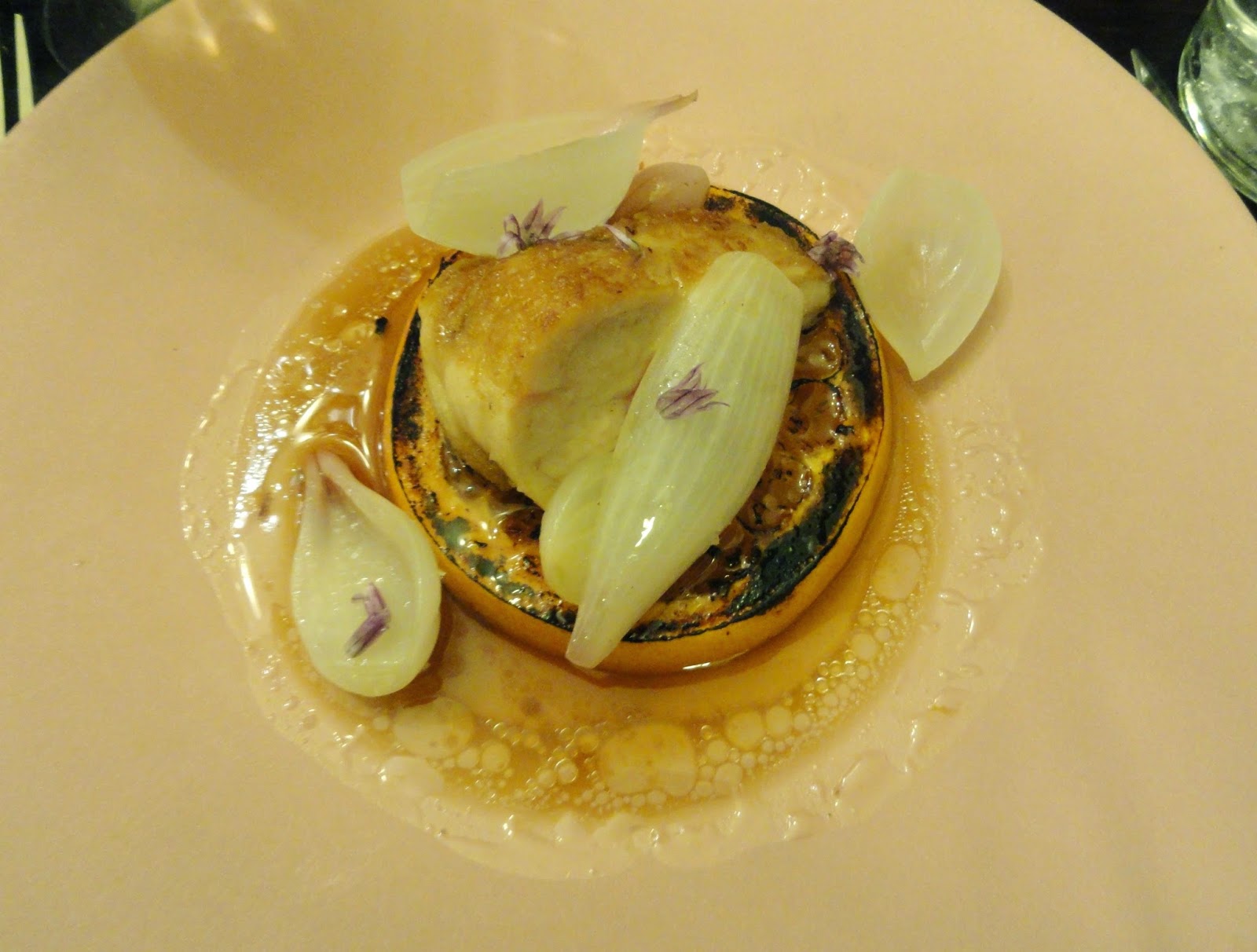
- Ris de veau, pampelmousse de Corse, tournesol: These were delicious and delicate sweetbreads on a bruleed grapefruit, with sunflower and long, elegant baby onions.
Cumieres (Chardonnay, pinot noir, pinot menier) Champagne 1st Cru George Laval


- Citron de Sicile, concombre, liveche: This was a sort of palate-cleansing entry into dessert, with Sicilian cedro (citron) granita, cucumber, and lovage (a citrus-scented green). Apparently I enjoyed it so much, and so quickly, that I didn't take a photo of it. Pardonnez-moi!
Biere Blanche Philomene

-Tocino del Cielo: We're back to this signature dessert dish of Aizpitarte's. And it's light and lovely and a cute visual/gustatory "trick" of sorts. It's a candied egg yolk atop a meringue egg shell with yolk "powder." It's barely sweet and delicious. (I could have used some chocolate, however. This is France, after all.)
Palo Cortado Fernando de Castilla
The egg dessert as it arrives at the table

The candied yolk is broken


And so our wonderful, interesting meal was over. My Parisian-dwelling friends have returned several times since then, and they're always guaranteed a dining experience unlike any other in the City of Light. That summer evening at Le Chateaubriand, we were quite happy to have enjoyed it together. Bisous mon ami!


LE CHATEAUBRIAND 129 Avenue Parmentier 75011
Paris, France
+33 1 43 57 4595
www.lechateaubriand.net


Thursday, July 3, 2014

The vlog: 4th of July Berry Mojito

July 4th is the perfect time to get exceedingly patriotic. And I do. I've made more all-American meals for clients than I can count, baked more red-white-and-blue cakes and pastries and tarts than I care to remember. And the 4th of July -- just an ordinary day for the Italians in Italy -- was always a favorite holiday of mine in Rome. I once gave myself an American flag pedicure for the occasion! Okay, maybe that was going a bit overboard. But it was the day we Americans could declare our American-ness, our patriotism, and our love for making fun of our beloved British friends. We got together for cookouts and pool parties, and ate hot dogs and hamburgers of our own making. And the drinks. Always, said the Italians, we knew how to make the most delicious cocktails. Of course, the mojito isn't exactly American. But anything and red (strawberries, raspberries), white (rum), and blue (blueberries) -- well, that qualifies. So here we have a "patriotic" berry mojito that's perfect for sharing with friends on July 4th, and throughout the heat of summer. The lime and fresh mint give the drink a zing and a refreshing bite that cut through the sugar and sweetness of the berries. Replace the rum with cachaça or vodka for a berry caipirinha or caipiroska, respectively -- a nod to the World Cup host country and a perfect drink to enjoy while viewing this exciting soccer tournament, live from Brazil.

Enjoy, and HAPPY FOURTH OF JULY!


Wednesday, July 2, 2014

QUICK BITE: Empanadas and Leche de Fruta, Quintero, Chile

Why does food -- and drink, for that matter -- always taste better when you're beachside? It's true. Think spaghetti alle vongole while overlooking the Mediterranean at a beach trattoria in Ostia. Or devouring a spicy green papaya salad purchased from a seaside cart in Krabi, Thailand. Or tucking into a rich shrimp moqueca while your toes are in the sand at a restaurant on the island of Morro de Sao Paolo in Brazil. I've done all of those things, and loved every minute of it. And somehow, the excitement of seaside snacking does not abate.
   
For instance, while most of the northeastern United States was suffering through a frigid first few weeks of the new year, I spent an afternoon in the Pacific Ocean-side town of Quintero, Chile, just about an hour north of Vina del Mar. It was a bit of an odd, popular place...sort of the Jones Beach of Chile, it seemed. And the locals we encountered there -- and we encountered only locals, as we were certainly the sole gringas on the beach that day -- seemed dressed more for an autumn outing in the park rather than the beach on an 82-degree afternoon in southern hemisphere summer. But no matter. We soaked up the sun and the beautiful natural surroundings of a cove we found, and then before getting a ride back to Vina, we indulged in a snack sold to us by a lovely older Chilean woman whose Spanish I was able to understand (Chilean Spanish is...challenging, I'll put it that way), and who was able to understand my Spanish in return. As a result, we enjoyed a frothy fresh mango juice and a couple of empanadas, one filled with fresh crab and cheese, the other with ground beef, onions, olives, and pine nuts, all wrapped up in a flaky pastry shell. This was the perfect snack to give us the energy to make it to dinner -- which was sure to be seaside, and to include at least one kind of ceviche. And since it was all consumed seaside, it was, of course, extra-delicious.