Wednesday, July 2, 2014

QUICK BITE: Empanadas and Leche de Fruta, Quintero, Chile

Why does food -- and drink, for that matter -- always taste better when you're beachside? It's true. Think spaghetti alle vongole while overlooking the Mediterranean at a beach trattoria in Ostia. Or devouring a spicy green papaya salad purchased from a seaside cart in Krabi, Thailand. Or tucking into a rich shrimp moqueca while your toes are in the sand at a restaurant on the island of Morro de Sao Paolo in Brazil. I've done all of those things, and loved every minute of it. And somehow, the excitement of seaside snacking does not abate.
   
For instance, while most of the northeastern United States was suffering through a frigid first few weeks of the new year, I spent an afternoon in the Pacific Ocean-side town of Quintero, Chile, just about an hour north of Vina del Mar. It was a bit of an odd, popular place...sort of the Jones Beach of Chile, it seemed. And the locals we encountered there -- and we encountered only locals, as we were certainly the sole gringas on the beach that day -- seemed dressed more for an autumn outing in the park rather than the beach on an 82-degree afternoon in southern hemisphere summer. But no matter. We soaked up the sun and the beautiful natural surroundings of a cove we found, and then before getting a ride back to Vina, we indulged in a snack sold to us by a lovely older Chilean woman whose Spanish I was able to understand (Chilean Spanish is...challenging, I'll put it that way), and who was able to understand my Spanish in return. As a result, we enjoyed a frothy fresh mango juice and a couple of empanadas, one filled with fresh crab and cheese, the other with ground beef, onions, olives, and pine nuts, all wrapped up in a flaky pastry shell. This was the perfect snack to give us the energy to make it to dinner -- which was sure to be seaside, and to include at least one kind of ceviche. And since it was all consumed seaside, it was, of course, extra-delicious.


Thursday, June 26, 2014

The vlog: Composed Salad for Summer

It's finally here! The first in a new series of instructional web cooking videos on the Blu Aubergine blog...that's right, the vlog! (Sounds Slavic, no?)...Well, it's here to guide you in delicious food prep with simple, easy-to-follow instructions for making various seasonal dishes.

First up: this summer composed salad. Like other famous composed salads (think Cobb, Nicoise, et al), these salads are composed of several ingredients other than greens -- usually a protein, a cheese, a fruit, a vegetable, and sometimes a nut or a grain. Most dressings can be whisked up in no time, but the dressing I make here has a spicy-sweet-sour base which requires a bit of cooking to infuse the flavor. I mention straining the ingredients after cooking, though I never actually do that in this video -- but the diced rhubarb, pepper, and garlic certainly don't detract from the salad. They may even enhance it. What kind of interesting combinations can you come up with for a delicious composed summer salad? The possibilities are endless...


As always, we welcome your comments and feedback. Enjoy, and buon appetito! 
 

Monday, June 16, 2014

HOLIDAYS: Father's Day


My Dad didn’t want a daughter. As the story goes, he said he wouldn’t be a good father to a girl. He couldn’t play ball with a girl, didn’t know how to talk to a girl. Wasn’t much for pink dresses and bows and ribbons and such. And then he said he saw me (a jaundiced lump of a thing), and held me (the largest of the newborns in my family), and it was love at first sight. And a foretelling start to our relationship. I am today and have always been what can only be described as a “Daddy’s Little Girl.” I’m the middle child sandwiched between two brothers, and they remind the whole family all the time of the hold they believe I have on my Dad’s heartstrings, repeating their favorite taunt of “whatever Dana wants, Dana gets.” While this is patently untrue, there's no denying the special bond that we share. My Dad has always told me how "delicious" I was as a baby in my little orange bathing suit (I'm wearing that famous suit in the photo above). And any time since then, when I've been sarcastic or snippy with him, he posits: "Where did that sweet little girl in the orange bathing suit go?" Even now, when I make a joke at his expense, or imitate my Dad -- which makes him cackle despite himself -- he wonders that same question. It's code for "when did you grow up so quickly?" and I think it's disarmingly sweet.

There's a lot of my Dad in me. I've got his long limbs and his gap-toothed smile, his skin coloring and his green eyes. And then some things are probably a hybrid: partly genetic but given a bump-up by learned behavior and emulation. Sarcasm and sense of humor? Check. An entrepreneurial sensibility? Yes. An ear for music and language? I think so. A friendliness and approachability that somehow attracts random strangers to ask for directions, or money, or even more bizarre requests? Indeed, people at home and even overseas seem to seek out both my father and me. My love of history and great storytelling (written or spoken) is an appreciation my father passed on to me. And certainly embracing my Jewish identity -- probably even more a cultural thing than a religious one -- my Dad really helped me with that, even when as a child, I struggled with it. When you're young, the last thing you want to be is different. My father taught me that not only is that okay, but it's a positive thing. Being different is being special, and what's better than that? It's a lesson and a conviction I've carried with me ever since.

I've got a lot of food memories involving my father, partly because my mother was the primary cook in the family, so on the less-frequent occasions on which my father cooked, his handful of "specialty items" were memorable. Often times on Friday nights, he would make a simple fried flounder, coated in breadcrumbs and pan-fried, with fried onions on top. I loved that dish. He also claimed to be the master of the omelette, which in reality was more of a protein pancake, with pastrami-and-eggs, ham-and-eggs, and salami-and-eggs as his Jewish deli-style specialties. This was his cure-all for pretty much anything that ailed us. And of course, though he didn't actually make the whole Saturday or Sunday morning spread, the process of procuring the best "bagels and lox" (a catch-all name for a variety of bagels, cream cheeses, and smoked fish) was something at which my Dad excelled, and still does.
I remember him bringing me along in the car to an appetizing store in Menlo Park, NJ as a little girl. All the guys in the shop knew him by name, but what stood out to me was the lone female among the smoked fish specialists, named Rita -- a sassy lady with short dark hair and a small mole on one cheek. She was so sweet to me, and always gave me a sample to taste the Nova lox she sliced paper-thin per my Dad's request. Then we'd go next door to the bagel shop to pick up a dozen warm, crusty bagels to go with the fish and cream cheese. The smell of that bagel bakery has haunted my senses since I was a young girl. So when my nose was caught off-guard one day, and I sniffed the exact same smell as that bagel bakery, more than 20 years later, I was surprised and giddy. It emanated from a famous forno (bread bakery) around the corner from my apartment, in the Jewish Ghetto, in Rome. I still adore that bakery, and I happily inhale as I walk past it when the ovens are on full-force, late in the afternoon or very early in the morning. To find pure childhood nostalgia, to be reminded of those father-daughter weekend morning treks -- in Rome of all places -- is pretty amazing.

And so, speaking of this Italian connection and the strong pull Italy has on me...it most likely has its roots with my father. He's a Jewish kid from Brooklyn, not Italian by heritage at all. And though Jewish and Italian cultures share a lot, especially the emphasis on family and food, it's more than that. My Dad always says he feels Italian. Maybe in another life, he was a peasant in the Italian countryside, he says. And: Francis Ford Coppola's "The Godfather" came out in 1972 -- not incidentally, I'm convinced, the year I was born. And ever since I was of a passable age to view the film, my father would watch it with me, almost coaching me on it. The significance of Sonny's outspokenness in front of his father, Michael's gutsy proposal to his Sicilian future father-in-law, Don Corleone's understanding that "it was Barzini all along"...it was like receiving a master class in mafia cinema. My Dad even gave a toast at one of my cousin's weddings in the manner of Luca Brasi! So imagine how thrilled I was when, a few years back, I was lucky enough to cook for the Godfather himself, Al Pacino. The irony of the actor (as kind and well-mannered as could be, by the way), suffering through a low-carb diet -- The Godfather, Il Padrino, unable to eat my pasta! -- was not lost on me, believe me. 

Nor is it lost on me that the one dish I grew up preparing together with my father turned out to be Pollo alla Romana. Of course, we called it "chicken with peppers, tomatoes, and onions" at the time. And my brothers still cringe at the thought of being force-fed this culinary creation that we thought we'd pretty much invented in the late '70s. My mother was more patient and accepting, as is her way. So she was quite game when I came home one summer while living in Rome, and my Dad and I decided to recreate this Sunday staple, but with a little more insight honed from my professional cooking career. I taught my father the finer points of knife skills and chicken-searing, and we all enjoyed a meal steeped in Italian flavor and nostalgia.
As a born chocoholic, the first dishes I prepared were sweets. My father taught me early on the importance of a perfect chocolate chip cookie, or a great chocolate cake, which I'd make for him with the help of my Mom. Dad often had these treats with milk (one word: "Milk'n'cake") as an evening snack between dinner and bedtime (not to mention his prolific consumption of Devil Dogs, Suzie Q’s, and anything containing chocolate that Drake or Hostess produced). As an adult, I've been able to steer my Dad's palate to a slightly more sophisticated chocolate dessert. My much-requested flourless chocolate cake uses so little sugar that even when I use Splenda instead (at my Dad's request), you can't taste the difference. It's pure chocolate decadence, something my Dad loves -- something I love, since the time I was Daddy's Little Girl in the orange bathing suit.

In Tel Aviv
With my parents in NYC
In the Scottish countryside

Friday, May 30, 2014

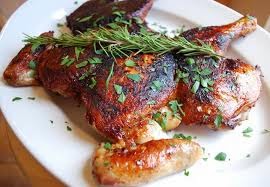
RECIPES: Pollo Al Mattone (Chicken Under a Brick)

Early summer is a great time for grilling -- either outdoors, where it's not too sweltering, or indoors in a grill pan, when the night may be a little too crisp for lingering outside. Either way, a great dish perfected by the Italians and beloved by everyone who enjoys a delicious, flavorful, juicy chicken dish (and who in their right mind doesn't -- vegetarians excluded, of course...though you really must know you're missing out)? Pollo Al Mattone, or chicken cooked under a brick, in English.

Most likely Etruscan in origin (there are frescoes depicting the cooking of this dish in ancient Etruscan tombs), this dish in modern times is very Tuscan: simply prepared, using a few top-quality ingredients, with rosemary and lemon as prominent flavorings. Italians in central Italy have mastered the art of grilling, and this method is a wonderful way to create a crisp, flavorful, charred skin while keeping the meat juicy on the inside.Opening the chicken up by removing its backbone allows the chicken to lay flat on the grill or grill pan. The flattening of the chicken allows for even cooking. You can find terra cotta weighted covers for grill pans both in the U.S. and in Italy, but it's just as easy to use the weight of a cast iron pan, or an actual brick to weigh down the chicken. (If the brick is not used specifically for cooking, you can wrap the brick in foil beforehand). Even better is placing a brick on top of a cast iron skillet to really weigh things down. Just make sure to place the "bricks" on the chicken from the very beginning of its cooking time to flatten it -- this is essential for even cooking and crisping the skin properly.
And don't be shy on the seasonings. Lots of salt and pepper, particularly on the skin side, will offer great payback at the end of cooking. I love to add lots of dried peperoncino (chili pepper) flakes to make the chicken spicy, which then makes the chicken dish Pollo alla Diavolo al Mattone. Once you flip the chicken to cook the other side, adding some rosemary and lemon is always a good idea. Other tasty additions would include fresh thyme, a little chopped garlic, and even more peperoncino. Brushing with a good, peppery Tuscan olive oil helps to keep the chicken moist.

Enjoy the cooking process by sipping a chilled Vernaccia di San Gimignano, the Tuscan white of choice, or try an Orvieto Bianco from nearby Umbria. Since Tuscany's wine production is 80% red, however, you could also match the smoky fire and spice of the diavolo with a hearty red like a Brunello di Montalcino, a Sangiovese (the grape comprises the majority of Chianti Classico wine), or a Morellino di Scansano, a lesser-known wine from Maremma in Southern Tuscany. Nibble on some prosciutto and salame toscana, and maybe some piave vecchio cheese and wait for your chicken to cook. Serve with some wilted greens or a salad of arugula and tomato with great olive oil and balsamic vinegar, and you have a fantastic, casual meal. This is the bella vita...and the start of summer!


POLLO AL MATTONE (Chicken Under a Brick)

Serves 2-4


1 whole chicken, 3-4 lbs.

fresh herbs – thyme, rosemary, and/or sage

Extra-virgin olive oil

Salt & pepper to taste

Peperoncino (optional)

1 lemon, cut into quarters


-          Preheat oven to 450 degrees F.

-          Wash the chicken and dry thoroughly.

-          On a cutting board, with the chicken facing breast side up, cut along either side of the backbone to remove it and open the chicken up. (Alternatively, have your butcher do this for you, so you can lay the chicken flat).

-           Rub the entire chicken with olive oil, even under the skin of the breasts. Fit herbs into the cavity and under the skin if you like. Sprinkle generously with salt and pepper (and peperoncino, if desired).

-          Put a heavy skillet, large enough to fit the chicken when opened flat, onto a burner on high for 3-4 minutes. Add a glug of olive oil to the pan and allow to heat for another 30 seconds.If using a grill, heat on high so it's searingly hot when meat touches the grate.

-          Place the chicken, skin side down, into the skillet (or on the grill). Cover with another skillet, as heavy as you can find, and then place a brick or heavy stone or piece of marble or granite on top to weigh it down. The idea is to flatten out the chicken as much as possible while it cooks.

-          Cook for approximately 15 minutes like this (you can turn the heat down to med-high if your stove burns hot).

-          Remove skillet and weights from the stove, still in place, and put into the preheated 450 oven, or on the grill, for approximately 10 more minutes.

-          Remove skillet and weights from oven/grill, take off weight/brick and top pan, and very carefully turn the chicken over in the skillet or on the grill.

-          Return to oven without anything on top, simply in the skillet, and cook for another 15 minutes to let the skin side continue to crisp up.

-          Remove from oven and let rest for 5-10 minutes outside of the oven or grill before carving. Serve with lemon quarters if you like.

Sunday, May 11, 2014

HOLIDAYS: Mother's Day

Being a mother, as the saying goes, is the hardest job in the world. But my Mom has always done it with such aplomb and such devotion to her kids and her family that she made it look almost -- almost -- easy. Since I can remember, my Mom spent a large portion of her time shuttling my brothers and me from school to activity to sport, to rehearsals and games and lessons and competitions. As grown adults, she's been our counselor and reference and moral compass, our confidante and friend. And as the only other female in our family of 5, my mother and I have had a special bond between us, planning girls' afternoons shopping or lunching, or nights at the ballet with just the two of us. I started ballet lessons at the ripe old age of 3, in part because my mother had studied throughout her youth and she thought I might love it too. (I did, and continued studying and performing dance over the course of 25 years).
Dance turned out to be one of the longest-standing and greatest loves of my life. But not only. I share much more than genes with my mother: my tendencies come both from chromosomes and from shared experiences. The part of me that enjoys chemistry and math, that's inborn, and that's my Mom. My love of art and culture and travel comes from exposure to these interests, from my parents. A nurturing nature and fascination with flora and fauna...a positive outlook and aesthetic appreciation and a love of travel to foreign places...a cackle of a laugh, and a devotion to mint chocolate chip ice cream...they're all aspects of me that I can trace back to my mother.

Then, there's what my Mom taught me about cooking. Or rather, about feeding people. I loved cooking from a very young age -- mostly baking. Desserts. I am still a devout chocoholic, and I love making sweet treats for myself and for others. There's something so personal and heartfelt about a beautiful birthday cake, for example. My Mom and I used to bake together about once a week, either over the weekend or after school, making chocolate chip cookies and fudge and cupcakes.
Her mother also had a sweet tooth, and was an excellent baker as well, so we were our own great audience and tasters. We loved baking. I remember some great dinner parties we'd host at our family home in New Jersey, and my mother always did all of the cooking from scratch. I loved to help her with this elevated dinner party fare, or for a family summer BBQ, or for a Thanksgiving feast. I remember sprinkling a chocolate glaze over a deep chocolate-mint dessert bar of some kind, thinking how elegant it was. I think I was 9 years old at the time. And so I learned not only about cooking, but about the joy that cooking for others can bring to families and friends. I learned from a young age how eating together brings people together, and I loved being able to have that positive effect on people. I found it intoxicating enough that I would one day make it my profession.

From a very young age, my Mom helped me to cultivate an interest in cooking, in culture, in nature, and in the plants and creatures that end up as our food. And so I thank my beautiful, sweet, intelligent, and loving mother for all that she's done for me, for our family, and for the many people whose lives she's touched over the decades. I thank her for her dedication and for her love. I thank her for letting me be my own person, even when I've taken paths in life she might not have taken, or made decisions she might not have wanted me to make for myself. I thank her for her support in all of my endeavors, for putting up with me when I was problematic or resisted her advice, and for giving me a shoulder to cry on when I needed it. And as much as anything else, I thank her for being my strong female role model.

I love cooking for my Mom now -- a little positive payback for all the meals she made for me over the years, all of those delicious grilled cheese sandwiches for lunch, tasty dinner dishes, and decadent desserts. I recently made my first attempt at sauerbraten, one of her favorite all-time dishes. I am not terribly familiar with the dish, nor with German food in general (her favorite), but I pulled together what I thought would be the best ideas from many different recipes, and tried to combine them to make one great meal. I sauteed mushrooms with roasted potatoes, and I cooked red cabbage in apple cider vinegar, herbs, and spices. I'm not sure if I succeeded with this foray into classic German home cooking, but my Mom certainly gobbled up the food...for 3 nights in a row. I think it tasted better because she knew it was made with love. The perfect dessert afterwards? A cup of mint chocolate chip ice cream. With two spoons.


Thursday, May 8, 2014

SEASONAL INGREDIENT: Watercress

I'm not a big fan of bitter. Bitter food, bitter drinks, bitter people: not my thing. Except for greens. I adore bitter greens in their many forms: from arugula to puntarelle, chard to endive to radicchio, they make me happy. I think I developed a palate for bitter greens with all my time spent living in Italy. Their bracing flavor can stand up to a powerful dressing or sauce, including the many versions of a "Caesar" dressing that are so often paired with crisp, bitter greens. A slick of olive oil, the bite of garlic and pepper, the salty, umami zing of parmigiano cheese, cut through by the acid of citrus juice or vinegar...well, I'll stop here. Because I want to name-drop my favorite of all bitter greens: watercress. It's not so much straight-up bitter as it is peppery, spicy. Perhaps that's why I adore it. And its versatility.


Spring is the perfect season for watercress and its varietals (try upland cress, sold still attached to its roots, and just snip and sprinkle into salads or over grilled fish or meat). It's so much more than a simple accompaniment for the classic English tea sandwiches of "egg and cress": egg salad bound with mayonnaise and spread on white bread, topped with watercress, and cut into crustless triangles. Don't get me wrong, these sandwiches have their place, and I adore them as part of a classic English high tea, or as cocktail nibbles at spring soirees. But watercress in a salad breathes life into an overused mesclun mix. I love the bite and plump crispy leaves when tossed with fresh herbs in a salad. I particularly love the salad pictured here, which I make with roasted butternut squash cubes, goat cheese OR gorgonzola, pumpkin seeds, and pomegranate arils. I like to bring it together with a sweet-tart pomegranate vinaigrette.  
One of my favorite dishes of one of my very favorite cuisines -- Vietnamese -- is shaking beef, a wonderful combination of vinegar- and soy-marinated beef fillet cubes cooked with onions and served on crispy watercress, which absorbs the sauce but doesn't wilt much (another benefit of this wonderful green). And speaking of benefits, watercress is an incredibly healthy green among greens, as well as among other fruits and vegetables. It boasts more calcium than milk, more vitamin C than an orange and more absorbable iron than spinach. It's rich in vitamins C, B1, B6, K, E, Iron, Calcium, Magnesium, Manganese, and Zinc. And it contains more potassium than apples, broccoli, and tomatoes. Not bad for a spring salad green!


Wednesday, April 23, 2014

QUICK BITE: CHEF, the movie


I love being a part of the food world, and I've always been a big film fan as well. Today I found myself at the crossroads of food and film at a screening of the soon-to-be-released movie, "Chef," starring, written and directed by local boy Jon Favreau. The film was screened as part of the Tribeca Film Festival last night here in New York, so Mr. Favreau was on hand after the screening today for a discussion and Q&A with Peter Travers of Rolling Stone magazine. The movie itself is a fun, realistic story about a chef in L.A. who's in a creative rut. Although he wants to break this rut with interesting, inspiring dishes, he still has to answer to "the man" -- as in the restaurant owner, played by Dustin Hoffman. New to social media and egged on by his kitchen staffers and his 10 year-old son, the chef joins the Twitterverse, which eventually takes a somewhat tragic turn (technology in the hands of the uninitiated!) as his rant against a hateful food critic goes viral. He eventually quits his job and decides to start a food truck, therefore feeding his soul as a chef, as it were. It's not a complicated conceit, and despite some prominent cast members, it's got an indie feel, harking back to Favreau's fabulous "Swingers" from the '90s. It's pleasant, and lighthearted, and anyone who's ever worked the back of house will recognize a lot of familiar sights, sounds, and situations throughout the film. Casting note: the kid who plays the chef's son in the movie, Emjay Anthony, is adorable, with real acting chops.

A few fun facts from behind the scenes? Roy Choi, LA's food truck king (and who happens to share a similar backstory to that of the chef in the movie), was the "trainer" chef on this film, demostrating to Favreau how to make his chef character physically, actively convincing. He worked in conjunction with the food stylist to make sure both the chefs' screen time, and the food shots, were realistic and enticing. To Favreau's credit, these scenes are gorgeous and really shot well. As a professional, watching the process, I could taste every ingredient and every dish as it was created and plated: truly mouth-watering kitchen visuals. Another fun fact is that actor Oliver Platt played the petulant critic with the make-or-break restaurant blog, a role with which he's somewhat familiar: his brother Adam is the food critic for New York Magazine.

CHEF hits theaters May 9th.

Trailer:
http://variety.com/2014/tv/news/jon-favreaus-chef-serves-up-first-trailer-1201153686/