Thursday, March 29, 2012

RECIPE: Spaghetti Aglio Olio Peperoncino

Italians excel at making something from nothing -- anzi, something great from nothing much. This is especially true when it comes to food, and the culinary embodiment of this magic is spaghetti aglio olio peperoncino.

This pasta is a standard go-to and a real comfort dish for Italians everywhere. The thinking is that at any given time, every Italian worth his or her salt in the kitchen has some garlic, olive oil, and dried chile pepper on hand. And pasta, of course.

It's comfort food because the flavors are the backbone of so many Italian dishes, and a standard because it's easy and quick. Years ago, when I'd been working at San Domenico New York for only a matter of weeks, I threw a holiday party with my roommates at our apartment. I invited my new amici from the kitchen, who showed up in a group after dinner service was over, some time after midnight. This arrival en masse didn't only give a jolt to the party (comments of the "where did all these hot Italian men come from??" variety were overheard). It also provided for late-night feeding. When the guests who remained into the wee hours got hungry again, after finishing off all of my cocktail party nibbles, the Italians came to the rescue. 

Exaggeration? Maybe a little...
All of a sudden, the ragazzi were in our kitchen, whipping out pots and pans, pasta and provisions. And somehow, in a flash, they were all shirtless as well! (perhaps they were not used to the stifling heat of Manhattan apartments in the winter?). And in seemingly the time it took to open another bottle of prosecco and fill glasses, we were all being served by lovely, topless Italian cooks, the perfume of browned garlic and spicy chile lingering in the air. Buon appetito! they announced. And silence fell on the crowd as everybody stuffed their faces appreciatively. Friends still remember that night fondly, noting that is was "one of the best pastas ever." Sometimes, simplicity rules. (And drunken hunger pangs help. As do sexy shirtless Italian men).
 
Garlic, olive oil, chile pepper, and pasta
So, the basic formula is this: Boil water. If using dried pasta, boil the pasta (if using fresh, throw the pasta into the water once you've already infused the oil). While it's cooking, you heat some olive oil, chopped garlic, and peperoncino in a pan. When the pasta is done cooking, toss it into the pan, add salt to taste, lots of chopped parsley if you have on hand, and there you have it. It's basic. The art of the dish is in the timing, the flourishes, the additions and modifications. 

I give the recipe as 'spaghetti', though the pasta could be any kind, keeping in mind that pasta lunga (long pasta) really is best. Fresh pasta works equally as well, as the tagliatelle in these photos will attest. I add parmigiano reggiano cheese when I have it on hand because I like it, but you can add any kind of grated cheese, or not, as you see fit. Same with the parsley, or any green herb (I've often thought that a handful of chives would add an interesting verdant, onion-y dimension to the dish). Once you get the timing down, and know enough not to burn the garlic and chile pepper, you can have fun with personalizing your very own version of aglio olio peperoncino. Topless Italian men optional.


SPAGHETTI AGLIO OLIO PEPERONCINO 
(4-6 people)

4 TBS. extra-virgin olive oil
2-3 garlic cloves, chopped up finely
Generous pinch of red pepper flakes (or whole peperoncino broken up)
Salt and pepper to taste
¼ cup finely chopped fresh flat leaf parsley
1 lb. spaghetti
1/2 cup grated parmigiano cheese

- Bring a large pot of water to a boil.
- Once the water comes to a rolling boil, add a generous couple of pinches of salt (the water should be briny, almost like seawater), and toss in the pasta and stir.
-After the pasta has been cooking for 6 minutes, heat a large skillet over medium heat, add the olive oil until warm, and then add the garlic and peperoncino, cooking until the garlic is barely browned, a minute or so.
- When the pasta is al dente, drain the pasta and add directly to the pan with the oil in it. Add salt and pepper to taste.
- Toss pasta to coat it with the oil mixture. Add the parsley and the cheese and stir until evenly distributed. Taste and adjust for salt. If the pasta is dry, add a little of the salted cooking water to the pan.
-Dig in!

Thursday, March 15, 2012

QUICK BITE: Spremuta di Melograno e Mandarino

The Campo de' Fiori market in Rome is a great place to come during the late morning and early afternoon. Not only can you do your produce shopping, order your favorite cuts of meat and game from the butcher, pick up some delicious cheeses and salumi, and get a slice of one of the best pizze bianche in the city, but you can also get a quick snack between meals. The variety of fruits and vegetables in the market, ready to be rinsed under the constantly-running Roman water spigots and eaten out of hand, is astounding -- and seasonal.
So when I was strolling through the market square one afternoon in January, my guys at the "Da Claudio" fruit and vegetable stand insisted that I try one of their fresh spremute, or fresh-squeezed juices. On offer for winter? Melograno e mandarino: Pomegranate juice and mandarin juice. My friend and I decided to try the two blended, which I highly recommend. It packs a vitamin C and antioxidant 1-2 wallop -- and it's incredibly delicious, sweet-tart, and the perfect way to beat the midwinter blues, even if spring is just around the corner...


Tuesday, March 6, 2012

RESTAURANT REVIEW: Grano -- Rome, Italy

Fresh from the process of updating and rewriting the Where to Eat section of the Fodor's Rome Guide 2012, I thought I'd post an expanded and modified (and personalized) review of one of the restaurants I added to the section this year.

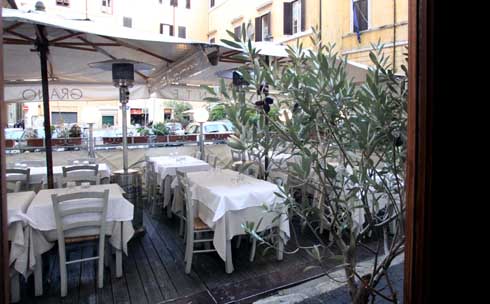
GRANO is a contemporary trattoria in a charming piazza around the corner from the Pantheon. Aesthetically, the white walls covered, in parts, with colorful children's drawings, give the main dining room the look of a postmodern architectural schoolhouse. 
The smaller, second dining room with the addition of bookshelves, seems the school's library. And the outdoor deck with large white umbrellas and numerous tables would, in this metaphor, be the playground. On the whole, Grano is a light and lively restaurant, serving tasty food, at not-too-steep prices, to a mostly local crowd. All good things.


Mozzarella and Alici
The kitchen is not quite chemistry lab, but it does turn out re-invented versions of Italian dishes, both Roman and from other regions up and down the Italian peninsula. For starters, the polpette di brasato con salsa verde are smallish meatballs of the famous piemontese wine-braised beef, here pulled, breaded, and deep fried, served on a slick of bracing green sauce. It's unusual and delicious. And for traditionalists, there are portions of pristine mozzarella di bufala and marinated anchovies served simply on a few leaves of arugula with a drizzle of extra-virgin olive oil. 
Polpo on Orzo Perlato
A delicious tweak of a Sicilian classic is the octopus antipasto (which could also be a primo): instead of pairing it with chickpeas or canellini beans as is the practice, a grilled baby octopus is placed atop a mound of orzo perlato, a grain -- not the pasta version of orzo -- with a bite that matches the chew of Sicilian polpo (octopus), here rendered tender by a braise before being grilled. The primi here are often standouts, including, when available, a pasta with tiny baby clams paired with asparagi di mare, know in English as sea beans. This is a delicious, fresh-tasting combination that encapsulates the brininess of the sea in every bite. 

Ditalini
Breaded Calamari
Also looking southward -- this time Campania -- is the simple pasta dish of tiny ditalini with a vegetarian "ragu" of sundried tomatoes, Gaeta olives, mozzarella, and basil. As for secondi, they're often less interesting. Porchetta (roasted suckling pig) with rosemary potatoes should be called 'porchetta...che peccato' (what a shame) because serving a so-so version of what can be one of The Greatest Things To Eat On This Planet is a sin. Ditto the tuna with caponatina: Sicily has some of the most prized fresh tuna on the planet, and caponata is one of the world's great traditional vegetable dishes (trumps ratatouille ANY day). Italians now need to learn how to cook said tuna, and Roman chefs could use some schooling in the ways of making sweet-and-sour eggplant-veggie-heaven the way it's meant to be made. Still, the breaded calamari is perfectly good, and with a side of broccoli or sauteed chicory, it makes a tasty main course.


Desserts here are relatively delicious, even though they don't stray far from Italian standards like tiramisu'. But the atmosphere is so pleasant, it's worth poring over the wine list to find a dessert wine or digestivo you can enjoy with your dining mates. A limoncello, or an amaro, perhaps? I liked the setting so much that I chose to have a recent birthday dinner here, surrounded by a dozen or so dear friends. We lounged and lingered, we ate, drank, and were merry.

And my lovely friends showered me with wine and prosecco and limoncello (my holy trinity?), and lots of gorgeous gifts, like the handmade earrings of breathtaking bronze freshwater pearls and jet I'm modeling in the photo below. And when all was said and done, they managed to find a tasty chocolate dessert into which they lodged a candle. I made my birthday wish -- and although it's bad luck to divulge that wish, I can say that it involves a lot more good food, great friends, and delicious fun in the future.


RISTORANTE GRANO
Piazza Rondanini 53
Roma 00186
+39 (06) 681 92 096
www.ristorantegrano.it

Tuesday, February 21, 2012

HOLIDAYS: Carnevale a Roma

Today is Fat Tuesday, or Martedi Grasso, in Italian. And while Venice is famous worldwide for its traditional pre-Lenten celebration, 18th Century masked balls and all -- well, Rome has left most of its traditions in the past, save, of course, for the edible ones. Romans love their food, and what would Carnevale time be in Rome without its fried sweet treats?

They go by many names around the Italian peninsula, but in Rome, they're called frappe: strips of dough, deep fried, and dusted with powdered sugar. The best bakeries have so much turnover that you can manage to get the frappe still warm, when the sugar melts a bit to form an impromptu glaze. Eating them right out of the paper bag is what it's all about. Another Carnevale time treat is the castagnola, basically what Americans call a "munchkin" or donut hole. In Italy, tDunkin Donuts evaporated when the man running the franchise, er, took the money and ran. So no "munchkins" here. These treats are known as castagnole because they're about the size of a chestnut, or castagna. (And they definitely pre-date Dunkin!). They too are fried balls of dough covered in sugar, with a soft cake center. And they're delicious. But to my mind, the frappe are 'where it's at.' Light, crisp, ethereal. And it seems wherever I lived in Rome, I had great versions nearby. All my years in Largo Arenula, I had jonly to trot down Via Giubbonari, to hit either (or both) Roscioli, and/or the Forno in Campo dei Fiori. With all the time I spent at Stardust in Trastevere, we were just a case of the munchies away from Forno Renella on Via del Moro, famous all over the city for the noteworthy crust on its filone, its loaves of almost-charred bread.  Their frappe were thick and crunchy.
And there was that one month, that one random, in-transition month I spent on Via della Luce, on the quieter side of Trastevere, before my apartment in the Ghetto was ready for me...that month during February and March, juuuust about the time of Carnevale, when I lived across the street from the Biscottificio Innocenti. This cookie factory taunted me day and night with the wafting scent of its treats baking inside, its treats including seasonal goodies, its treats that...well, they were for sale to the public. And who better to share the love and to support the enterprise than neighbors?!

Ah, Carnevale. Carnevale in Rome: lots of memories. There were some great costume parties, because this is the time of year that Italians really get into "fancy dress," as the Brits call it. Halloween is still a relatively new holiday for Italians, and they're convinced that it's only for dressing as ghosts, witches, and scary monsters. So carnevale always brought out the variety and creativity of dressing up, even in adults. The standard masked and wigged revelers influenced by Venice still exist, sure. But I remember a particularly fun and pretty wild party at Supper Club, near the Pantheon, one year. And I also remember a great party at my friends' place near chiesa nuova -- they'd just moved in, Monica and Lorraine, and so the apartment was fairly furniture-free and just begging for a christening-of-sorts -- so the party was last-minute. Which meant we all had to throw together last-minute costumes. 

My roommate Leah was Miss America, my friend Elizabeth threw on a biker jacket and lots of small black leather items and a blonde wig: biker chick. And I was able to make a fairly convincing Native American getup with brown and tan leather pieces -- threw on some turquoise jewelry and braided my hair and via! Pocahontas. My friend Gareth had the hilarious last-minute idea of coming as Lee Marvin. He simply wore a suit and used a bit of scotch tape to tape up his nose to look like Marvin's. That was a big hit. So was the fact that one of the hostesses of the party was, at that time, dating an Italian guy who was a mime in Piazza Navona. As in, that was his job. He came to the party when he got off work, and everyone complimented him on his very convincing costume. He was confused. We loved it -- and it was a great party!

Buon Carnevale a Tutti! Happy Carnevale, Carnival, Mardi Gras...whatever you're celebrating tonight!

Tuesday, January 17, 2012

LOCAL INGREDIENT: Puntarelle

In many ways, it's the essence of Italian Food: it's seasonal, it's hyper-local, and it's a great use of a vegetable that may otherwise go unused, uneaten, and unappreciated. Puntarelle.

Its season begins as the cold weather descends upon the center of the Italian peninsula, and puntarelle usually don't last much beyond the winter months. Puntarelle means "little tips" in Italian -- these are the tender bottom ends of a specific variety of cicoria, or chicory. Cicoria is a bitter leafy green usually par-boiled and either served cold with lemon or sauteed in olive oil with garlic and chile pepper. It's ubiquitous in Rome, much like sauteed spinach is in Florence. But in the winter months, roughly November to March, Romans focus on the puntarelle, the stems of the chicory plant which are cleaned of any leaves, sliced lengthwise in thin strips, and soaked in cold water until they curl up. 

You'll see older Roman women and men in the markets of Rome working with great dexterity over a bucket of water, peeling and slicing the puntarelle so that customers can buy them already cleaned and ready to use. Much like the beloved Roman artichokes, puntarelle are a labor-intensive labor of love. 

When making puntarelle, one begins with the dressing: an unctuous vinaigrette flavored with ground anchovies, fresh garlic, lemon, and wine vinegar, with a healthy glug-glug of top quality extra-virgin olive oil and salt and pepper to taste. Then you mix this in with the cleaned puntarelle, and let it sit for 30 minutes or so. And then? Magic. The greens stay crispy, yet they absorb the flavor of the dressing, which you'll want to sop up with bread after you clean your dish of the greens.

It's a very old Roman recipe -- to my mind, probably assimilated into the Roman culinary canon from the city's Jewish community, because of its telltale use of anchovies (Jewish Romans often used {kosher} anchovies where Roman Catholics would use  guanciale, or cured pork cheek, as a salty flavor base in a recipe). The cool thing about puntarelle? It's a super-extra-totally Roman vegetable, so even people in nearby areas like Abruzzo, Tuscany, and Le Marche don't get to enjoy the bitter-savory winter contorno

It's really the original Caesar salad, in a way -- and actually from the land of the Caesars.

When in Rome? Head to the Campo de' Fiori market where you can purchase the greens and all the ingredients to make the salad at home. Then head to the famous Forno at the top of the piazza for some warm pizza bianca fresh out of the oven, to accompany the dish. 
If you're lucky, the Forno's sandwich shop, right across the tiny vicolo from the bakery, will be serving Pizza con le Puntarelle: a fabulous sandwich of the pizza bianca stuffed with puntarelle salad. Crunchy, chewy, warm, cool, salty, bitter, with the astringent zip of lemon and garlic...it's a heavenly Roman winter sandwich sure to make anyone a very happy campo-er.

When Rome is not your home? Puntarelle are, as noted, extremely local, though I have been lucky enough to stumble upon a special of puntarelle salad one cold winter night in New York, at the authentic and always-excellent Bar Pitti. When I asked the waiter in Italian where he'd managed to find puntarelle, he responded very simply, "eh, signora: dall'Italia. Ovviamente." From Italy. Obviously.


Puntarelle alla Romana
If you're not one of the lucky few who can get his or her hands on the real deal, you can approximate the texture and bitterness of the puntarelle by thinly slicing a mixture of celery and belgian endive lengthwise, then putting those slices in ice water so they curl a bit. Then mix with the dressing as you would the puntarelle. As with Caesar salad fans, you have those who like it heavy on the anchovies, and those who prefer a less fishy flavor. I think there should be a nice balance of flavor -- using the anchovy liberally, but mashed well, will give the dressing its best consistency.

8 oz. washed & dried puntarelle (sliced chicory stems curled in cold water)

1 clove garlic

1 lemon, for juicing

6 TBS. extra-virgin olive oil

1 TBS. red wine vinegar

1-2 anchovy fillets

salt & pepper to taste


- In a salad bowl, rub the garlic clove over the surface of the bowl and then with the tines of a fork, crush it a bit.


- Add the anchovy fillets and crush them with the fork as well.


- Squeeze the lemon juice over the garlic and anchovies, add the vinegar, and muddle the ingredients so they form a paste.


- Using the fork – or even better, a small whisk – add the olive oil in a thin stream until a vinaigrette forms. 


- Add salt and pepper to taste, or more oil if necessary. Toss puntarelle in vinaigrette and serve.

Tuesday, November 29, 2011

HOLIDAYS: The First Thanksgiving...in Rome

For the length of my adult life, Thanksgiving has been my favorite holiday. Not burdened with religious associations or the need for gift-giving (and spending), this is a holiday about food, loved ones, and celebrating American tradition.

In college, it meant coming home to see family and friends, and there were always tons of social happenings and great food to enjoy. Post-college, living in New York City, it was more of the same -- sometimes fewer friends coming back to our hometown, but lots of family, food and so many of those closest to me. Then I moved to Rome. Suddenly, I was living in a country where the fourth Thursday in November was not a holiday. Where even my English-speaking friends weren't all American. Where I had to take the day off to celebrate. 

So that first year living in Rome, in 2000, take the day off I did! I was working in a restaurant called Le Bain (French-sounding name, but Italian food....with sushi. Italians trying to be progressive. A story for another place and time). I'd had the idea to host, along with my American roommate Leah, the first official Roman Thanksgiving among our group of friends -- expats, many of them. We didn't invite Italian friends. We invited some Brits and a Canadian for good measure, however (and to show them -- show off, really -- what an American feast looked like). And so we got to planning what was a wonderful joint effort and coming-together of American ingenuity in a land where finding Thanksgiving essentials we usually took for granted (cranberries, pecans, sweet potatoes...and even, well, whole turkeys!) were difficult to come by. What a project. And what a blast!

And so there were trips to the various markets around the city, Campo de' Fiori being the most central and one of the largest (and most expensive!). The stall that would become my second home in the market, Da Claudio, would order "strange foreign ingredients" for me upon request in subsequent years -- I like to think the reason Rome now has access to fresh cranberries, American sweet potatoes, and butternut squash is thanks to my long discussions and litigation with the guys about availability and seasonality and what we need for our American feasts. But this year, this first year, I didn't know enough to order these things in advance, and I wasn't yet established as a chef in the city. So, Castroni was our fallback for a lot of things. This mythical international food store has so much great product, and you pay through the nose for it. But it's worth it. A good meal always is. And no one understands that line of thinking better than the Italians.

I remember the morning of Thanksgiving: it was pretty chilly that year, especially since in subsequent years in Rome, I remember wearing a t-shirt to run last-minute errands. The only way to procure a whole turkey in Rome is to order one well in advance, and I'd ordered one from a trusted butcher shop in Trastevere, who delivered as well. They knocked on my door early in the morning with a 6 kilo bird (15 pounds, which I worried wouldn't be big enough. How quickly I learned that in Rome, the turkey is only the meal's centerpiece in name!). And it still had some feathers intact for me to pluck off, oh joy! 

Once that turkey was safely in my fridge, I called my friend Patrick back to tell him I was ready to be picked up. He'd called me extremely early that morning -- he always had to get up early to open his laundromat -- and when I'd answered my cell groggily (I worked until after midnight at the restaurant the night before), he sang in my ear: "goooooood....mornin', good MOR-nin'!", the song from Singin' in the Rain, which of course also includes a "buon giorno!" This became our go-to song to sing into each other's ears, either over the phone or in-person, when we wanted to annoy each other in a very goofy way. So, Patrick swung by on his scooter and we were off on a run for plates, cups, and flatware, etc. He knew of a place in Monteverde that had some such colorful items, and we laughed and sang "Good Mornin'" the whole ride to the store and back. 
Our friend Elizabeth, whose sister is a florist in Chicago (and who knows a thing or two about flower arranging herself) helped with the table setting too. And finally, around 7 or so, everyone started showing up. Remember, this is not a holiday in Rome and some guests were coming straight from the office.

We had some American friends visiting among our group, including my older brother. We decided the best way to cobble together a feast would be to dole out food responsibilities to every guest, initiating what would become our tradition: everyone brings a dish (or is assigned one), a bottle of wine, and a small monetary contribution to defray the costs of table settings and flowers and the like. This worked out incredibly well, as everyone participated.
Me proudly holding my first Roman tacchino, 2000

I took care of the turkey, mashed potatoes, gravy, cranberry sauce, and 2 kinds of stuffing, along with several desserts: Leah and I each took a stuffing and if I remember correctly, she made a brown sugar cake while I made a chocolate swirl cheesecake and either an apple pie or a chocolate pecan pie. Maybe all 3. Friends brought salad, vegetable sides like carrots and sweet potatoes and broccoli and zucchine and of course Martin's favorite, creamed corn (he's from Iowa). 

November and December in Italy means novello, the young red wine that's meant to be consumed un-aged (many people know the French version, beaujolais nouveaux), which happens to go well with turkey and all the trimmings. We seemed to have endless bottles of it, certainly more than one per person. And I believe we consumed all of it! 


It was quite the festive evening: relaxing and warm and delicious, and all the more rewarding for the fact that we were able to pull together and recreate our personal versions of Thanksgiving together, as old and new friends gathered around a table in our adopted home, The Eternal City.
I hope everyone had a buon giorno di ringraziamento...Happy Thanksgiving!

Monday, October 31, 2011

Cheese from the Goat Farm & "Toscumbrian" Feasts

It took her a while to discover it, but since she has, my friend Laurie has been a regular at Val di Mezzo, the goat farm in Anghiari, Tuscany owned by a Michigan native named Brent. It's close to the Umbrian border and its small town of Lippiano, where Laurie has a country house. This is a gorgeous and less-discovered area of 2 famous neighboring Italian regions. And though Chianti in Tuscany, and Orvieto and Perugia in Umbria, are amazing places...well, there's something really nice about being somewhere that feels distinctly more local

I hadn't been to Laurie's in several years, as we seemed to have just missed each other in Italy the past few seasons. Late September and early October this year, however, we finally got our timing right. I headed up to what I call "Toscumbria" (the Tuscany/Umbria border area where one fades into the other almost seamlessly, then back again), with some friends from Rome. It was still very much late summer in central Italy, with warm sunny days and nights that were just cool enough to warrant a sweater or jacket. Laurie's fig tree on the sloping hill alongside her house was still heavy with ripe fruit, and the wild lavender alongside it still perfumed the air. She'd wanted me to visit Brent's goat farm and I really wanted to see what this American was stirring up in the Italian countryside. So we went.
As it turned out, Brent had just departed for the U.S. for a few weeks, but his helpful dairy farm hand led us around and gave us a tour of the place. Most of the goats are female, of course, and many had given birth in the spring. Others were pregnant (a handful of studly male goats were loudly 'bahhh'-ing in a nearby pen). All were happy to see us and really took to Laurie's visit inside their pen just before feeding time.


We met a nice family that runs a farm west of Charlottesville, Virginia (town of my alma mater, UVa. -- the husband was actually a graduate of their masters program in poetry. Small world!). They were there learning the ropes: Italian cheesemaking combined with innovative American touches, to produce some traditional local cheeses as well as some interesting twists of Brent's own invention.
A tasting allowed us to try different versions and ages of goat milk cheeses. They were all delicious, and we bought lots of it: the Italian caciotta, a feta-like caprino (goat cheese) best for grating, a goat cheese aged in ashes made of local herbs like rosemary and lavender, and one wrapped in chestnut leaves.

When we got back to Laurie's house, We picked a handful of fresh figs from her tree, their insides a deep, brilliant crimson, and I made a fig-peperoncino jam to accompany the caciotta. It was a delicious end to a "Tuscumbrian" meal that we made in her kitchen: a meal for which we spent the day gathering local ingredients. 
Dinner -- particularly that local caciotta and homemade fig-peperoncino jam -- truly tasted like Umbria, like Tuscany, like our home away from home.