Friday, October 14, 2011

RECIPE: Pollo alla Romana...and Giallorosso

Alla Romana means 'Roman style', and there are plenty of food preparations, from pastas to tripe, that are Roman style. It means something different in each iteration, though the most alla Romana of any dish out there, to my mind, is Pollo alla Romana. Why? Because it's giallorosso, of course! This refers to the colors of the dish, yellow (giallo) and red (rosso) -- but it's also a reference to La Roma, or AS Roma, the Eternal City's beloved soccer team.

Fans of AS Roma are called Romanisti, or giallorossi, after the team's official colors. Technically, there is another team for Rome and the whole region in which Rome is located: Lazio. But to most locals who live in the city, to suggest that they are Laziale is to call them traitors, even fascists. The commonly-held view is that AS Roma is Roman to its core, founded in the popular neighborhood of Testaccio in 1927, and followed by the locals with an amazing dedication and ferocity, despite the fact that they've only won the scudetto (the Italian soccer championship) 3 times in the team's history. I was lucky enough to be privy to one of those wins, June 17th, 2001. 
Hometown hero and world-class player Francesco Totti helped lead his beloved team to victory, and I can honestly say I've never seen quite a celebration of a sports victory in any city, ever. (Yes, I've seen the Yankees win the World Series in New York, the Giants win the Superbowl. I was even in Rome when Italy won the World Cup in 2006 -- the only time I saw a celebration comparable to Roma winning the '01 scudetto).
The fact that one of my all-time favorite players, Argentina's Batistuta (mmm...Bat-i-stu-ta), led ROMA to victory alongside Totti, made it that much sweeter! Red and yellow flags and confetti were everywhere, car horns honked nonstop, literally for days on end. The bars stayed open into the wee hours that night. The following week, Rome hosted a huge concert at the Circo Massimo in honor of their home team's glorious win, where an estimated one million fans came to celebrate the victorious team. People were hanging from the ruins of the Palatine Hill to get a view! I remember it like it was yesterday: Antonello Venditti sang what's considered the soccer team's anthem, "Grazie Roma" with Italian beauty Sabrina Ferilli parading on stage (she'd promised to strut naked in Circo Massimo if Roma won -- which didn't happen, though she is wearing next to nothing!). http://www.youtube.com/watch?v=mXVFbVtkopg
 ...It was the kind of celebration, grande festa, that happens once in a lifetime. Forza giallorossi!... https://www.youtube.com/watch?v=IidgnZ3lR2c 

I've always say that Italians are fiercely loyal to three things: town, team, and table (in no particular order). With AS Roma, town and team go hand-in-hand. Pollo alla Romana, a gorgeous stew of chicken with red and yellow peppers, tomatoes, onions, and a bit of peperoncino and vinegar for kick, is the perfect representation of table, of i romani sul piatto (Romans on a plate): colorful, bold, a bit spicy, a bit acido. Not timid. But also comforting. And with late summer lingering, the peppers in this dish are still very much at their peak. Try to find a free-range chicken raised without antibiotics, to approximate what the best Roman home cooks would use (possibly even from their own land outside the Roman city walls).
Enjoy, and forza Roma!

Pollo alla Romana
-->
Serves 2-4
1 whole chicken, cut into pieces
4 peppers, red and yellow, sliced into 2-inch-long, ½-inch-wide slices
2 small onions, sliced thinly into half-moons
4 fresh plum tomatoes, or a small can of whole peeled San Marzanos, chopped
1 clove garlic
¾ cup white wine
½ cup chicken broth (optional)
¼ cup red wine vinegar
Extra-virgin olive oil
Salt + pepper to taste
Sprig of rosemary (optional)
Peperoncino (flakes are fine), a healthy pinch

- Wash the chicken and dry thoroughly, leaving it out to reach room temp (this allows it to crisp better).
- In a heavy-bottomed sauté pan or skillet, heat enough olive oil to cover the bottom of the pan. After 30 seconds, add the garlic clove and cook until fragrant and starting to brown.
- Sprinkle the chicken pieces with salt & pepper just before they go into the pan. Brown them on both sides, and remove from pan when browned. Work in batches if you need to so as not to crowd the pan.
- Add a bit more olive oil to the pan and sauté the onion and the peppers until they begin to soften, about 5 minutes.
- Add the white wine and vinegar to “deglaze” the pan, scraping up all the browned bits from the chicken that were stuck to the bottom. Cook another 2-3 minutes.
- Add the tomatoes, breaking them up, stirring. Add a sprinkle of salt and cook for another 5-7minutes.
- Add the chicken to the pan, plus rosemary and/or peperoncino if desired, and cover and cook for 10 minutes.
- Lift the cover and stir the chicken in with the peppers and onions so it’s no longer sitting on top of them. Cook another 30 minutes, checking occasionally, and adding some chicken broth or water if it gets too dry. Salt to taste. When done cooking, remove cover and serve immediately…although this dish is great heated up the next day after the flavors have had 24 hours to “meld” together.
* In Photo: Pollo alla Romana served with oven-roasted fingerling potatoes and grilled asparagus. Buona Cena!

Thursday, September 29, 2011

ESCAPES: Isola di Ponza, Italy -- Part I

Shhhhh. Don't let the word get out. Ponza, an island escape off the Mediterranean coast between Rome and Naples is a hidden gem -- at least as far as foreign tourists go. And we who've enjoyed the island for years for its unique natural beauty, its bountiful fresh seafood and local vegetables, its impossibly clean aqua waters, its open-air bars and restaurants with jawdropping views, its cute shops open until late...well, we'd like to keep it somewhat hidden. Here, wandering the steep and winding streets, one hears almost exclusively Italian, with its various dialects, Neapolitan and Roman being the most pronounced. And this is refreshing in Italy, a country with so many gorgeous and enchanting spots that seem to have been discovered and sometimes overtaken by foreign tourists.

And what an enchanting and gorgeous spot it is. Ponza is one of the group of isole pontine, and along with its nearby sister island, Palmarola, offers some of the most beautiful landscape off the coast of the Italian peninsula.
Palmarola isn't really an inhabited island, but you can take giri (tours) around the island by day, stopping for swims along the way. There are plenty of places to drop your anchor, countless gorgeous coves and charming spots to share with other visitors, or in which to find oneself alone, in pace. Those arriving in sailboats can even stay the night in one of these beautiful coves, and wake up in the morning to an invigorating swim in crystalline waters teeming with tiny fish. On Palmarola, there are also a couple of lunch spots that serve up the fresh catch of the day, and do excellent pastas and specialty items. We indulged in a local zucchine in scapece (sauteed and cured in vinegar, garlic, and a bit of peperoncino), and an insalata di polpo, fresh-caught octopus salad, a classic antipasto from Italy's central coast on down to Sicily.

The Chiaia di Luna beach is a stunning stop-off, with various grottoes and a vista from the water where you can take in the vertiginous limestone cliffs that drop down into the sandy beach below. The sapphire water that meets the white cliffs offers a truly stunning juxtaposition of color and light.

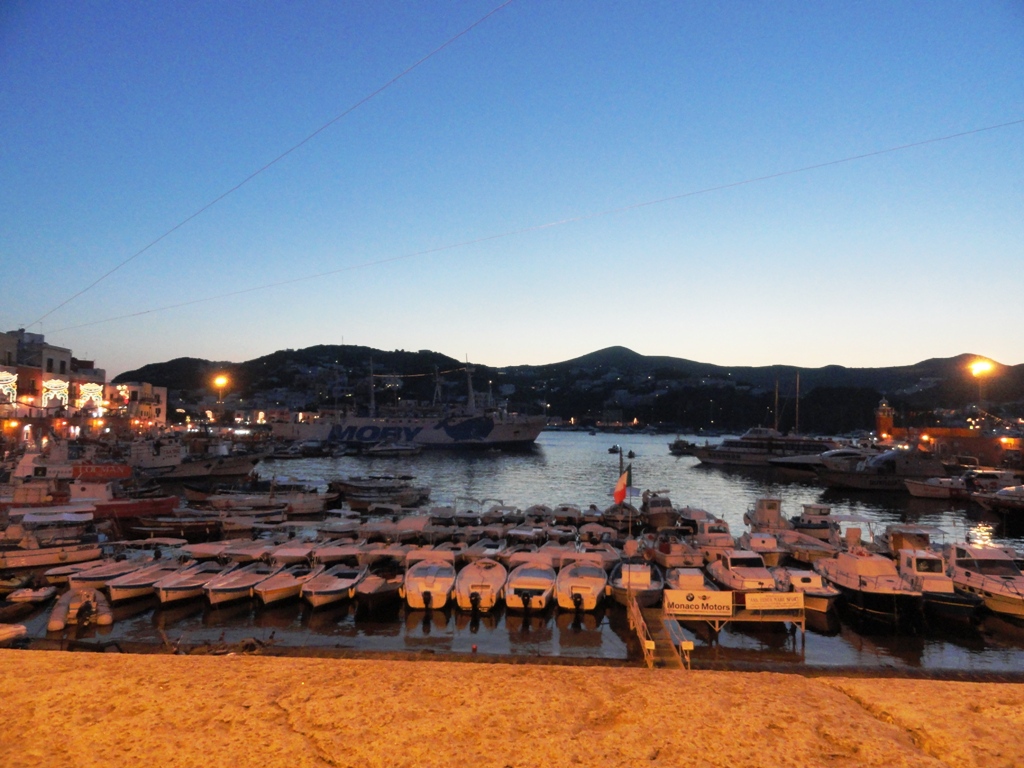
When returning from an island boat trip, the thing to do is to share aperitivi with friends in the main piazza overlooking Ponza's harbor. Italian pre-dinner drinks, like the classic spritz, or any variation on alcohol or soda with a bitter like Campari or Aperol, are a must. The scene at our favorite, Bar Tripoli, is always lively -- and you're sure to make new friends with vacationing neighbors, sailors, and various ponzese (Ponza locals) as colorful as their island houses. Plus, the view at dusk is hard to beat.


Tuesday, September 6, 2011

RECIPE: Sano e Semplice, Fish Fillet

So many people I speak with -- clients, students, friends -- tell me they're afraid of cooking fish. Everyone seems to think that because a fillet of white fish is relatively delicate, it's a complicated task to prepare. Not so. A white, flaky fish fillet (and not canned tuna!) is, to my mind, the chicken of the sea: everybody likes it, and you can almost always find some variety of white fish where you purchase fresh seafood, filleted and ready to be cooked and eaten. The local catch varies from place to place, of course, and in many cultures, fish is usually sold whole. This is not to save the fishmonger the work of filleting the fish, but more for the discerning customer who wants to judge the freshness of the fish by checking to see that its eyes are clear, and that the fish's gills are a rosy red. But in the U.S., whole fish can be hard to come by. Seafood shops resemble sushi counters, with a variety of already-filleted specimens arranged on ice for the customer to select. Here, since you can't look the fish in the eyes, it becomes important that you trust that your fishmonger is getting in a constant supply of fresh fish.

But regardless of where you are on the globe, how you buy your fish, or what your local catch may be, you can always whip up a healthy, fresh fish meal in about 30 minutes. Recently, I found a gorgeous fillet of locally-caught wild blackfish. I wanted a light, healthy meal for a warm September evening. I often plan my plates using color as a guide -- a surefire way to pair foods containing a variety of vitamins and minerals -- so here I accompanied the fish fillet with diced oven roasted sweet potato and fresh snap peas. The result is a dinner plate filled with a riot of eye-catching color, and great flavor. Since it's easy to prepare a pan sauce after cooking the fillet, I decided to make use of a fresh lime and some sauvignon blanc I had on hand.

This recipe is for one; it can easily be multiplied for any number of guests you may have.

You'll need:
*Fillet of white flaky fish: any fresh catch will do, from sea bass to snapper to flounder and anything in between. 6-8 ounces per serving.
*Sweet potato or yam
*Handful of snap peas
*1 lime or lemon
*1/4 cup crisp white wine
*dash of white balsamic or rice wine vinegar
*good quality olive oil
*pat of butter
*salt and pepper
*Sriracha sauce (if you like a bit of a kick)

- Preheat an oven to 350 degrees farenheit/175 celsius. Scrub a sweet potato or yam clean under running water. I left the skin on. You can peel it if you like. Cut the potato into 1/2 inch dice, sprinke with salt and pepper, and toss with a dash of good quality olive oil. Arrange on a baking sheet and bake, tossing occasionally, for about 30 minutes, until the pieces are cooked through and lightly browned.

- In the meantime, bring a small pot of water to boil. Clean the snap peas (a handful per person) by pulling off the stringy membrane on the flat side of the pod. When the water is boiling, add a healthy pinch of salt. Toss the snap peas into the water and cook for 2-3 minutes. Drain the snap peas and dump them immediately into ice water to stop the cooking. Once completely cooled, drain.

- Heat a nonstick saute pan over medium-high heat. Drizzle a glug of good quality olive oil in the pan. Heat until it shimmers a bit and tilt the pan so the whole surface is covered in the oil. Sprinkle the dry surface of the fish fillet with salt and pepper, and place skin side up in the pan. Do not touch the fillet for at least 3 minutes. This is important: when cooking delicate white fish, patience is a virtue!
Sprinkle the skin side with salt and pepper, and shake the pan a bit -- when the first side is done cooking, the fillet should shake free from the surface of the pan. With a fish spatula, gently flip the fillet. Turn the heat down to medium. Continue cooking another 3 minutes until the fish is cooked through. Remove from pan and put on a plate.

- With the flame still on, cut a lime or lemon in half and squeeze the juice directly into the pan. Add 1/4 cup crisp white wine (per serving), and a dash of white balsamic vinegar. Turn the heat up to high and reduce the liquid by 2/3. When it's been reduced, turn the heat down to medium-low. add a pinch of salt and a tablespoon or two of butter, gently swirling the pan to melt but the butter, but don't allow the sauce to bubble.

- In the meantime, take the potatoes from the oven, and serve as is or toss with a squirt of Sriracha sauce (sweet potatoes are a great foil for a piquant sauce and can stand up to the heat). Plate the potatoes and place the fish fillet on top. 

- If the sauce is a little thick, add a touch of warm water to the pan and swirl to blend. Taste and adjust for salt. Drizzle the sauce over and around the fish fillet.

- Turn the heat up on the pan, toss the snap peas in, and warm through. This will also coat the peas with the remaining pan sauce. When they're warm, put the snap peas on the plate alongside the fish and potatoes.
- Serve immediately...and pour yourself a glass of that crisp white wine. Enjoy!


Friday, August 26, 2011

ITALIAN CLASSICS: Prosciutto e...

Every so often, we pay homage to the Italian classics: flavor combinations so wonderfully matched, it's like they were created by ancient Roman gods of taste with perfect palates! We recognize that the creation of prosciutto alone is a miracle in and of itself -- a product so varied and nuanced in the many parts of the world where it's produced that it elicits rapturous poetry and steadfast allegiances. But that's for another time, another blog post. 

Right now, it's all about the salty with the sweet. The unctuousness of a silky paper-thin slice of prosciutto (the best is when they're actually gossamer, like a whisper of a silk curtain hanging in the window of a Renaissance palazzo...sorry, but you can see what I mean about eliciting poetic phrases!). The perfume of a sun-ripened melon, its flesh so sweet it practically melts as you slice it. Now, I'm usually a San Daniele girl when it comes to prosciutto (and yes, I do lerrrv pata negra, the Rolls Royce of cured pig, but that's Spanish, and for now we're sticking to Italian) -- I love San Daniele's sweetness and complexity. But here, paired with melon, I'm going to have to come down on the side of the classic Prosciutto di Parma. It's saltier than most hams, in part due to the diet of the local pigs used (they're fed leftovers from the parmigiano-making process). This saltier prosciutto is a nice contrast to the sweetness of the melon.

And since we're in late summer, we can also enjoy the crops of fresh figs available now. Prosciutto e fichi might be an even better pairing than the classic prosciutto and melon. Blasphemy? Not at all! Italians celebrate this pairing both raw and cooked. I always anxiously awaited the day that the Forno in Campo de' Fiori's next-door takeout sandwich shop posted the hand-written sign "Pizza Prosciutto e Fichi" in the window. 
This meant that while the ingredients were still on hand, one could order a piece of their famous pizza bianca, warm and stuffed with prosciutto and sliced fresh figs. Sometimes I'd stop by my favorite cheese shop-on-wheels in the Campo market, to slather some buffalo milk ricotta cheese inside this glorious panino. I can taste it in my mind right now. Another delicious summer treat, at the beginning or end of a meal, is a fresh juicy fig cut in half and wrapped in prosciutto, thrown on the grill to slightly char the ham. What the figs add, besides their unique flavor, is the textural crunch of the hundreds of little seeds inside the fruit. Salty, sweet, crunchy, savory...and a touch of umami. What's not to love about prosciutto and melon? And figs? Buon estate! (Happy summer!)


Saturday, July 23, 2011

Mangiare al Mare!

There's nothing that captures the essence of the estate romana (Roman summer) like eating a seafood meal at the beach. Rome is only 22 kilometers (about 15 miles) from the Mediterranean Sea, which makes it an easy day trip in a car or even on a scooter. If you're free, it's great to go midweek for lunch, when it's less crowded, or on the weekend mid-afternoon to stay for aperitivi, sunset, and a seafood dinner. Dining alfresco while looking at the water really heightens the enjoyment of a great meal of antipasto, pasta, frutti di mare, and pesce. Along the coast near Rome, the beaches of Ostia, Torvaianica, and Fregene are filled with locals coming to enjoy the sun, the sea, the sand, and the foods of summer. Popular dishes include antipasti like alici marinati (marinated fresh anchovies), and polpo con patate (octopus and potato salad), dressed in extra virgin olive oil with a spritz of lemon. These dishes are perfect with a crisp white wine or even a glass of prosecco, as is customary as an aperitivo in Italy. 

After the antipasto, moving on to a primo piatto featuring local ingredients is a must. The classics? Either spaghetti con le vongole veraci (spaghetti with tiny clams in a garlic, olive oil, and white wine sauce), or pasta allo scoglio (a mix of shellfish, shrimp, calamari -- whatever is local and fresh -- with tomatoes, olive oil, parsley, garlic, and a splash of white wine). 
In Lazio and south, oversized paccheri are often featured with shellfish -- we enjoyed this one particular version with shrimp, cherry tomatoes, and arugula. No matter which pasta you choose, these dishes are made to then "fare una scarpetta," using some crusty bread to sop up all the delicious sauce. The go-to main dish along the coastline, the dish by which you can judge a restaurant's seafood chops, is the fritto misto, or mixed fish fry.
Here, pieces of calamari, baby fish fried whole, and shrimp so tender and delicate you eat the shell and the legs along with everything else -- are dusted lightly with flour, tossed in the fryer (olive oil gives the seafood great flavor and crispness), and gently sprinkled with sea salt. A squeeze of lemon at your discretion. When it's not done properly, it's very average, but when it's prepared well, it's the essence of the mare mediterraneo: the perfect Italian summer meal.

Allora, tutti al mare!

Tuesday, July 5, 2011

EAT, PLAY, LOVE, Part 2: Cake & Compleanni

The first thing I ever cooked for Patrick was a birthday cake. We'd only met a few weeks earlier, in the Trastevere neighborhood of Rome. My friend Elizabeth came to me one day in May '99 and said, "I met your future boyfriend today" (which still makes me chuckle) -- he owned the Lavarapido, where she'd gone to do her laundry because it was one of few places in the city with dryers. Patrick was the owner: an American, she'd said, my age, cute, and very nice. And then one lazy Sunday afternoon at Stardust, the bar that would become our second home in Rome, I showed up for brunch and there he was outside the bar, sitting on a bench against an ivy-covered stone wall. He was wearing a blue t-shirt: I remember because it matched his eyes. (Blue still makes me think of Patrick). He was cute, yes -- but more importantly, he was incredibly sweet, with an infectious, full-body laugh. We instantly hit it off over our capacity for snark and jokey, sarcastic comments made at the expense of our new mutual friend Martin, the American bartender at Stardust who served us our drinks and lots of conversation to go with them. It was all in good fun, and it didn't take us long to assemble the beginnings of what would become our group of expats and colorful Italians that eventually formed our famiglia romana -- our Roman family

And so I found myself baking Patrick a birthday cake on June 10th,1999. I'd found a shop down the street from my apartment off the Campo de' Fiori that sold some specialty items from the U.S., including Betty Crocker cake mix and Philadelphia cream cheese. I wanted to make a retro, all-American cake of the kind my mother made for my birthdays in grade school: chocolate cake with cream cheese icing. Martin was having a gathering at his place in honor of Patrick's 27th birthday. But sadly, by the time 9:00 rolled around and I arrived proudly with cake in hand, Patrick had gone home. Seems he'd had a little too much to drink and had to call it a night before the sun went down. I remember being disappointed -- but it was just like Patrick to pull out all the stops, as early as possible, and occasionally burn out before the party got started!
Patrick in June 1999
A few weeks later, I hosted my first real dinner party in Rome (shades of many future nights to come). I'd invited Martin and Elizabeth, my English friend Monica and my Italian friend Federico, and Patrick. This was the summer before I started culinary school, and so while I enjoyed cooking, I was by no means yet a professional. (I hadn't even figured out how to work the oven in my apartment. It gave off a terrible odor every time I turned it on, and I found out the night of my dinner party that I needed to manually light the pilot light...so I'd basically been gassing everything I'd baked!) Anyway, that evening, I served a salad and a pasta, and had made a flourless chocolate cake, from scratch, for dessert. I served it with fresh local strawberries from the nearby hill town of Nemi, and a sprinkling of powdered sugar. Or so I thought. I'd been running low on powdered sugar, so had picked up another pouch of it-- same brand, almost same packaging. After sprinkling a few slices of cake with the sugar I had on hand, I started on the new pouch. 
I served all the cake slices at one time, with a sweep of the wrist and a "buon appetito!" to all of my guests. We tasted the cake -- always a crowd-pleaser -- and everyone noted how delicious it was. But some guests said, "you know, this is interesting, it's really coming alive in my mouth." I thought it was a slightly strange descriptive for the dessert, but shrugged it off. And after a few more bites, Patrick said, "it's kind of like Pop Rocks. Don't get me wrong, it's tasty, but this cake is...frizzante," a word used to describe fizzy water, meaning sparkling or carbonated. At which point a light bulb went on in Martin's head, and he pulled me into the kitchen. "Show me the sugar you sprinkled on this cake," he said, and when I did, his eyebrows raised: "this is bicarbonato: it's baking soda!" We immediately broke out into hysterics, Martin falling against the kitchen door, hand covering his mouth, cackling. I was doubled over, holding my stomach in happy pain. "Why don't you sprinkle some baking soda on it?" became a running joke at my expense in Rome. And, I was 0 for 2 on cakes.

View of Trastevere
Fast-forward to the summer of 2003. It was the hottest summer anyone could remember, when people were literally dropping from the heat all over southern Europe. I was the executive chef of a place called Ristorante Cibus, in the same Trastevere neighborhood where we passed so many of our days and nights in Rome. Patrick and I had become pretty inseparable, and now I was working full-time in our "hood." He used to come visit me at the restaurant, passing through the air conditioned dining room back into the kitchen, where it was always 10 degrees hotter than anywhere else, with 8 burners, 2 ovens, and one huge hot water boiler for pasta -- all of which were constantly going during the 9-10 hours of our prep and dinner service. "Oh wow, it's hot in here!" is what he (and everyone) said upon entering the kitchen, as if it was some revelation to me, standing there melting! Sometimes Patrick would bring me an icy granita to help me cool off. Sometimes he'd show up when we were wrapping things up, after a night where I'd been sweating my butt off and he'd been cooling his off in a chair sipping Jack-and-Cokes next door. For his birthday that year, we decided that our group of friends would celebrate with a dinner at Cibus, and I would prepare a special menu for the group, as well as a very special gourmet birthday cake.
Patrick shared a birthday with our friend Caroline, and both were present to celebrate that summer. The meal itself consisted of what was surely a pasta dish and probably a beef fillet for the main course. I don't remember the details. But I definitely remember that I made a baked chocolate mousse cake with chocolate buttercream and ganache. And that cake? A winner! It was rich and chocolaty and light as air. It seemed the third time was a charm indeed.

This year on June 10th, I did not bake Patrick a birthday cake. I went out and bought the cream cheese and powdered sugar, got the hand mixer from a friend here in Rome, and tried to find chocolate cake mix -- just for old time's sake, and for our friend Caroline, who was back in Rome this year and spent her birthday with us, with our extended famiglia romana. But I couldn't bring myself to actually make the cake. Patrick would have been 39 years old on June 10th this year. Instead, he is forever 38 and 1/2. Patrick was born 3 months and 24 days before I was born, but now I'm older than he is, and I can't get my head around that concept.

This year on June 10th, instead of baking Patrick a birthday cake, we gathered our "Roman family" from near and far, to celebrate Patrick's life. Roman style.

We returned to Trastevere, our neighborhood full of wonderful memories. Stardust no longer exists, and though Patrick's laundromat is still there, sign and all, he sold it when he left Rome in '05 and it's now shuttered. But still, this will always be our neighborhood. So, we found a beautiful apartment around the corner from those spots. And we came together, from Rome, from all over Italy and Europe, from Malta, from the United States. We drank to Patrick's full life, we exchanged stories and memories, we saw videos and photos of those golden years in Rome that Patrick felt were some of the best of his life. We ate at one of our favorite neighborhood trattorias, we toasted to his life, we sang, we cried, but most of all we laughed, remembering Patrick's full-body guffaw and his capacity to laugh about everything, even in the face of tragedy. He was able to see the good in everyone and everything, which is what made Patrick so sweet, so refreshingly optimistic, and so beloved by so many.
At Alle Fratte
Erica, Patrick's older sister, with me

In the whirlwind and haze of that Roman evening, which for me was surreal, I did notice something. Many people wore white, the complete opposite of the traditional black that signifies mourning, and a color that celebrates light and life. But more interesting still: even more people wore blue -- unwittingly, I think, but it was Patrick's color, and it was so fitting. He was the one thing so obviously missing from a birthday party he would have LOVED. But there we were, friends and family, gathered together to eat, drink, and celebrate the life of our lovely Patrick, dressed in colors of light and summer and Patrick's pool-blue eyes. He had, once again, pulled out all the stops and left the party early, way too early. But we celebrated on into the night, and to sunrise, in his honor.

Patrick on his 30th Birthday in Rome (with a cake his Mom made and is presenting to him)
We love you, Patrick, and miss you terribly. Auguri, auguri, auguri, from your Famiglia Romana...


Tuesday, June 7, 2011

QUICK BITE: Bresaola Salad

It's a perfect flavor combination -- a concept which appears in Italian cuisine so frequently. Think about it: who first conceived of tomato, mozzarella, and basil together? Genius! And so it goes with bresaola, rughetta, e parmigiano. Bresaola is prosciutto's beefy cousin, cut from the lean top round of the cow, and salted and air-dried. It hails from Valtellina in Lombardy's northern alps, but is eaten all over the Italian peninsula. When sliced extra-thin and arranged on a plate, it's topped with peppery arugula tossed in extra-virgin olive oil, and shavings of parmigiano reggiano cheese. Drizzle a bit of a balsamic vinegar reduction on top, and via! You've got an amazingly flavorful light lunch that delights the eye and the palate. And it's much better for you than pizza -- though, admittedly, it makes a great sandwich stuffer nestled inside a piece of warm Roman pizza bianca

Perfetto!